

table of contents
A container of organic fertilizer rarely gets held at the border because the product is wrong. It gets held because the HS code on the declaration does not match what the officer sees on inspection—or because one certificate is missing from the file. Either way the goods sit, demurrage runs, and the buyer starts asking who made the mistake.
Classification looks like a clerical detail until it costs a week of storage. This guide does two jobs. First, it shows how organic fertilizer is actually classified—why most of it sits at HS heading 3101 and when it moves to 3105. Second, it lists the documents that clear the shipment, including the one that catches the most first-time importers: the phytosanitary certificate.
Quick Facts
| Question | Short answer |
|---|---|
| Core HS heading for organic fertilizer | 3101 — “animal or vegetable fertilizers” (subheading 3101.00) |
| When does it move to 3105? | Blended fertilizers with 2–3 of N, P, K—or any fertilizer packed ≤10 kg gross |
| How much of the code is universal? | The first 6 digits; the last 2–6 digits are set nationally |
| Document most often missing | Phytosanitary / plant-quarantine certificate for plant- or animal-derived inputs |
| Who decides the final code? | The importing country’s customs—lock it with a binding tariff ruling |
The Core Code: Why Organic Fertilizer Starts at 3101
Most organic fertilizer is classified under HS heading 3101. Chapter 31 of the Harmonized Tariff Schedule covers fertilizers, and heading 3101 is the line written for organic material: “animal or vegetable fertilizers, whether or not mixed together or chemically treated; fertilizers produced by the mixing or chemical treatment of animal or vegetable products.” Compost, manure, guano, seaweed used as fertilizer, blood meal and bone meal all read onto that description.
The subheading is 3101.00. That six-digit code is the same in every country that uses the Harmonized System, which is what makes it the safe starting point for a quote or a proforma invoice. Where it stops being safe is the moment the product is a blend or a packaged retail item — covered in the next two sections.
What is the HS code for organic fertilizer?
For raw or composted organic fertilizer of animal or vegetable origin, the HS code is 3101 (subheading 3101.00). That covers manure, compost, guano, seaweed, and processed animal or vegetable inputs sold as fertilizer. Blended NPK products and small retail packs classify differently — see below. The final national code (8, 10, or more digits) is set by the destination country.
The 6-Digit Handshake: Where the Code Actually Gets Decided
The first six digits of any HS code are the part the exporter and the importer can agree on; everything after that is a national decision. Call it the 6-Digit Handshake. The World Customs Organization harmonizes headings and subheadings to six digits across more than 200 economies, so “3101.00” means the same organic fertilizer in Qingdao, Rotterdam, and Jebel Ali. That shared root is why a proforma should always carry the six-digit code—it tells your buyer, in one number, exactly what you are shipping.
Duty and clearance, though, are decided by the digits after the handshake. The European Union extends the code to eight digits in its Combined Nomenclature; the United States runs ten digits in the HTS; several GCC states go further. Those national digits carry the tariff rate and any import controls. So the exporter’s job ends at an accurate six-digit heading and a truthful product description—the importer’s broker sets the national suffix.
In practice, we have had buyers send us a six-digit code that was globally correct but paired it with the wrong ten-digit US line, which changed the duty owed. The fix is not to guess the national code from a blog. It is to request a binding tariff ruling—a written determination from the importing customs authority (CBP in the US, a BTI in the EU) that fixes the classification before the goods move.
Which HS Heading Fits Which Organic Input
Not every product a fertilizer factory ships lands in 3101. The heading turns on two things: whether the product is a straight organic material or a blend and how it is packed. The table below maps common organic inputs to their usual heading — treat the “confirm” rows as exactly that, not as a final ruling.
| Product | Usual HS heading | Note |
|---|---|---|
| Raw / composted organic fertilizer, manure | 3101 | Animal or vegetable origin |
| Seabird guano | 3101 | Vegetable/animal fertilizer material |
| Blood meal, bone meal, fish meal | 0511 / 0506 / 2301 / 3101 — confirm | Blood meal is excluded from Chapter 31 (Note 1(a)) → 0511; fish meal has its own heading 2301.20; simply prepared bone meal sits in 0506—chemically treated meals can reach 3101 |
| Seaweed used as fertilizer | 1212 (raw/dried) or 3101 (processed) — confirm | Raw or simply dried seaweed keeps its own heading 1212; composting or chemical treatment moves it to 3101. A biostimulant claim can shift it again |
| Humic acid / fulvic acid | 3101 or 3105/3824—confirm | Depends on presentation and the national view |
| Amino acid fertilizer | 3101 or 3105 — confirm | Turns on composition and form |
| Organic NPK blend (2–3 of N/P/K) | 3101 (purely organic) / 3105 (organo-mineral) | 3101 covers organic materials “whether or not mixed together”; adding mineral or chemical nutrients moves the blend to 3105 as “other fertilizers.” |
| Any fertilizer packed ≤10 kg gross | 3105.10 | USITC lists Chapter 31 goods in ≤10 kg packs / tablets under subheading 3105.10 |
| Biostimulant (non-fertilizer claim) | 3824 possible — binding ruling | Contested gray zone |
Two rules do most of the work here. A blend carrying two or three of the fertilizing elements nitrogen, phosphorus, and potassium moves from 3101 to heading 3105, which also captures “other fertilizers” and—this one surprises people—any goods of Chapter 31 in packages of 10 kg gross or less (USITC lists those under subheading 3105.10). So the same organic blend can sit in 3105.10 as a retail 5 kg bag and read differently in a 25 kg export sack. Match the declared composition to your certificate of analysis; a declaration that disagrees with the COA is what triggers a reclassification at inspection.
Is an organic NPK blend classified under 3101 or 3105?
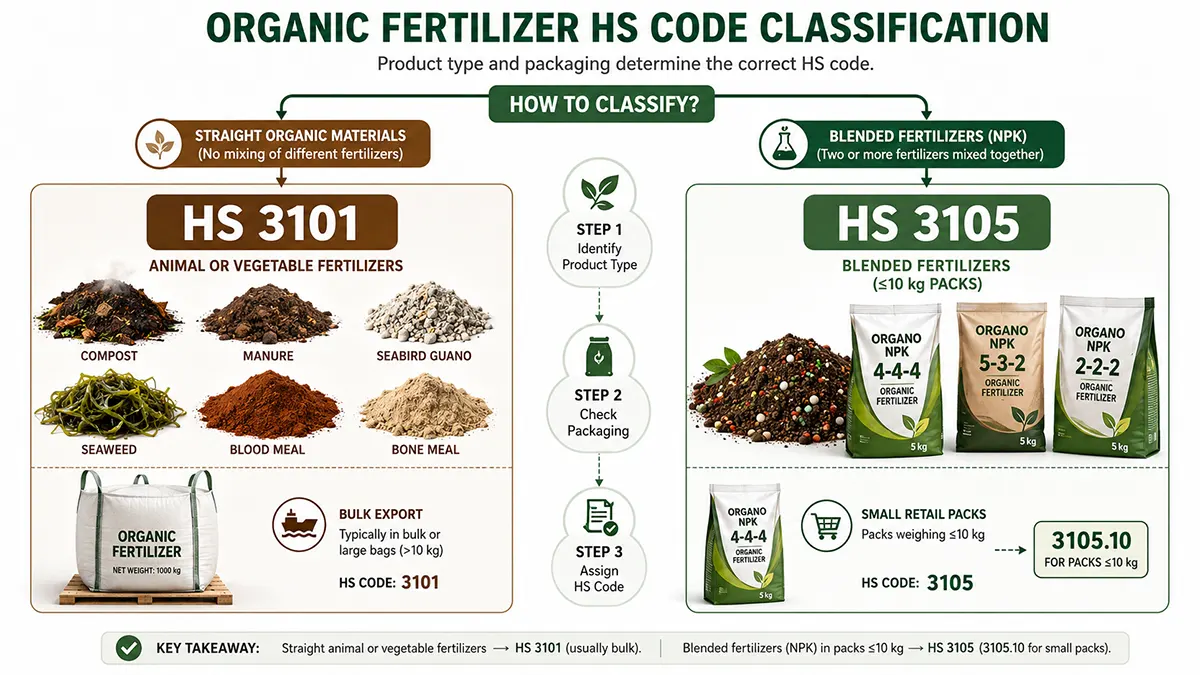
An organic NPK blend is normally 3105, not 3101. Heading 3105 covers fertilizers containing two or three of nitrogen, phosphorus, and potassium, plus “other fertilizers,” plus anything in packs of 10 kg gross or less. A single straight organic material stays in 3101; the moment you blend for an N-P-K ratio or drop into small retail packaging, expect 3105. Confirm the exact subheading with the importing country’s tariff schedule.
⚠️ Field Note: Biostimulants sit in a real gray zone. Some authorities classify them inside Chapter 31 as fertilizers; others push them to heading 3824 (chemical products not elsewhere specified) when the label makes a plant-stimulation rather than a nutrient claim. Do not settle this from a product page. For humic, fulvic, amino-acid and biostimulant lines, get a binding ruling before the first bulk order—the duty difference between chapters is not trivial.
The Documents That Actually Clear the Shipment
A correct HS code with an incomplete file still gets held. The code tells customs what the goods are; the documents prove it and satisfy the import controls attached to that heading. For organic fertilizer, the file is longer than for an inert industrial good, because plant- and animal-derived material is a regulated article in most markets.
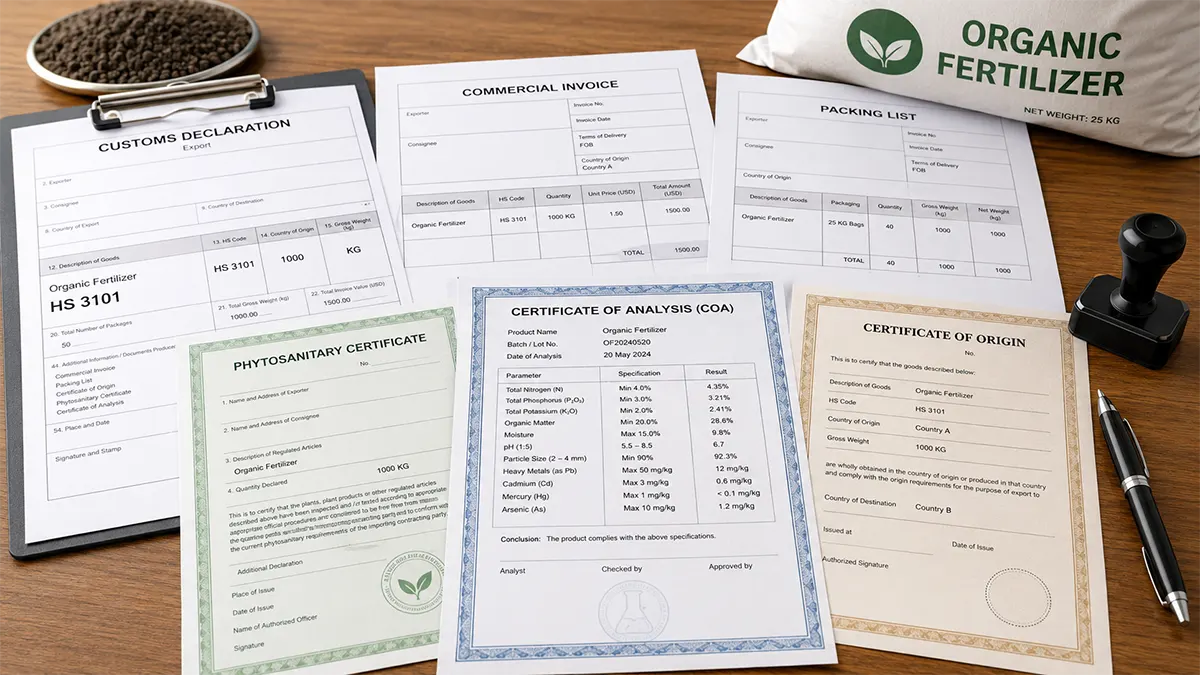
A complete export pack for organic fertilizer usually includes:
- Commercial Invoice and Packing List—value, weight, and the declared HS code.
- Bill of Lading or Air Waybill — the transport contract and title document.
- Certificate of Origin (Form A or an FTA certificate where a preference applies) — sets the duty rate.
- Certificate of Analysis (COA) — the composition the declaration must match.
- Phytosanitary / plant-quarantine certificate — for plant- or animal-derived material (see below).
- Fumigation certificate — where wood packaging or the origin requires it.
- Organic certification (ECOCERT, CERES, or USDA NOP)—where the buyer sells the product as organic.
- MSDS / SDS and, where the destination requires it, an import permit or fertilizer registration.
A complete file is still not enough if the documents disagree with each other or with the code. Customs reads across the whole file, so one line that contradicts the rest is what turns a clean entry into an inspection. These are the mismatches that most often stall an organic-fertilizer shipment:
| Document | What it should carry | Mismatch that stalls the container |
|---|---|---|
| Commercial invoice | Product name, declared HS heading, quantity, value, origin, Incoterms | Generic “organic fertilizer” with no grade—or an HS heading the COA does not support |
| Packing list | Bag size, net / gross weight, bag count, pallet and container detail | Declares 25 kg export sacks while the label or photos show 5 kg retail packs (a 3105.10 trigger) |
| COA | Batch number, NPK, organic matter, moisture, pH, heavy metals | Shows a formulated NPK blend while the invoice declares a straight 3101 product |
| Certificate of origin | Exporter, origin, invoice reference, product description | The product name differs from the invoice or the bill of lading |
| Organic / input certificate | The exact SKU and standard the buyer sells under | The certificate covers a different SKU or the company only, not this product |
Do you need a phytosanitary certificate to import organic fertilizer?
For plant- or animal-derived fertilizer, usually yes. Many importing authorities treat it as a regulated article that needs a phytosanitary or plant-quarantine certificate issued by the exporting country’s plant protection organization, under the IPPC framework. The certificate attests the goods are free of regulated pests. It is also the document most often left out of a first order—and its absence is not a paperwork slap on the wrist: under the rules many customs services apply, a shipment without a valid phytosanitary certificate can be returned or destroyed, not just fined.
Requirements are destination-specific and change. The USDA APHIS plant-export program and the importing country’s own quarantine rules define what the certificate must state — down to naming the production and storage facilities and their registration numbers. Confirm the exact wording your destination expects before the goods are booked, not after they land.
Regional Rules That Change the Suffix — US, EU, GCC
The heading is global; the suffix and the paperwork are local. The same 3101.00 organic fertilizer meets three different rulebooks depending on where the container lands.
- United States: classify to the full ten-digit HTS line via the USITC schedule, and expect formal entry—the 2025 tightening of the de minimis exemption means low-value parcels no longer skip duty and documentation the way they once did. Confirm current entry rules with a customs broker or CBP.
- European Union: the code extends to eight digits in the Combined Nomenclature (look it up in TARIC), and products sold as organic must meet the labeling and control rules of Regulation (EU) 2018/848. Extract-based inputs may also raise REACH questions.
- GCC states: several members extend the national code beyond eight digits, and the exact suffix varies by country. Do not hard-code a GCC number from a third-party site—confirm the current code with the importer’s broker for that specific market.
None of these suffixes are worth memorizing, because rates and subheadings get revised. What is worth building is the habit: agree to the six-digit heading up front, then verify the national code and the document list at the time of shipment.
Before You Book the Container
- Classify to the six-digit heading—3101 for straight organic material, 3105 for NPK blends or ≤10 kg packs—then let the importer’s broker confirm the national suffix.
- For anything plant- or animal-derived, assume a phytosanitary certificate is required until the destination’s rules prove otherwise.
- Match the declared composition to the COA. A declaration that disagrees with the certificate of analysis is what invites reclassification at inspection.
- For gray-zone inputs—biostimulants, humic, fulvic, and amino acid—get a binding ruling before the first bulk order.
Then turn it into supplier instructions. Paste these lines into your RFQ so the file is built before production — not scrambled together after the container books. They pair with a full supplier due-diligence checklist:
- State the proposed six-digit HS heading and the reason for it, based on composition and use.
- Send the latest batch COA and product spec so our broker can confirm the classification.
- Confirm net and gross weight per bag or carton — small packs can move the heading to 3105.10.
- List every export document you can provide for this product and destination, including phytosanitary, fumigation, and organic certificates where they apply.
- Confirm whether the organic or input certificate covers the exact SKU being quoted.
Frequently Asked Questions
What is the HS code for organic fertilizer?
Raw or composted organic fertilizer of animal or vegetable origin is classified under HS heading 3101, subheading 3101.00. That includes manure, compost, guano, seaweed, blood meal, and bone meal used as fertilizer. Blended NPK products and packs of 10 kg or less move to 3105. The final 8- to 10-digit national code is set by the importing country.
Is compost the same HS code as an NPK fertilizer?
No. Compost and other straight organic materials sit in 3101; a fertilizer blended to carry two or three of nitrogen, phosphorus, and potassium sits in 3105. The dividing line is whether the product is a single organic material or an engineered blend. Small retail packaging (10 kg gross or less) also pushes a product into 3105, regardless of content.
Which documents should a China supplier provide for customs clearance?
At minimum: a commercial invoice, packing list, bill of lading, certificate of origin, and certificate of analysis, plus a phytosanitary certificate for plant- or animal-derived material. Add organic certification where the buyer sells the product as organic and an MSDS. Some destinations also require an import permit or fertilizer registration. Ask for the full set in the RFQ so it is ready before shipment.
Do I need a phytosanitary certificate for organic fertilizer?
Usually yes for plant- or animal-derived fertilizer. Most importing authorities treat it as a regulated article requiring a phytosanitary certificate from the exporting country’s plant protection service. Missing it is high-risk: the shipment can be returned or destroyed rather than simply fined. Confirm the exact certificate wording your destination requires before booking the container.
How do I confirm the exact 10-digit code for my country?
Start from the six-digit heading (3101 or 3105) and then look up the national subheading in your country’s tariff schedule—the USITC HTS for the US, TARIC for the EU. For certainty, request a binding tariff ruling from the importing customs authority. That written determination protects you if an officer later disputes the classification.
Next step: send the product, its composition, and the destination country, and we will return the six-digit heading, a draft document list for that market, and a quotation with the export paperwork included. If you want to see the format first, download the export document checklist and match it against your last shipment.
— Rutom Bio. Technical Supply
About This Guide
Reviewed by Rutom Bio. Technical Supply. Rutom Bio. manufactures and exports organic fertilizer inputs and prepares the export documentation set for each order. This guide is classification and procurement guidance, not customs or legal advice: the final HS code is the decision of the importing country’s customs authority, confirmed through a binding tariff ruling, and document requirements change by destination and over time. The tariff and phytosanitary references below are public sources, provided so buyers can verify each point. Last updated: 2026-07-07.
References & Sources
- USITC — Harmonized Tariff Schedule of the United States (Chapter 31, Fertilizers)
- World Customs Organization — Harmonized System Nomenclature
- USDA APHIS — Plant and Plant Product Export Certification
- FAO / IPPC — Requirements for Phytosanitary Certificates
- Regulation (EU) 2018/848 on organic production and labelling
- U.S. Customs and Border Protection — Importing into the United States
About the Author: Rutom




 English
  Spanish
  French
  Japanese
  Korean
  German
  Portuguese
  Italian
  Indonesian
  Vietnamese
  Turkish
  Persian
  Russian
  Chinese