

A certificate of analysis can carry a stamp, a signature, and a lab logo and still tell you nothing about the bags sitting in your container.
That gap — between a document that looks official and one that actually proves what you bought — is where importers lose money. This guide reads an organic fertilizer COA the way our quality desk reads one before a lot ships: which lines are non-negotiable, which numbers decide accept-or-reject, and the red flags that should stop a shipment before it clears customs. It’s written for buyers, not for a lab. If you source organic fertilizer for export, distribution, or re-blending, this is the read that keeps a bad lot out of your warehouse.
The Conforms Trap: When a COA Proves Nothing
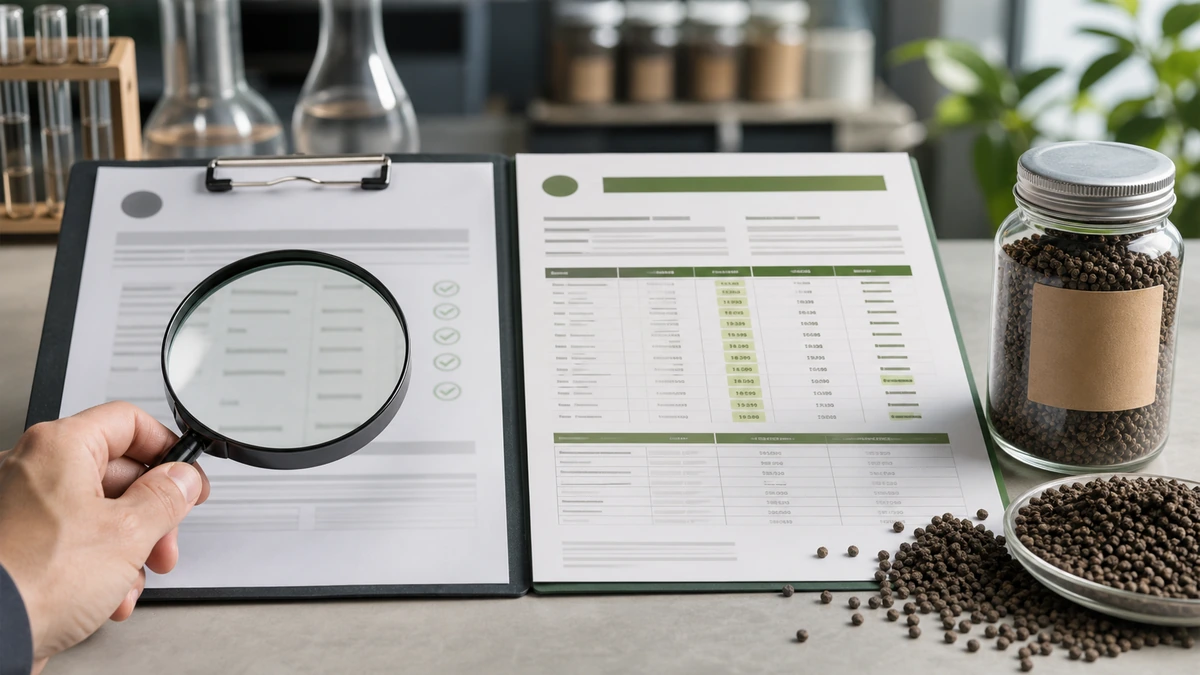
Start with the single failure that costs buyers the most—and it has a name worth remembering: the Conforms Trap.
A COA is not a label, and it’s not a technical data sheet. A *guaranteed analysis* on the bag is a marketing-legal promise of nutrient content. A *technical data sheet (TDS)* describes the product in general. A *certificate of analysis* is supposed to report the actual measured results for the specific lot you received—tied to a batch number, with real numbers, against stated specifications.
The Conforms Trap is the document that swaps measured results for the word “Conforms” or the value “Typical.” It reads as reassurance and proves nothing about your lot. The moment a measurable parameter shows “Typical” with no batch-specific figure, you are holding a data sheet wearing a COA’s clothes.
So before you read a single nutrient figure, ask one question: *Does this document report results for my batch or describe the product in the abstract?* Everything below assumes the former. If it doesn’t, you’re already done — send it back and ask for the batch-specific certificate.
The 12-Line Organic Fertilizer COA Check
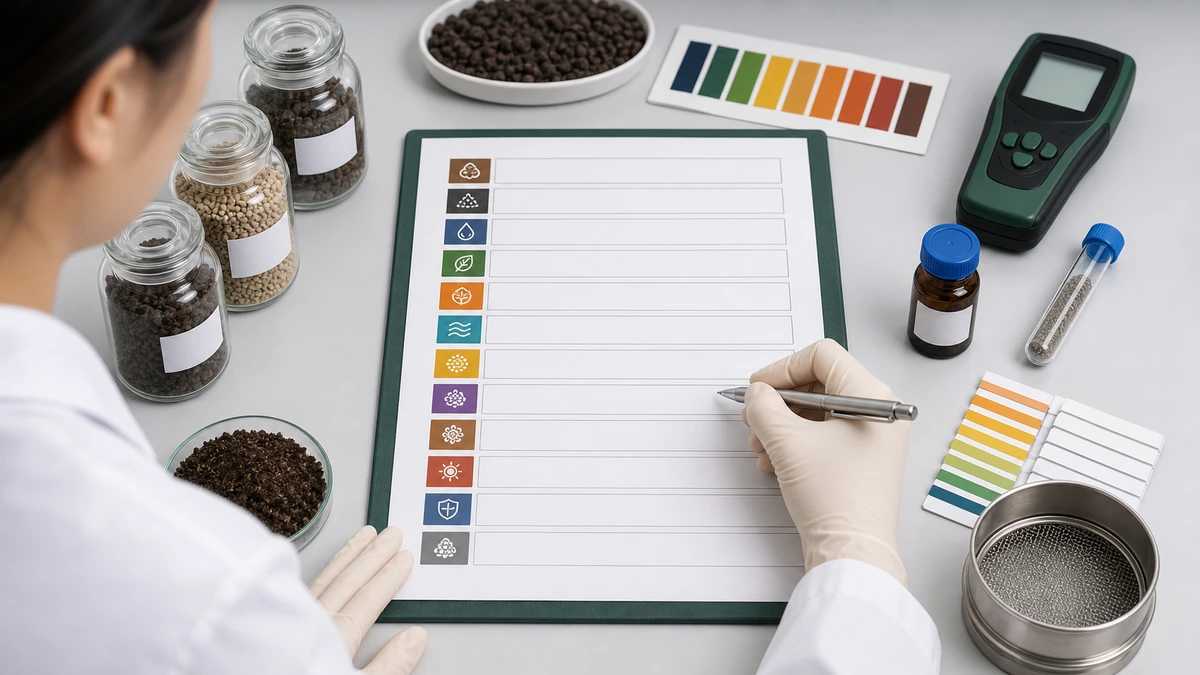
A fertilizer COA reads differently from a chemical or supplement COA because the parameters that decide value and market access are different. Generic COA guides stop at “product ID, lab, purity, and contaminants.” For organic fertilizer you need more—five line types those guides never mention: the NPK guaranteed analysis, organic matter, the derived-from statement, heavy metals, and certification scope.
Here’s the check we run on every lot before it ships—and the same one you can paste into an RFQ so a supplier knows you’ll be verifying it.
📐 The check—paste it straight into your RFQ:
| # | Line on the COA | What it should show | Why it matters to a buyer |
|---|---|---|---|
| 1 | Product name + lot/batch number | Specific code matching your container | A COA from another lot is invalid, however good it looks |
| 2 | Production / analysis date | Recent, traceable to this batch | Stale dates signal a recycled “typical” certificate |
| 3 | Total Nitrogen (N) | % with method | The headline nutrient claim, must match the label grade |
| 4 | Available Phosphate (P₂O₅) | % with method | Availability, not just total P—organic sources vary |
| 5 | Soluble Potash (K₂O) | % with method | Completes the N-P-K grade promised |
| 6 | Organic matter | % (min) | The defining claim of an *organic* fertilizer |
| 7 | Derived-from / source statement | Named raw materials | Verifies organic inputs, not synthetic spiking |
| 8 | Moisture | % (max) | High moisture = caking, weight you paid for as water |
| 9 | pH (1% solution) | range | Compatibility with crop and blend |
| 10 | Particle size / solubility | range or % | Must match drip, foliar, or broadcast use |
| 11 | Heavy metals — Cd, Pb, As, Hg | mg/kg, per-lot | Export market access (see cadmium below) |
| 12 | Lab + test method + accreditation | named lab, ISO/IEC 17025 | An unaccredited “in-house pass” is weak evidence |
Two of these carry more weight than buyers expect.
The derived-from statement (line 7) is where an organic claim lives or dies. Per the AAPFCO Product Label Guide, if a nutrient is claimed, it must be guaranteed and its source disclosed—for organic products, that derivation tells you whether the nitrogen came from feather and soybean meal or from a cheaper synthetic shortcut. No derivation statement, no verified organic input.
Organic matter (line 6) is the parameter generic COA templates omit entirely, yet it’s the substance of what you’re selling as “organic.” A low organic-matter figure on a product marketed as a premium organic input is a quiet downgrade—and the line a re-blender’s own customers will eventually test for.
Heavy Metals and the Cadmium Line
This is the line that decides whether a container clears or gets turned back — and it’s missing from every generic COA guide.
Organic and mineral phosphate inputs can carry cadmium, lead, arsenic, and mercury. Cadmium is the one that closes markets. Regulation (EU) 2019/1009 sets a cadmium limit on phosphate fertilising products sold in the EU, and shipments over the line don’t get a warning—they get rejected.
So on any organic fertilizer headed for a regulated market, line 11 is not optional. Confirm a per-lot cadmium result, in mg/kg, against the destination’s limit—not a “typical” range, not a yearly average. Keep that certificate filed with the shipment in case customs asks.
There’s a second cadmium pathway buyers miss: the crop. For crops where cadmium accumulates in the harvested product—cocoa is the textbook case, capped for food under Commission Regulation (EU) 488/2014—the fertilizer cadmium figure ties directly to your customer’s market access, one tier downstream of your own. We walk through that crop-level risk in our guide to organic fertilizer for cocoa.
We wouldn’t approve a phosphate-bearing organic input for an EU-bound lot without a current per-lot cadmium certificate in hand. That’s not caution — it’s the difference between a clean delivery and a destroyed container.
What a COA Can’t Tell You
A COA is evidence, not a guarantee of every bag—and knowing its limits is what separates a buyer who gets burned from one who doesn’t.
A certificate reports what the lab measured on the sample it received. It can’t tell you whether that sample represents the whole container, whether bag 400 matches bag 4, or whether the lot was blended uniformly before sampling. A clean COA on a badly sampled lot is still a clean COA — and still a risk.
That’s why the document is only half the system. The other half is how the sample was drawn and who can retest:
- Sampling method. Composite samples pulled from multiple bags across the lot beat a single grab sample. Ask how the COA sample was taken.
- Retest rights. Reserve the right to a third-party retest (SGS or equivalent) at the load port on a sample *you* witness drawn. A COA you can verify independently is worth ten you can only read.
- Retained samples. A supplier who keeps a sealed retained sample per lot can settle a dispute later. One who can’t is asking you to trust the paper alone.
None of this shows up as a line on the certificate. It belongs in your contract—which is why the last section of this guide is about the PO, not the PDF.
Does the COA Match the Certification Scope?
A certification logo on a brochure is not the same as a certified lot.
Organic certifications — ECOCERT, CERES, EU organic, USDA NOP — are granted by a named certifier for specific products or input lists, not as a blanket “this company is organic.” The frequent mismatch: a supplier holds a valid certificate, but the *specific SKU or batch you ordered* isn’t inside its scope. Vetting that scope is part of vetting the supplier—we cover the full supplier check in our organic fertilizer supplier checklist; here the point is narrower: cross-check the certifier’s name, the certificate’s product scope, and whether your SKU appears in it. If the COA references a certification, ask for the certificate itself, not a logo.
We keep our scope documentation product-specific for exactly this reason—you can see how it’s presented on our ECOCERT-certified organic fertilizer and CERES-certified organic fertilizer pages.
Red Flags That Should Stop a Shipment
Most bad COAs share the same handful of tells. Any one of these is a reason to hold the lot and ask questions.
- “Typical” or “Conforms” instead of measured numbers—the Conforms Trap; the document is a TDS, not a COA.
- Lot number doesn’t match your container — a valid certificate for the wrong batch is worthless.
- No testing laboratory named or no ISO/IEC 17025 accreditation—an anonymous “passed in-house” carries little weight.
- Heavy metals section missing entirely—for export organic fertilizer, that’s a gap, not an oversight.
- Suspiciously round numbers across every line — real lab results have decimals and scatter; a column of clean integers suggests a template, not an analysis.
- No derived-from statement on an “organic” product — the organic claim is unverified.
A common issue we see is a polished PDF where every parameter reads “Conforms.” It looks reassuring and proves nothing. Send it back and ask for the batch results.
The Cost of Accepting a Bad COA

The reason to insist on a real per-lot certificate isn’t paperwork discipline—it’s the size of the loss when the document was fiction.
Walk the math on one rejected EU-bound container. The numbers below are illustrative ranges, not a quote—your figures depend on port, lane, and product—but the shape holds:
- Demurrage and detention while the lot is held: often €100–200 per day, and a contested rejection can sit for weeks.
- Disposition—either return freight back to origin (a one-way ocean leg, frequently US$2,000–5,000 on major lanes) or in-market destruction and disposal of the goods.
- The lot value itself, written off if it can’t be re-sold into a non-regulated market.
- The customer, who placed the order against a delivery date you just missed.
Stack those and a single failed container turns into a five-figure loss plus a damaged buyer relationship. The control that prevents it — a per-lot cadmium test at an accredited lab — costs on the order of tens of dollars per parameter. That asymmetry is the whole argument: the certificate is the cheapest insurance in the transaction, and the Conforms Trap is the most expensive thing you can wave through.
💡 Worked check: Before approving any EU-bound phosphate-bearing lot, put the cost of one independent cadmium retest next to the demurrage on one held container. The retest wins every time. Plug in your own port’s daily rate and see.
Your Lot → The Line That Decides It
Not every COA line is equally decisive for every buyer. Map your situation to the one that fails lots in your channel first.
| Your situation | The line that decides your lot | What to confirm |
|---|---|---|
| EU-bound, phosphate-bearing input | Line 11 — cadmium | Per-lot Cd in mg/kg vs Reg (EU) 2019/1009 |
| Supplying a food crop (cocoa, rice, leafy veg) | Line 11 + crop accumulation | Fertilizer Cd *and* the crop’s food limit downstream |
| Re-blending / private label | Lines 3–7 — NPK + organic matter + derived-from | Grade and organic inputs match your label claim |
| Drip / foliar / fertigation use | Lines 9–10 — pH + particle size/solubility | Solubility fits the application or it clogs |
| Selling on an organic certification | Line 12 + cert scope | Accredited lab *and* your SKU inside the certificate |
The decisive line moves with the channel, but every channel still needs all twelve checked. The grid tells you which one to look at first when a COA lands and a ship date is pressing.
What to Lock In Before You Order
The COA review is too late if the contract never required a real one. Set the terms up front.
- Write the full guaranteed analysis plus heavy-metal limits into the RFQ and the PO — N, P₂O₅, K₂O, organic matter, moisture, and Cd/Pb/As/Hg ceilings for your destination.
- Require a per-lot COA with the matching batch number before shipment, not a generic certificate.
- Reserve the right to third-party retest (SGS or equivalent) at the load port, on a witnessed composite sample, and name who pays if a lot fails.
- Confirm the certification scope covers your exact SKU, in writing.
- Specify which export documents travel with the container—COA, commercial invoice, packing list, certificate of origin, MSDS, and HS code.
Get those five into the agreement, and the COA stops being a document you hope is real—it becomes a clause you can enforce.
Every Rutom Bio shipment ships with a per-lot COA, tested in our own lab or by a third-party institution such as SGS, with CIQ inspection handled for export clearance. If you want a sample COA to benchmark your current supplier’s paperwork against, request our spec sheet and COA sample — it’s the fastest way to see what a complete certificate should contain.
Frequently Asked Questions
What parameters should I verify on an organic fertilizer COA before a 20MT order?
Eight lines first: lot number (must match your shipment), total N, available P₂O₅, soluble K₂O, organic matter %, the derived-from statement, moisture, and heavy metals (Cd, Pb, As, Hg). For EU-bound lots, the per-lot cadmium figure against Regulation (EU) 2019/1009 is the one that can stop the container at the border.
What’s the difference between a COA and a guaranteed analysis?
The guaranteed analysis is the fixed nutrient promise printed on the bag and registered with authorities. The COA is the laboratory’s measured proof for one specific batch. You verify the COA *against* the guaranteed analysis—if a batch result falls below the labeled guarantee, that lot is out of spec and you can reject it.
Is a COA that says “Conforms” or “Typical” valid?
No — not as proof of your lot. That’s the Conforms Trap: “Typical” and “Conforms” describe the product in general, not the batch you received. A genuine COA reports actual measured numbers tied to your lot number. If measurable parameters show no real values, treat the document as a technical data sheet and request the batch-specific certificate.
How do I confirm the lab on a fertilizer COA is legitimate?
Look for a named laboratory with ISO/IEC 17025 accreditation and a certification number, plus the test methods used for each parameter. An accredited third party such as SGS carries more weight than an unnamed in-house “pass.” When the figures matter to market access, reserve the right to a third-party retest at the load port rather than relying on the certificate alone.
Why does cadmium matter so much on an organic fertilizer COA?
Cadmium enters fertilizer mainly through phosphate inputs and accumulates in crops and soil. Regulation (EU) 2019/1009 caps cadmium in phosphate fertilising products sold in the EU, so an over-limit lot can be rejected at the border. For crops like cocoa that concentrate cadmium — capped for food under Regulation (EU) 488/2014—the fertilizer figure ties directly to your customer’s market access.
Why We Wrote This
We manufacture organic fertilizer and issue the per-lot COAs that travel with it — which means we read these documents from the factory side, not the forwarding side. A trader passes a certificate along; a producer has to be able to defend every line on it. That’s the vantage point here.
Two honesty notes. The cost figures in this guide are ranges from public freight and port practice, framed to show the shape of the risk—not promises; your numbers will depend on your lane and destination. And our own process claims describe how Rutom Bio ships; verify any supplier’s process, including ours, against the actual paperwork.
References & Sources
- AAPFCO Product Label Guide — Association of American Plant Food Control Officials (guaranteed analysis, derived-from statement)
- Regulation (EU) 2019/1009 — EU fertilising products, cadmium limits on phosphate products
- Commission Regulation (EU) 488/2014 — maximum cadmium levels in cocoa and chocolate (downstream crop limit)
- ISO/IEC 17025 — testing and calibration laboratory accreditation
About This Guide
Reviewed by Rutom Bio Technical Supply Desk · Last updated: 2026-06-29
Scope note: figures cited are standard reference limits, labeling rules, and illustrative cost ranges; verify exact thresholds and costs against your destination market’s current regulation, your freight lane, and the specific lot COA. Rutom Bio (Jiangxi Rutom Biotechnology Co., Ltd.) manufactures organic fertilizers and issues per-lot COAs; the certification scope is product-specific—confirm your SKU in writing.
About the Author: Rutom




 English
  Spanish
  French
  Japanese
  Korean
  German
  Portuguese
  Italian
  Indonesian
  Vietnamese
  Turkish
  Persian
  Russian
  Chinese