
table of contents
Updated July 2026.
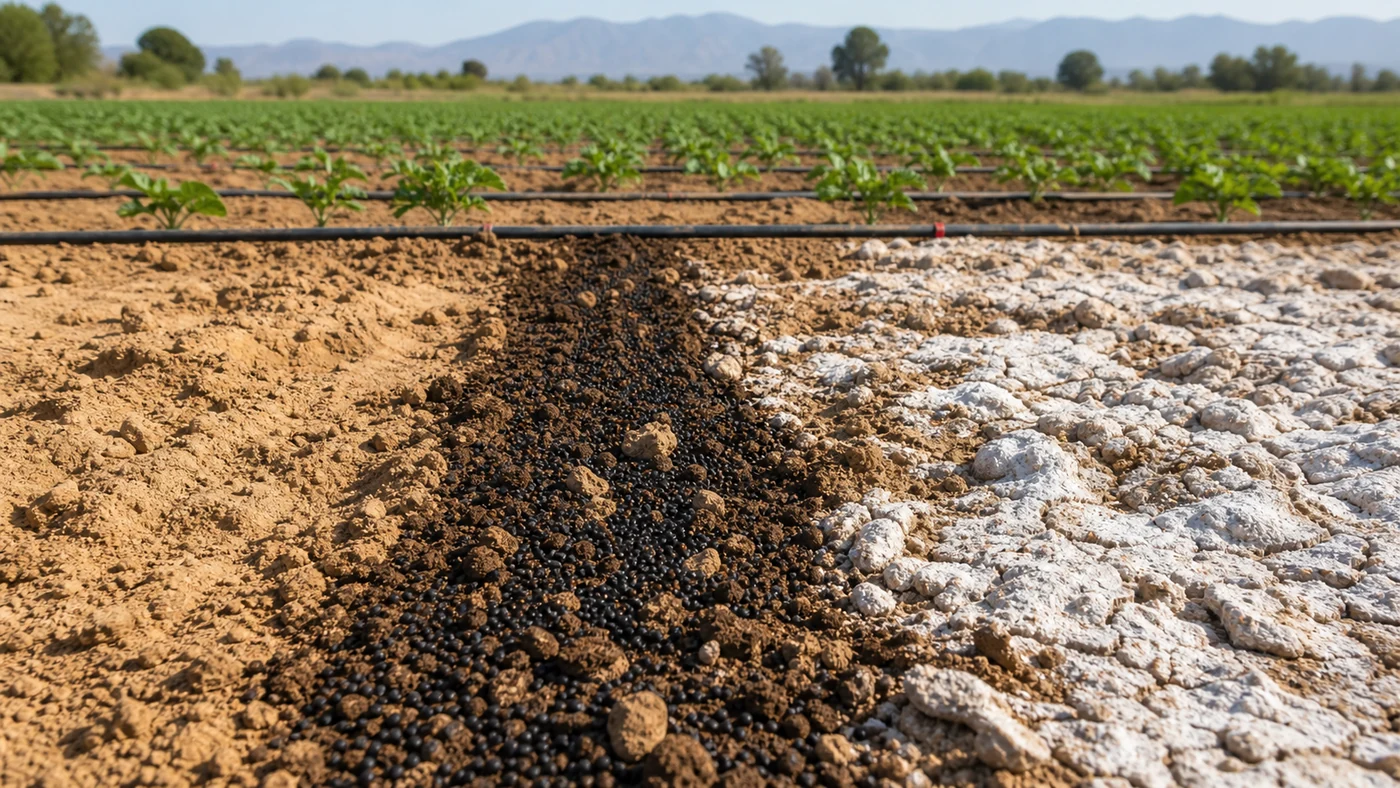
Growers in arid and coastal regions usually fight two soils at once, and each one wastes money a different way. Sand lets water and fertiliser run straight past the roots. Salt does the reverse. It holds a chemistry that pulls water back out of the plant and cements the ground shut. Humic acid gets pitched as the answer to both, almost always on a glossy benefits list that never bothers to say how it works on either.
This guide takes the two apart. What goes wrong in each soil, what humic acid actually changes, the numbers from field trials on saline and sandy ground, roughly how much to put down, and the part most sellers skip: what it will not fix.
Humic Acid for Saline & Sandy Soils: The Short Answer
One property does the work on both soils. Humic acid adds cation-exchange capacity and glues loose particles into stable aggregates. On sand, that holding capacity keeps water and nutrients within reach of roots instead of letting them drain off. On salty and sodic ground, the firmer structure plus the way humic acid ties up cations helps calcium get to the clay and shove sodium off it, so the salt can be washed down below the root zone.
One caveat belongs up front, because it decides whether the product is worth buying. On a genuinely sodic soil, humic acid is a helper, not a cure. The sodium still has to be knocked off the clay by calcium and flushed out with water. Run it that way and it earns its keep. Buy it as a standalone salt remover and it will let you down.
Why Sandy and Saline Soils Fail Crops
Sand and salt ruin crops for nearly opposite reasons, which is the whole reason one product ends up doing two jobs.
Start with sand. It cannot hold onto anything. Big particles, big gaps between them, so water pours through fast, and with little clay or organic matter there is almost no cation-exchange capacity to catch nutrients on the way. Apply fertiliser and a good share of it rinses past the roots with the next irrigation or storm. Between waterings the soil bakes dry. The grower answers with more water and more fertiliser, and still gets less into the plant.
Salt is the opposite complaint. The soil holds the wrong thing, and holds it too tightly. Dissolved salts raise the osmotic pull of the soil water, so roots have to strain against it just to drink, which is drought with wet ground underfoot. Let sodium take over the exchange sites and the clay stops sticking together, structure falls apart, and the surface bakes into a crust that shuts out water and air. Seedlings stall. Stands thin. Yields drop.
Same amendment, opposite jobs: humic acid lifts what sand can hold, and helps rebuild what salt has broken.
The Leaky-Bucket Fix: Humic Acid on Sandy Soil
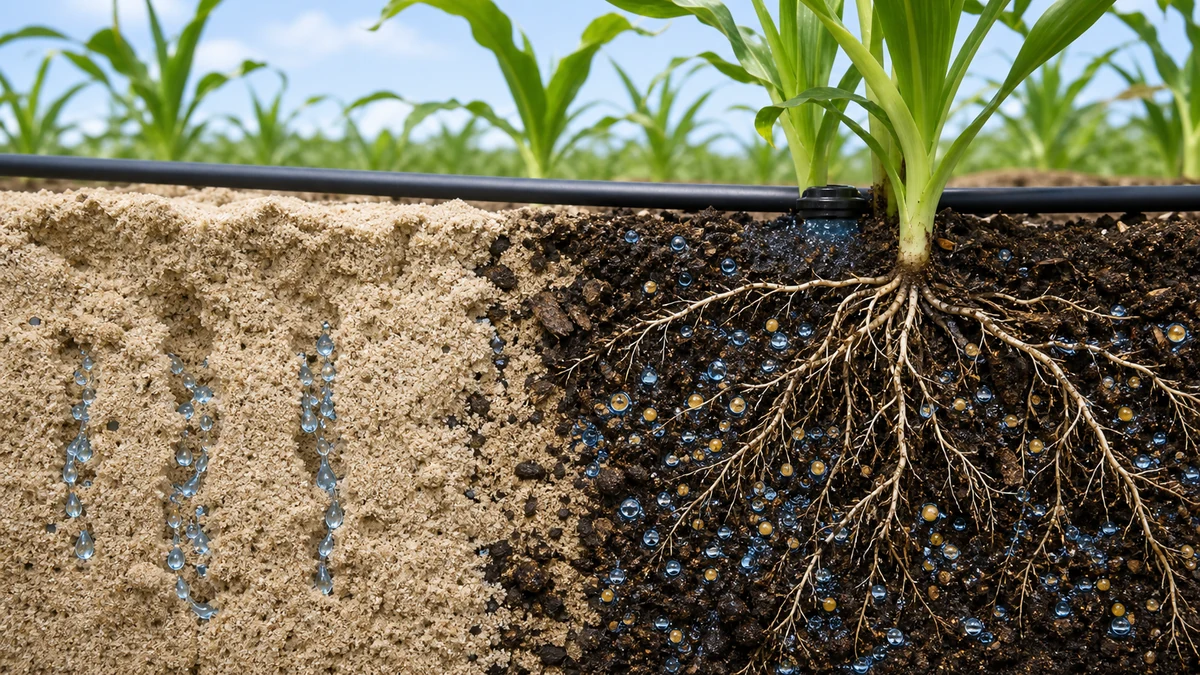
Picture sand as a leaky bucket. Humic acid is the liner. I call it the Leaky-Bucket Fix, and there is nothing mysterious about it: you are putting cation-exchange capacity and structure into a soil that has almost none, so water and nutrients stop pouring straight through. Every "improves water retention" line on a bag is describing this, and usually hiding it.
The mechanism is simple enough. Humic acid molecules are covered in negatively charged sites. Drop them into sand and those sites turn into storage, holding calcium, magnesium, potassium, and ammonium against the pull of draining water, then handing them back to roots. The same molecules bind loose grains into small crumbs, and those crumbs open up fine pore space that grips water by capillary action instead of letting it fall through.
Field trials put a size on it. On a nutrient-poor sandy loam in a semiarid trial near Cairo, humic acid worked into the root zone raised plant-available water by about 26%, lifted moisture at field capacity by 22%, dropped bulk density by roughly 5%, and pushed wheat yield up around 54% at the higher rate. None of that is a feeding you top up weekly. It is built into the soil. On coarse sand under drip, it is the line between fertigation that reaches the crop and fertigation that quietly waters the aquifer.
How does humic acid help sandy soil hold water?
Two ways, both already covered. It adds exchange sites, and it builds aggregates. The charged sites catch nutrient cations before they leach; the aggregates open capillary pores that hold water. Sand starts with so little CEC that the proportional gain is largest right here, on the soil that needs it most. Check the rate against a soil test, though, since a pure sand asks for more than a sandy loam.
On sand, the win is rarely the nutrient you added. It is the nutrient and the water you stopped losing.
Saline, Sodic, or Saline-Sodic? Know Which You Have
Salt is not one problem, and the wrong diagnosis is where most reclamation programs quietly die. Treat a sodic soil like a merely salty one and you can set it back. So before anything else, name the soil.
| Soil type | Core problem | Structure | Primary fix | Humic acid's role |
|---|---|---|---|---|
| Saline | Too much soluble salt | Often still intact | Leach with clean water | Keep infiltration moving |
| Sodic | Sodium dominates the clay | Dispersed, crusted | Calcium (gypsum) first, then leach | Support structural recovery |
| Saline-sodic | High salt and high sodium | At risk | Calcium before heavy leaching | Structure and retention aid throughout |
Saline is the easy case. The soil just holds too much dissolved salt, and the structure is usually still sound. The cure is mostly water: leach enough clean water through to carry the salt below the roots, with humic acid keeping infiltration moving. Calcium is not really the lever.
Sodic is the trap. The salt reading can be low, but sodium has claimed the clay, so the soil disperses and crusts over. Leaching on its own backfires here, because rinsing out what little salt there is, without replacing the sodium, tips the clay further toward collapse. You need calcium first, usually gypsum, to knock the sodium loose, then leaching, with humic acid helping the structure come back.
Saline-sodic soils carry both loads at once, and here the order is everything. Put the calcium down before you leach hard. Flush the salt out ahead of displacing the sodium, and a soil that was saline-sodic can flip to strongly sodic on you. Through all three cases humic acid rides along as a structure and retention aid. It is never the calcium.
Reading the Soil Test: EC, ESP & SAR
Three numbers on a soil test tell you which soil you are actually dealing with, and where the money should go. Skip them and you are guessing with a chequebook.
| Indicator | What it measures | Threshold that matters | What it tells you to do |
|---|---|---|---|
| EC (saturated paste) | Salinity | Above ~4 dS/m = saline | How much leaching the soil needs |
| ESP | Sodicity (sodium on exchange sites) | Above ~15% = sodic | Whether you need calcium (gypsum) |
| SAR | Sodium hazard vs calcium + magnesium | Rises as sodium dominates | Cross-check on sodicity; read on irrigation water too |
| pH | Alkalinity | Above ~8.5 often flags sodic | Confirms the sodic reading |
EC, electrical conductivity, is the salinity read. Once the saturated-paste EC climbs past roughly 4 dS/m the soil counts as saline, and the higher it goes, the harder roots pull to drink. That single number sets how much leaching you need.
ESP, exchangeable sodium percentage, is the sodicity read: the share of exchange sites sodium has taken. Past about 15% the soil is sodic, the structure is at risk, and calcium goes on the list. SAR, the sodium adsorption ratio, chases the same hazard through the sodium-calcium-magnesium balance, and you often read it off the irrigation water as much as the soil itself.
pH fills the last corner. Strongly alkaline, above about 8.5, and you are usually looking at a sodic or saline-sodic soil. So EC for how much to leach, ESP or SAR for whether calcium is needed, pH as the tie-breaker. Match the amendment to those readings, not to a product label, and get the readings from a lab test on the actual field, because salt can swing sharply from one corner of a property to the next. EC tells you how salty. ESP and SAR tell you how sodic. Only the sodic reading calls for calcium, and humic acid backs up every case while replacing none of them.
The Salt-Displacement Pathway: Humic Acid on Saline & Sodic Soil
On salt-affected ground, humic acid is one link in a chain, not a solvent you pour on salt. The chain, call it the Salt-Displacement Pathway, runs like this: open the structure so water can move, help calcium push sodium off the clay, then leach the freed salt down past the roots. Drop any one link and the whole thing stalls.
Humic acid does something at each step. It aggregates dispersed clay and opens pore space, reopening the channels a sodic soil has sealed shut, so water can finally get in and carry salt downward. Its exchange and chelating sites keep calcium available and moving, which feeds the swap where calcium takes sodium's seat on the clay. And once the sodium is loose, rain or irrigation carries it out, with the better structure keeping that flow going.
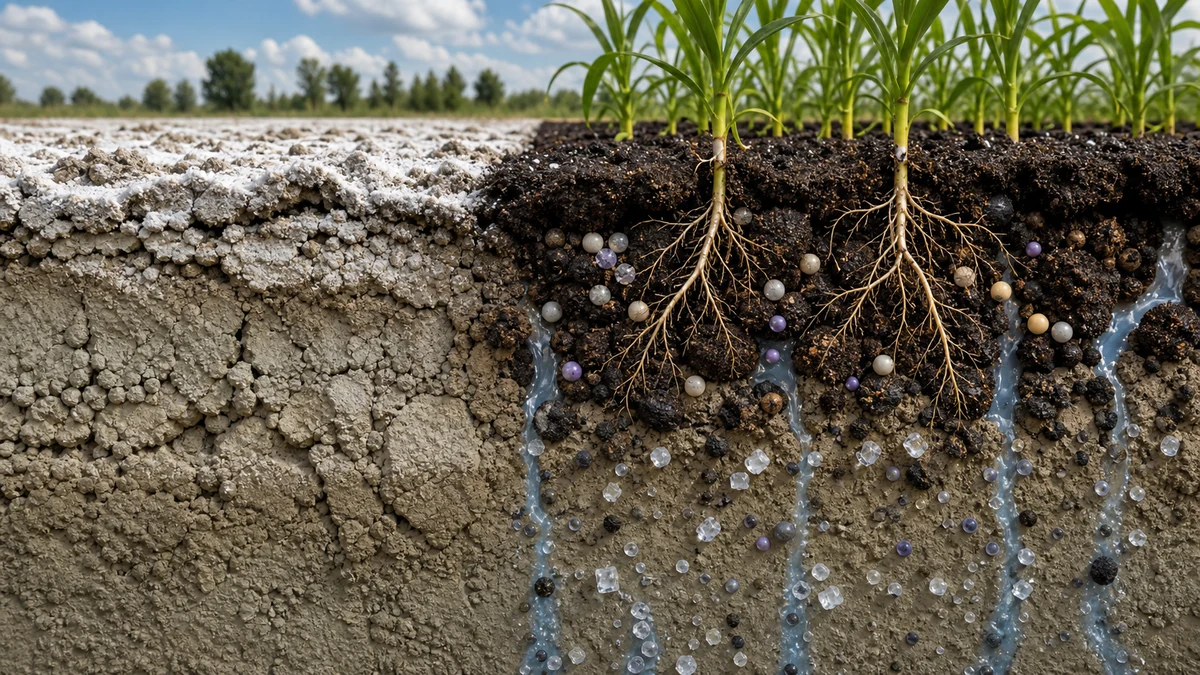
The boundary sits right here, and it is worth stating flatly. Humic acid does not remove sodium by itself. On a real sodic soil the calcium almost always has to come from gypsum or a similar amendment, and drainage plus enough leaching water are not optional extras. Humic acid makes that program faster and more effective. It does not stand in for it.
Does humic acid remove salt from soil?
Not on its own. It improves structure and helps calcium displace sodium, but the salt still leaves with water, and on sodic soils the calcium still comes from gypsum. Think of it as a reclamation aid working inside a program of calcium and drainage, not a substitute for either. Any supplier telling you humic acid alone desalinates a soil is selling past the truth.
What the Research Shows
The research reads best as backing for the reclamation role, not for a miracle. A 2024 field study on coastal saline-alkali soil (humic acid and microbial fertilizers on saline-alkali soil) put real numbers on the mechanism above. Humic acid on its own dropped electrical conductivity by 60 to 75% and total soluble salts by 50 to 74% across two seasons, came close to doubling aggregate stability, and lifted wheat yield by 41 to 56%. Pair it with a Bacillus inoculant and the salinity and yield gains stretched further still.
Two things there should catch a buyer's eye. The best results came from humic acid inside a combined program, which is exactly what the mechanism predicts. And the numbers were pinned to specific outcomes on saline-alkali soil, EC, soluble salts, aggregate stability, and yield, rather than a vague "healthier soil." That specificity is what to ask a supplier for. Its absence is what to distrust.
The microbial angle is worth a beat longer, because it hints at why humic acid helps beyond plain chemistry. Feed and reshape the soil's microbial community and you are supporting the living half of recovery, not only the exchange sites. For a buyer the lesson stays narrow and practical: ask for evidence on the soil and the result you actually care about, a saline trial with an EC or yield figure, not a blanket claim that humic acid is good for soil.
Application Rates & Program by Soil Type
Rates move with the soil and the form, so what actually helps is a starting frame you check against a soil test, not one magic number. Sand likes small, regular inputs. Salt-affected ground wants humic acid folded into a calcium-and-leaching program rather than run on its own.
| Soil type | Granular humic (soil-incorporated) | Soluble humate (fertigation) | Sequence note |
|---|---|---|---|
| Sandy | Tens of kg/ha, split and repeated | Fraction of a % up to ~1% in solution, through the season | Little and often; sand will not hold one heavy dose |
| Saline / sodic | Incorporate to help reopen structure | Supports the crop during recovery | Calcium amendment and leaching do the heavy work; multi-season on badly sodic ground |
On sand, the aim is to build cation-exchange capacity and keep it up. Work a granular grade into the root zone at planting, then top it up with soluble humate down the drip line through the season, because irrigation spends the whole season trying to flush it back out. Sand holds so little that split, repeated doses beat one heavy pass every time.
On saline and sodic ground the order matters more than the amount. Put down the calcium your soil test calls for, work in a granular humic grade to help pry the structure open, and irrigate with enough clean water to carry the loosened salt below the roots. A soluble humate through fertigation keeps the crop going while the soil mends. On badly sodic land, plan for several seasons rather than one pass.
For planning numbers, and only as a starting point to confirm on a soil test: granular grades tend to go in at soil-building rates in the tens of kilograms per hectare, and soluble humate gets dosed through fertigation somewhere between a fraction of a percent and about one percent in solution during the season. Sand sits at the lower single-dose end but comes around more often. Salt-affected soils lean on the granular pass to reopen structure while calcium and water do the lifting. None of these are prescriptions; your real number tracks your EC, ESP, texture, and crop.
This is squarely an export problem for arid and coastal markets. Across much of the Middle East, North Africa, and coastal Asia, growers hit sandy texture and rising salinity together under irrigation, which is why the granule-plus-fertigation pairing usually beats reaching for one product. Whatever the soil, convert to active humic before you set a rate, and trust the soil test over the label. For the crop-by-crop side of these rates, our guide on humic acid for plants goes further, and the soil-science background sits in our explainer on humus soil.
Which Grade to Source for Reclamation
Over a whole field, grade choice comes down to two things: freight and function. Reclamation moves real tonnage, so what decides the economics is cost per unit of active humic and cost to ship a tonne.
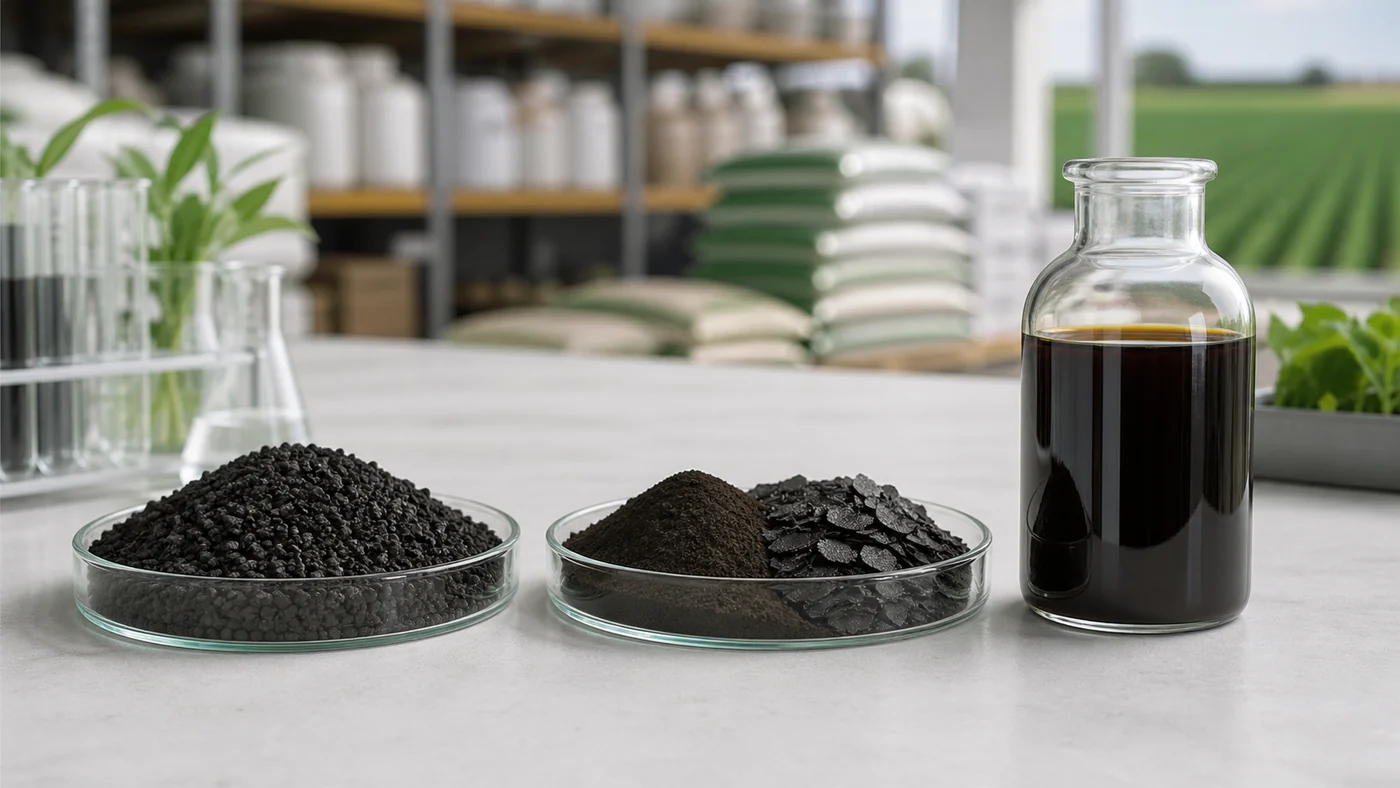
The raw humic acid granule is the workhorse for getting humic matter into soil at scale. It is the cheapest way into the ground, and for a soil pass you do not need it to dissolve. For the fertigation that carries a crop through recovery, a soluble grade like potassium humate flake 1-0-11 goes cleanly down drip lines. Most buyers running large arid-region programs keep both on hand, and the full grade matrix and landed-cost breakdown live on our humic acid fertilizer sourcing page.
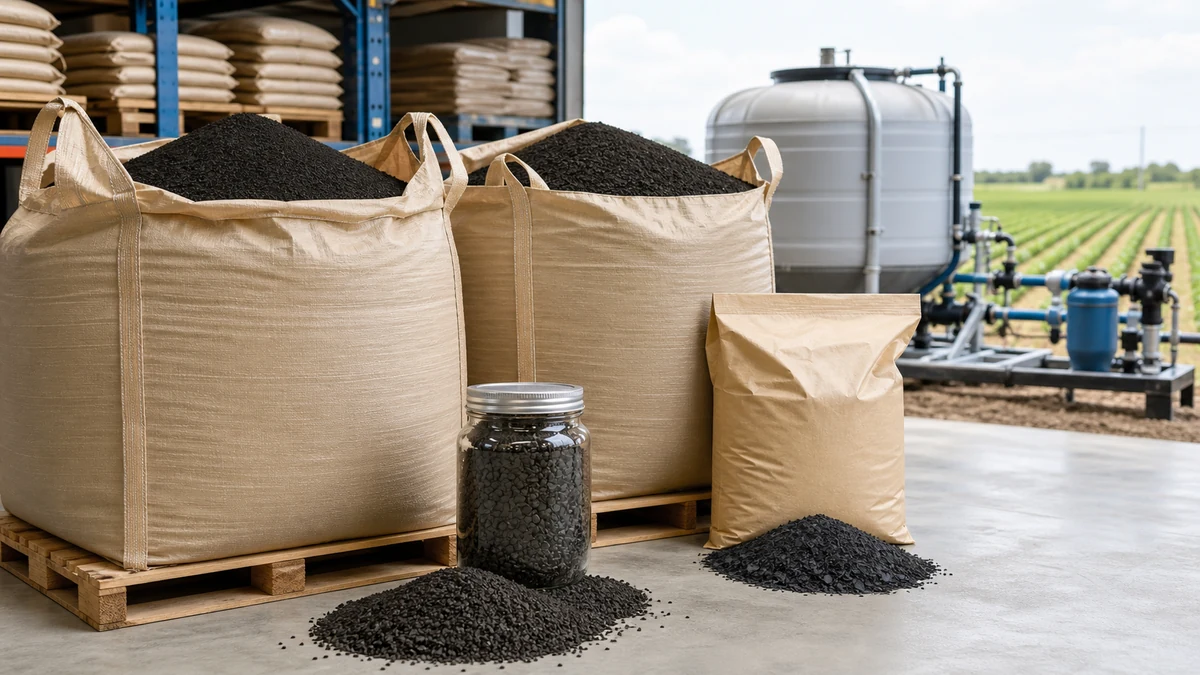
One caution rides along with anything made from leonardite. The raw material is brown coal, so ask for the heavy-metal panel on the COA, and ask hardest when the product is going onto soil in volume, season after season.
What to Expect, and What Humic Acid Won't Fix
Selling humic acid well means being straight about it. The results are real, but they are neither instant nor unlimited, and knowing where the edge sits keeps a good product from taking blame for the wrong things.
On sand, expect steadier water and nutrients that build across one to a few seasons as structure and organic matter come up, not by next week. On saline soil inside a proper program, expect infiltration, structure, and crop stand to improve gradually as salt leaches and calcium takes over from sodium. Since you are rebuilding soil rather than spraying a fix, the gains stack with repeat use.
Now the other side. Humic acid will not desalinate a soil by itself, will not stand in for gypsum on sodic ground, and will not feed a crop nitrogen, phosphorus, or potassium the way a fertiliser does, beyond the trace of potassium in a humate. And it cannot beat bad drainage: if water has no way out, neither does the salt. Use it to make sandy or salty soil hold and function better, then give it the calcium, drainage, and nutrition the soil test still asks for.
Frequently Asked Questions
Is humic acid good for sandy soil?
Yes. Sandy soil has very low cation-exchange capacity, so it leaks water and nutrients, and humic acid adds the charged sites and structure that hold both in the root zone. In one semiarid sandy-loam trial it raised plant-available water by about 26%. The proportional benefit is largest on sand precisely because it starts with so little. Apply in split doses through the season rather than one heavy pass, since sand does not hold a single large application well.
Can humic acid reclaim saline or sodic soil?
It helps, but only as part of a program. Humic acid improves structure and supports the calcium-for-sodium exchange, yet the sodium still has to be displaced by calcium, usually from gypsum, and leached out with enough drainage water. On sodic soils it is a reclamation aid, not a standalone treatment. Expect a multi-season recovery, not a single-pass fix.
How long does humic acid take to improve soil?
Expect gradual gains over one to a few seasons rather than immediate results, because humic acid works by rebuilding structure and cation-exchange capacity. On sandy soil under irrigation you may notice better moisture retention within a season; on saline soil, structural and stand improvements build as salt leaches across several cycles. The effect compounds with repeated applications.
What is the best humic acid form for soil conditioning?
For soil-incorporated conditioning at scale, a raw granular grade is usually best: it is the cheapest way to move humic matter into the ground and does not need to dissolve. Keep soluble powder or flake for the fertigation that supports the crop during recovery. Match the form to the pass, and compare products on cost per unit of active humic, not on bag price.
How much humic acid do I apply per hectare on sandy soil?
Granular grades typically go in at soil-building rates in the tens of kilograms per hectare, repeated more often than on heavier soils because sand will not hold one large dose. Soluble humate is then dosed through fertigation at a fraction of a percent in solution during the season. Treat these as planning figures and confirm against your own soil test and texture, since a pure sand needs more frequent inputs than a sandy loam.
Does humic acid raise or lower soil pH?
Humic acid itself is mildly acidic, but as a soil conditioner its main job on problem soils is structural rather than a big pH shift, and refined humate grades are alkaline. On saline-alkali soils, do not lean on humic acid to correct pH; use the calcium amendment and leaching your soil test specifies, and treat humic acid as the structure and nutrient-retention aid working alongside them.
— Reviewed by Rutom Bio Technical Supply Desk
Last updated: 2026-07-22
Related Articles
- Humic Acid Fertilizer: Supplier, Grades & Bulk Sourcing, the money page. Use this when you are ready to compare grades and request a quote for a reclamation program.
- Humic Acid for Plants, the agronomy side. Use this when the question is how humic acid behaves in soil, crop by crop.
- Humus Soil, the soil-science background. Use this when a customer asks what humus and cation-exchange capacity actually are.
- Humic Acid vs Fulvic Acid, the decision guide. Use this when the buyer needs to decide whether the problem is soil structure, fast plant uptake, or both.
Working Saline or Sandy Ground?
Tell us the soil problem (saline, sodic, or sandy), the treated area, and whether you need a soil-incorporated granule, a fertigation grade, or both, and we will return a grade recommendation, a moisture-adjusted FOB quote, and a COA sample within 24 hours.
Request a Grade Recommendation & FOB Quote →
About This Guide
Reviewed by the Rutom Bio Technical Supply Desk. Last updated 2026-07-22. The mechanisms described here are standard soil science, the saline and sandy soil results come from the peer-reviewed studies referenced below, and the grade specifications are our own published product data. We manufacture the granular and soluble humate grades discussed, which is why this guide leads with the sourcing and program detail that benefit-list pages leave out. Confirm all application rates against your own soil test.
References & Sources
- Humic Acid and Microbial Fertilizers on Coastal Saline-Alkali Soils. Peer-reviewed study, National Library of Medicine (PMC), 2024.
- Humic Acid in Nutrient-Poor Sandy Soil of a Semiarid Region. Peer-reviewed study, National Library of Medicine (PMC).
- What Are Humic Substances?. International Humic Substances Society.
- Rutom Bio published product specifications: humic acid granule and potassium humate flake 1-0-11 grade data.
About the Author: Rutom




 English
  Spanish
  French
  Japanese
  Korean
  German
  Portuguese
  Italian
  Indonesian
  Vietnamese
  Turkish
  Persian
  Russian
  Chinese