
tabela de conteúdo
Atualizado em julho de 2026.
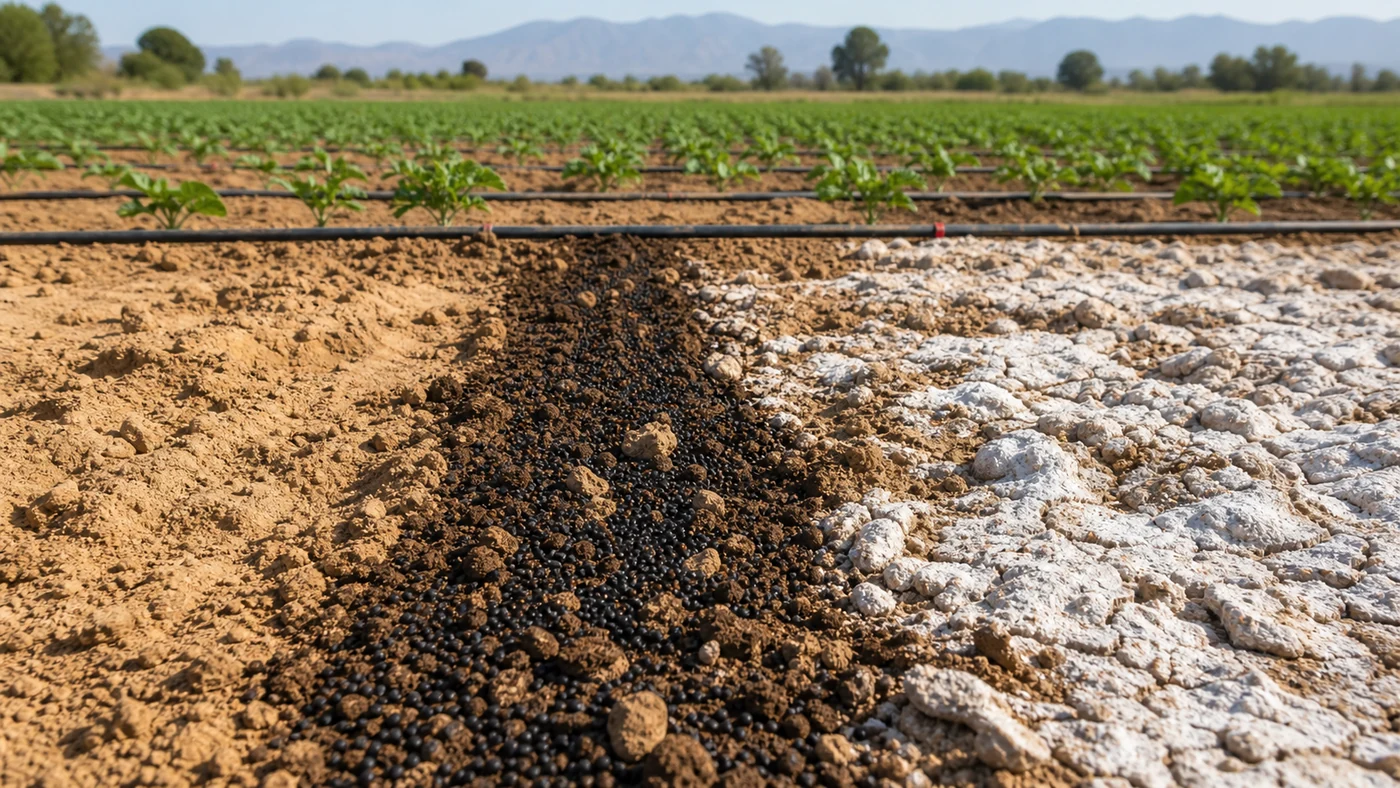
Os produtores em regiões áridas e costeiras geralmente enfrentam dois tipos de solo ao mesmo tempo, e cada um deles causa prejuízo de uma maneira diferente. A areia deixa a água e o fertilizante passarem direto pelas raízes. O sal faz o contrário. Ele contém compostos químicos que retiram a água da planta e compactam o solo, impedindo a penetração. O ácido húmico é apresentado como a solução para ambos os problemas, quase sempre em uma lista de benefícios bem elaborada que nunca se preocupa em explicar como ele age em cada um deles.
Este guia analisa esses dois aspectos separadamente. O que dá errado em cada tipo de solo, o que o ácido húmico realmente altera, os dados de ensaios de campo em solos salinos e arenosos, a quantidade aproximada a ser aplicada e o que a maioria dos vendedores omite: o que ele não resolve.
Ácido húmico para solos salinos e arenosos: a resposta curta
Uma única substância atua nos dois tipos de solo. O ácido húmico aumenta a capacidade de troca catiônica e une partículas soltas, formando agregados estáveis. Na areia, essa capacidade de retenção mantém a água e os nutrientes ao alcance das raízes, em vez de permitir que sejam drenados. Em solos salinos e sódicos, a estrutura mais firme, aliada à forma como o ácido húmico retém cátions, ajuda o cálcio a chegar à argila e a expulsar o sódio dela, de modo que o sal possa ser levado para abaixo da zona radicular.
É preciso deixar uma ressalva bem clara desde o início, pois ela determina se vale a pena comprar o produto. Em um solo genuinamente sódico, o ácido húmico é um auxiliar, não uma cura. O sódio ainda precisa ser removido da argila pelo cálcio e eliminado com água. Se usado dessa forma, ele faz jus ao seu preço. Mas se você comprá-lo como um removedor de sal independente, ele vai decepcioná-lo.
Por que os solos arenosos e salinos prejudicam as culturas
A areia e o sal prejudicam as plantações por motivos quase opostos, e é exatamente por isso que um único produto acaba desempenhando duas funções.
Comece pela areia. Ela não consegue reter nada. Partículas grandes, com grandes espaços entre elas, de modo que a água escorre rapidamente; e, com pouca argila ou matéria orgânica, quase não há capacidade de troca catiônica para reter nutrientes ao longo do caminho. Aplique fertilizante e boa parte dele será levada para além das raízes com a próxima irrigação ou tempestade. Entre as regas, o solo fica completamente seco. O agricultor reage com mais água e mais fertilizante, mas ainda assim menos nutrientes chegam à planta.
O excesso de sal é o problema oposto. O solo retém o que não deve e o retém com muita força. Os sais dissolvidos aumentam a pressão osmótica da água do solo, de modo que as raízes precisam se esforçar contra ela apenas para se hidratar — o que equivale a uma seca, mesmo com o solo úmido. Quando o sódio ocupa os sítios de troca, a argila deixa de se aglomerar, a estrutura se desintegra e a superfície se transforma em uma crosta que impede a entrada de água e ar. As mudas param de crescer. A densidade da plantação diminui. A produtividade cai.
A mesma alteração, funções opostas: o ácido húmico aumenta a capacidade de retenção da areia e ajuda a reconstruir o que o sal destruiu.
A solução do “balde furado”: ácido húmico em solo arenoso
Imagine a areia como um balde furado. O ácido húmico é o revestimento. Eu chamo isso de "Solução do Balde Furado", e não há nada de misterioso nisso: você está adicionando capacidade de troca catiônica e estrutura a um solo que quase não possui essas características, de modo que a água e os nutrientes deixam de vazar diretamente. Todas as frases do tipo “melhora a retenção de água” nas embalagens estão descrevendo isso, e geralmente escondendo essa informação.
O mecanismo é bastante simples. As moléculas de ácido húmico possuem sítios com carga negativa. Ao serem colocadas na areia, essas áreas se transformam em reservatórios, retendo cálcio, magnésio, potássio e amônio contra a força de drenagem da água, para depois devolvê-los às raízes. As mesmas moléculas aglutinam grãos soltos, formando pequenas migalhas, e essas migalhas criam poros finos que retêm a água por ação capilar, em vez de deixá-la escorrer.
Os ensaios de campo permitem quantificar isso. Em um solo franco-arenoso pobre em nutrientes, em um ensaio em região semiárida perto do Cairo, o ácido húmico incorporado à zona radicular aumentou a água disponível para as plantas em cerca de 26%, elevou a umidade na capacidade de campo em 22%, reduziu a densidade aparente em aproximadamente 5% e elevou o rendimento do trigo em cerca de 54% na dosagem mais alta. Nada disso é uma adubação que se repõe semanalmente. É incorporado ao solo. Em areia grossa sob irrigação por gotejamento, essa é a linha que separa a fertirrigação que chega à cultura daquela que, silenciosamente, rega o aquífero.
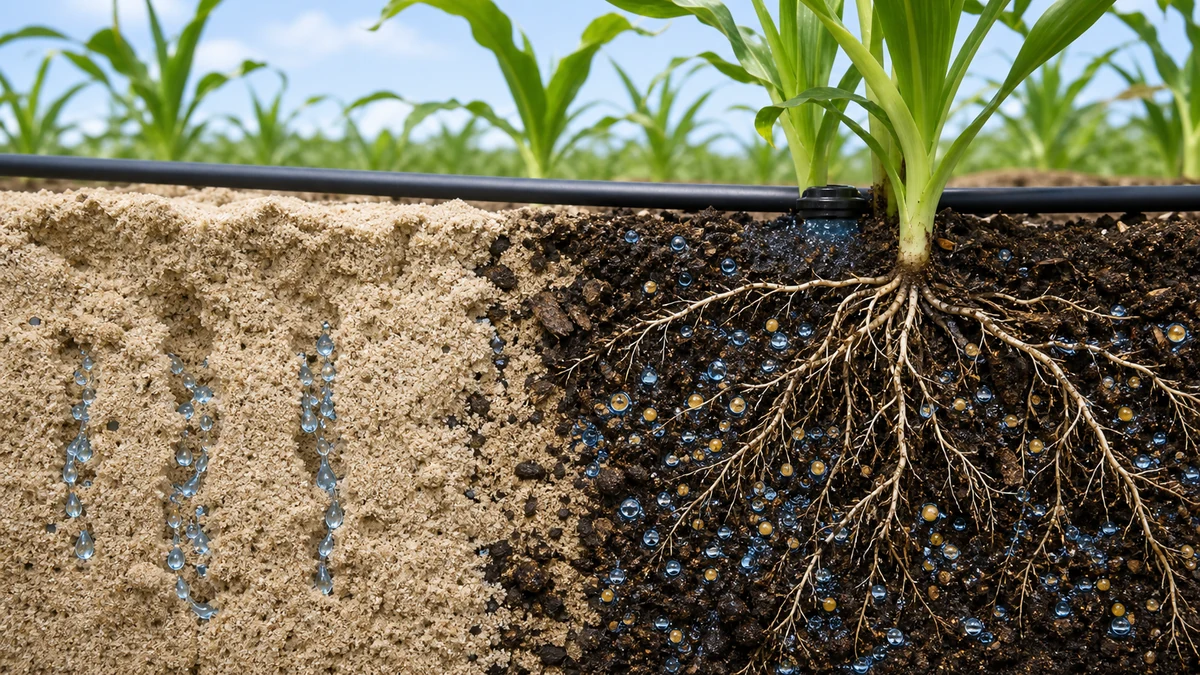
Como o ácido húmico ajuda o solo arenoso a reter água?
Duas maneiras, ambas já abordadas. Ele adiciona sítios de troca e forma agregados. Os sítios carregados retêm os cátions nutrientes antes que eles sejam lixiviados; os agregados abrem poros capilares que retêm água. A areia começa com uma CEC tão baixa que o ganho proporcional é maior justamente aqui, no solo que mais precisa disso. Verifique a dosagem com base em uma análise de solo, pois uma areia pura requer uma quantidade maior do que um solo franco-arenoso.
Em solo arenoso, o resultado positivo raramente se deve ao nutriente que você adicionou. É o nutriente e a água que você deixou de perder.
Solução salina, sódica ou salina-sódica? Saiba qual é a sua
O sal não é o único problema, e é devido a um diagnóstico incorreto que a maioria dos programas de recuperação fracassa discretamente. Tratar um solo sódico como se fosse apenas salino pode prejudicar o processo. Portanto, antes de mais nada, identifique o tipo de solo.
| Tipo de solo | Problema central | Estrutura | Correção principal | O papel do ácido húmico |
|---|---|---|---|---|
| Solução salina | Excesso de sal solúvel | Muitas vezes ainda intactos | Lavar com água limpa | Mantenha a infiltração em movimento |
| Sódico | O sódio é o elemento predominante na argila | Dispersos, com crosta | Primeiro o cálcio (gesso), depois a lixiviação | Apoiar a recuperação estrutural |
| Salina-sódica | Alto teor de sal e alto teor de sódio | Em risco | Cálcio antes da lixiviação intensa | Estrutura e apoio à retenção em todo o texto |
A salinidade é o caso mais simples. O solo simplesmente retém sal dissolvido em excesso, e a estrutura geralmente ainda está intacta. A solução consiste principalmente em água: fazer com que uma quantidade suficiente de água limpa se infiltre para levar o sal para abaixo das raízes, com o ácido húmico mantendo a infiltração em andamento. O cálcio não é realmente o fator determinante.
O sódio é a armadilha. A concentração de sal pode ser baixa, mas o sódio tomou conta da argila, fazendo com que o solo se disperse e forme crostas. A lixiviação, por si só, acaba sendo contraproducente nesse caso, pois enxaguar o pouco sal existente, sem repor o sódio, leva a argila ainda mais perto do colapso. Primeiro, é preciso cálcio — geralmente gesso — para soltar o sódio; depois, a lixiviação, com o ácido húmico ajudando a restaurar a estrutura.
Os solos salino-sódicos apresentam ambas as cargas ao mesmo tempo, e, nesse caso, a ordem é fundamental. Aplique o cálcio antes de realizar uma lixiviação intensa. Se você eliminar o sal antes de remover o sódio, um solo que era salino-sódico pode passar a ser fortemente sódico. Nos três casos, o ácido húmico atua como um auxiliar de estrutura e retenção. Nunca é o cálcio.
Como interpretar a análise do solo: CE, ESP e SAR
Três valores em uma análise de solo indicam com que tipo de solo você está lidando, na verdade, e onde deve investir seu dinheiro. Se você ignorar esses valores, estará gastando seu dinheiro às cegas.
| Indicador | O que ele mede | O limite que faz a diferença | O que ele orienta você a fazer |
|---|---|---|---|
| EC (pasta saturada) | Salinidade | Acima de ~4 dS/m = solução salina | Qual é a quantidade de lixiviação necessária para o solo? |
| ESP | Sodicidade (sódio em sítios de troca) | Acima de ~15% = sódico | Se você precisa de cálcio (gesso) |
| SAR | Risco do sódio versus cálcio + magnésio | Aumenta à medida que o sódio se torna predominante | Verifique os níveis de sodicidade; leia também sobre a água de irrigação |
| pH | Alcalinidade | Valores acima de ~8,5 costumam indicar excesso de sódio | Confirma a leitura de sódio |
A EC (condutividade elétrica) é o valor de salinidade medido. Quando a EC da pasta saturada ultrapassa aproximadamente 4 dS/m, o solo é considerado salino; quanto mais alto esse valor for, mais dificuldade as raízes terão para absorver água. Esse único número determina a quantidade de lixiviação necessária.
O ESP (percentual de sódio trocável) é o valor de sodicidade: a proporção de sítios de troca ocupados pelo sódio. Acima de cerca de 15%, o solo é sódico, a estrutura fica comprometida e o cálcio passa a ser um fator de risco. O SAR, ou índice de adsorção de sódio, monitora o mesmo risco por meio do equilíbrio sódio-cálcio-magnésio, e costuma ser medido tanto na água de irrigação quanto no próprio solo.
O pH ocupa o último canto. Se for fortemente alcalino, acima de cerca de 8,5, geralmente estamos diante de um solo sódico ou salino-sódico. Portanto, use a CE para determinar a quantidade a ser lixiviada, o ESP ou o SAR para verificar se há necessidade de cálcio, e o pH como critério decisivo. Adapte a correção a esses valores, e não ao rótulo do produto, e obtenha os valores por meio de um teste de laboratório realizado no próprio campo, pois a salinidade pode variar drasticamente de um canto a outro da propriedade. A CE indica o grau de salinidade. O ESP e o SAR indicam o grau de sodicidade. Apenas a leitura de sodicidade requer cálcio, e o ácido húmico auxilia em todos os casos, sem substituir nenhum deles.
A via de deslocamento do sal: o ácido húmico em solos salinos e sódicos
Em solos afetados pelo sal, o ácido húmico é um elo de uma cadeia, não um solvente que se despeja sobre o sal. A cadeia — chamemos-lhe “Via de Deslocamento do Sal” — funciona assim: abre a estrutura para que a água possa circular, ajuda o cálcio a expulsar o sódio da argila e, em seguida, lixivia o sal liberado para além das raízes. Se qualquer um dos elos falhar, todo o processo fica paralisado.
O ácido húmico atua em cada etapa. Ele agrega a argila dispersa e abre o espaço poroso, reabrindo os canais que um solo sódico havia selado, para que a água possa finalmente entrar e transportar o sal para baixo. Seus sítios de troca e quelação mantêm o cálcio disponível e em movimento, o que alimenta a troca em que o cálcio ocupa o lugar do sódio na argila. E, uma vez que o sódio está solto, a chuva ou a irrigação o levam embora, com a melhor estrutura mantendo esse fluxo em andamento.
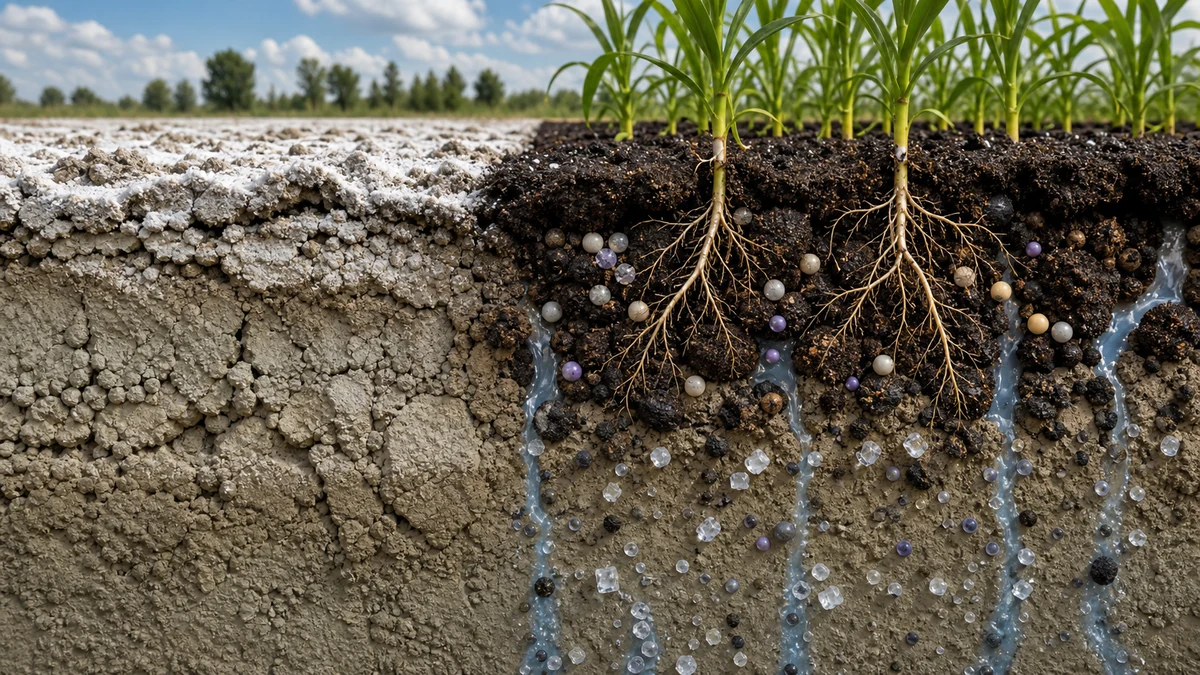
O limite está exatamente aqui, e vale a pena deixar isso bem claro. O ácido húmico, por si só, não remove o sódio. Em um solo sodico de verdade, o cálcio quase sempre precisa vir do gesso ou de um corretivo semelhante, e a drenagem, aliada a água de lixiviação suficiente, não são itens opcionais. O ácido húmico torna esse processo mais rápido e eficaz. Ele não substitui esse processo.
O ácido húmico remove o sal do solo?
Não por si só. Ele melhora a estrutura e ajuda o cálcio a substituir o sódio, mas o sal ainda é lixiviado com a água e, em solos sódicos, o cálcio ainda provém do gesso. Pense nele como um auxiliar de recuperação que atua dentro de um programa de cálcio e drenagem, e não como um substituto de nenhum dos dois. Qualquer fornecedor que lhe diga que o ácido húmico, por si só, dessaliniza um solo está exagerando.
O que as pesquisas mostram
A pesquisa deve ser interpretada, antes de tudo, como um apoio à função de recuperação, e não como um milagre. Um estudo de campo de 2024 sobre solos salinos-alcalinos costeiros (ácido húmico e fertilizantes microbianos em solo salino-alcalino) apresentou valores concretos sobre o mecanismo descrito acima. O ácido húmico, por si só, reduziu a condutividade elétrica em 60 a 75% e os sais solúveis totais em 50 a 74% ao longo de duas safras, quase dobrou a estabilidade dos agregados e aumentou o rendimento do trigo em 41 a 56%. Quando combinado com um inoculante de Bacillus, os ganhos em termos de salinidade e rendimento foram ainda maiores.
Há dois aspectos que devem chamar a atenção do comprador. Os melhores resultados foram obtidos com o uso de ácido húmico em um programa combinado, o que é exatamente o que o mecanismo prevê. E os números se referiam a resultados específicos em solo salino-alcalino, condutividade elétrica (CE), sais solúveis, estabilidade dos agregados e rendimento, em vez de uma vaga referência a um "solo mais saudável". É essa especificidade que se deve exigir de um fornecedor. Sua ausência é motivo para desconfiança.
Vale a pena dedicar um pouco mais de atenção ao aspecto microbiano, pois ele sugere por que o ácido húmico ajuda além da simples química. Alimente e remodele a comunidade microbiana do solo e você estará apoiando a parte viva da recuperação, não apenas os locais de troca iônica. Para um comprador, a lição é direta e prática: peça evidências sobre o solo e o resultado que realmente lhe interessa, um teste em solo salino com dados de condutividade elétrica (CE) ou rendimento, e não uma afirmação genérica de que o ácido húmico é bom para o solo.
Doses de aplicação e programa por tipo de solo
As taxas variam de acordo com o solo e a forma de cultivo; portanto, o que realmente ajuda é ter um parâmetro inicial que você compare com a análise do solo, e não um único número mágico. Solos arenosos respondem melhor a aplicações pequenas e regulares. Solos afetados pelo sal precisam que o ácido húmico seja incorporado a um programa de cálcio e lixiviação, em vez de ser aplicado isoladamente.
| Tipo de solo | Húmico granular (incorporado ao solo) | Humato solúvel (fertirrigação) | Nota sobre a sequência |
|---|---|---|---|
| Arenoso | Dezenas de kg/ha, em doses fracionadas e repetidas | Fração de % até ~1% em solução, ao longo da temporada | Pouco e com frequência; a areia não suporta uma dose pesada |
| Salina / sódica | Incorporar para ajudar na reabertura da estrutura | Apoia a cultura durante a recuperação | A correção com cálcio e a lixiviação fazem o trabalho pesado; em solo com alto teor de sódio, o efeito perdura por várias safras |
Em solos arenosos, o objetivo é aumentar a capacidade de troca catiônica e mantê-la elevada. Incorpore um granulado na zona radicular no momento do plantio e, em seguida, complemente com humato solúvel ao longo da estação, por meio da linha de gotejamento, pois a irrigação passa a temporada inteira tentando levá-lo embora. A areia retém tão pouco que doses divididas e repetidas são sempre mais eficazes do que uma única aplicação em grande quantidade.
Em solos salinos e sódicos, a ordem é mais importante do que a quantidade. Aplique a quantidade de cálcio indicada pela análise do solo, incorpore um aditivo húmico granulado para ajudar a abrir a estrutura do solo e irrigue com água limpa suficiente para levar o sal solto para abaixo das raízes. Um humato solúvel aplicado por fertirrigação mantém a cultura saudável enquanto o solo se recupera. Em solos com alto teor de sódio, planeje várias safras em vez de uma única intervenção.
Para fins de planejamento, e apenas como ponto de partida a ser confirmado por meio de uma análise de solo: os produtos granulados costumam ser aplicados em doses para melhoria do solo na ordem de dezenas de quilogramas por hectare, enquanto o humato solúvel é dosado por fertirrigação em uma concentração que varia entre uma fração de um por cento e cerca de um por cento na solução ao longo da safra. A areia fica na faixa mais baixa de dose única, mas é aplicada com maior frequência. Solos afetados pelo sal dependem da aplicação granular para restaurar a estrutura, enquanto o cálcio e a água atuam na melhoria da fertilidade. Nenhuma dessas informações constitui uma prescrição; seus valores reais dependem da condutividade elétrica (CE), da resistividade elétrica (RE), da textura do solo e da cultura.
Esse é, sem dúvida, um problema de exportação para os mercados áridos e costeiros. Em grande parte do Oriente Médio, Norte da África e da Ásia costeira, os produtores enfrentam simultaneamente a textura arenosa do solo e o aumento da salinidade em sistemas de irrigação; é por isso que a combinação de granulado com fertirrigação costuma ser mais eficaz do que optar por um único produto. Seja qual for o tipo de solo, opte por húmico ativo antes de definir uma dosagem e confie mais na análise do solo do que nas indicações do rótulo. Para saber as dosagens específicas por cultura, consulte nosso guia sobre ácido húmico para plantas vai além, e os fundamentos da ciência do solo estão descritos em nosso artigo explicativo sobre solo húmico.
Qual classe de material deve ser utilizada para a recuperação?
Em um campo inteiro, a escolha do tipo de solo se resume a dois fatores: frete e função. A recuperação movimenta uma tonelagem significativa; portanto, o que determina a viabilidade econômica é o custo por unidade de matéria húmica ativa e o custo de transporte de uma tonelada.
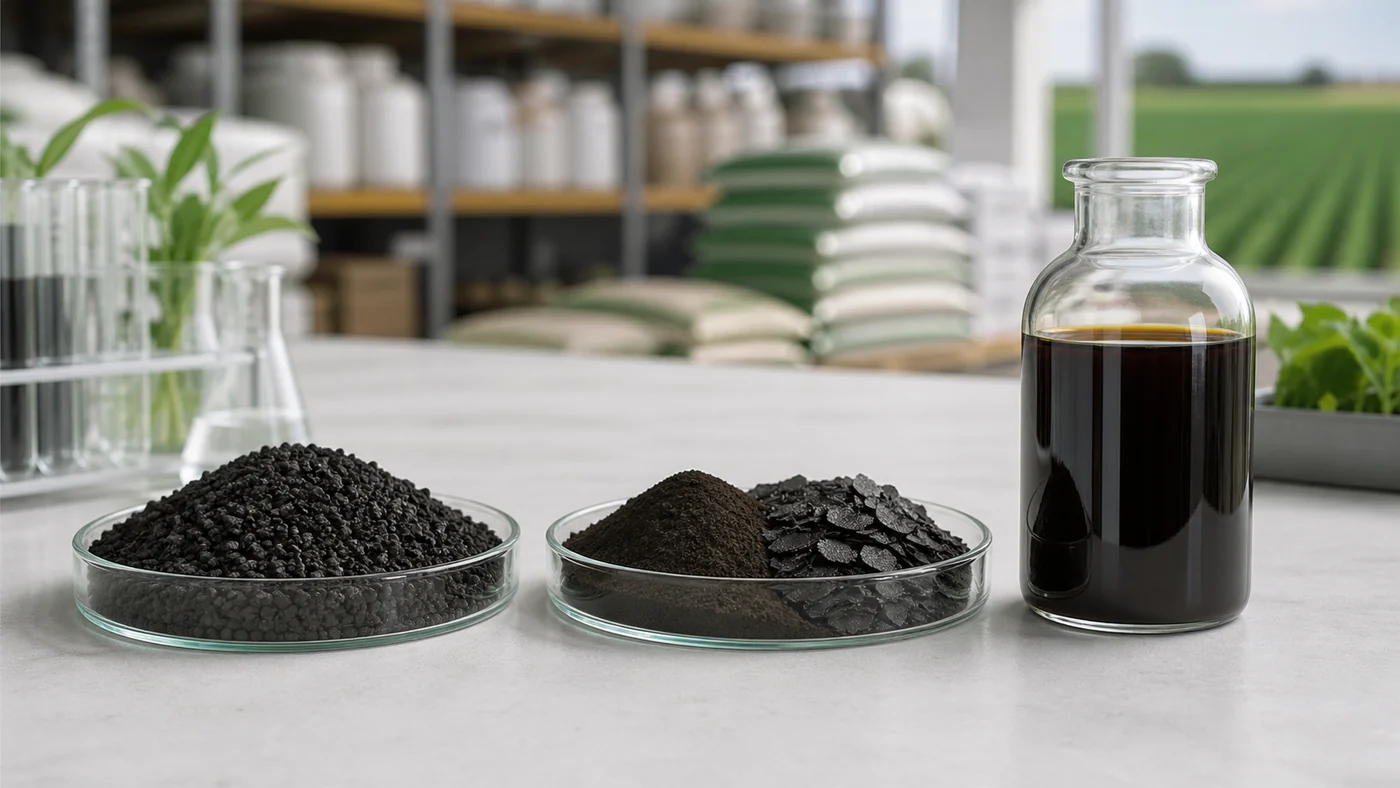
O grânulo de ácido húmico bruto é o principal recurso para incorporar matéria húmica no solo em grande escala. É a forma mais econômica de aplicá-lo no solo e, para uma aplicação direta no solo, não é necessário que ele se dissolva. Para a fertirrigação que acompanha a cultura durante a recuperação, um produto solúvel, como o humato de potássio em flocos 1-0-11, flui sem problemas pelas linhas de gotejamento. A maioria dos compradores que administram grandes programas em regiões áridas mantém os dois tipos à disposição, e a matriz completa de classificações, bem como a discriminação dos custos finais, estão disponíveis em nosso fertilizante de ácido húmico página de fornecimento.
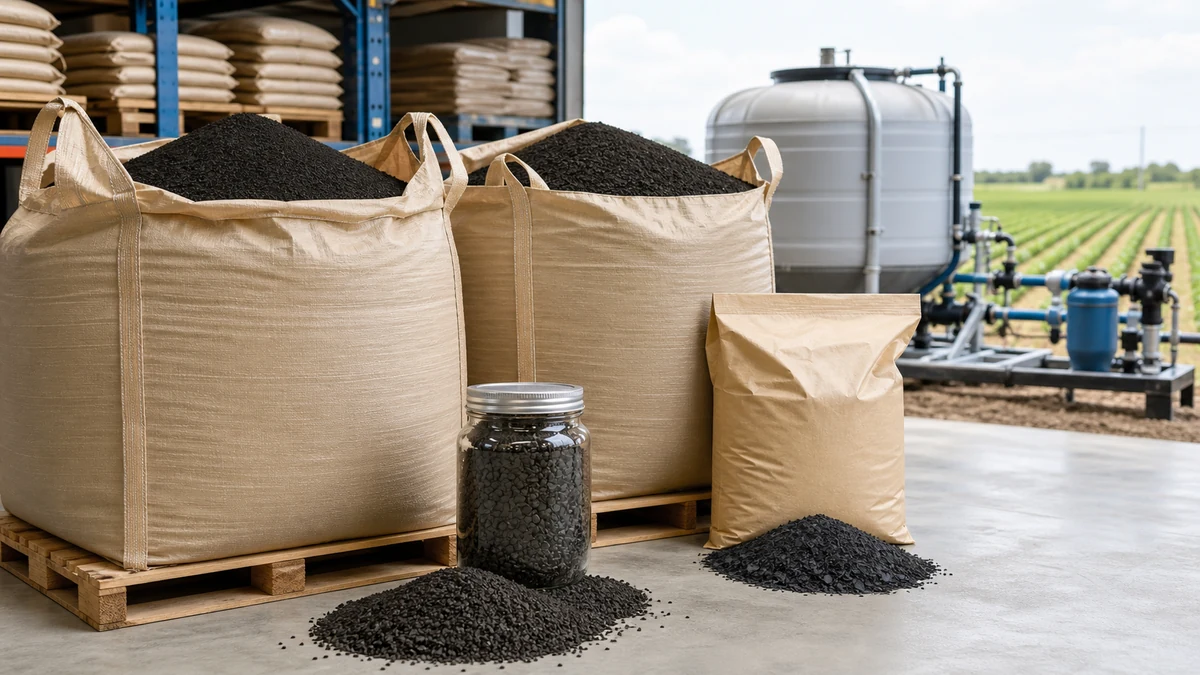
Há uma precaução a ser tomada com qualquer produto fabricado a partir de leonardita. Como a matéria-prima é o carvão marrom, solicite o relatório sobre metais pesados no Certificado de Análise (COA) e seja ainda mais rigoroso quando o produto for aplicado em grandes quantidades no solo, temporada após temporada.
O que esperar e o que o ácido húmico não resolve
Vender bem o ácido húmico significa ser sincero a respeito dele. Os resultados são reais, mas não são nem instantâneos nem ilimitados, e saber quais são os limites evita que um bom produto seja culpado por coisas que não são de sua responsabilidade.
Em solos arenosos, espere que a disponibilidade de água e nutrientes aumente de forma mais gradual ao longo de uma a algumas safras, à medida que a estrutura e a matéria orgânica se desenvolvem — e não já na próxima semana. Em solo salino, dentro de um programa adequado, espere que a infiltração, a estrutura e o desenvolvimento das plantas melhorem gradualmente à medida que o sal é lixiviado e o cálcio substitui o sódio. Como você está reconstruindo o solo em vez de aplicar um remédio, os ganhos se acumulam com o uso repetido.
Agora, o outro lado da moeda. O ácido húmico, por si só, não dessaliniza o solo, não substitui o gesso em solos sódicos e não fornece nitrogênio, fósforo ou potássio às culturas da mesma forma que um fertilizante, além do traço de potássio presente no humato. E ele não resolve o problema da má drenagem: se a água não tem por onde sair, o sal também não. Use-o para melhorar a retenção e o desempenho de solos arenosos ou salinos e, em seguida, forneça o cálcio, a drenagem e os nutrientes que a análise do solo ainda indicar como necessários.
Perguntas frequentes
O ácido húmico é bom para solos arenosos?
Sim. O solo arenoso possui uma capacidade de troca catiônica muito baixa, por isso perde água e nutrientes, e o ácido húmico adiciona os sítios carregados e a estrutura que retêm ambos na zona radicular. Em um ensaio realizado em solo franco-arenoso semiárido, ele aumentou a água disponível para as plantas em cerca de 26%. O benefício proporcional é maior na areia justamente porque ela parte de um nível muito baixo. Aplique em doses fracionadas ao longo da estação, em vez de uma única aplicação pesada, já que a areia não retém bem uma única aplicação em grande quantidade.
O ácido húmico pode recuperar solos salinos ou sódicos?
Isso ajuda, mas apenas como parte de um programa. O ácido húmico melhora a estrutura e favorece a troca de cálcio por sódio; no entanto, o sódio ainda precisa ser substituído pelo cálcio — geralmente proveniente do gesso — e lixiviado com água de drenagem em quantidade suficiente. Em solos sódicos, trata-se de um auxílio à recuperação, não de um tratamento isolado. Espere uma recuperação ao longo de várias safras, não uma solução imediata.
Quanto tempo o ácido húmico leva para melhorar o solo?
Espere ganhos graduais ao longo de uma a algumas safras, em vez de resultados imediatos, pois o ácido húmico atua reconstruindo a estrutura e a capacidade de troca catiônica. Em solos arenosos irrigados, você poderá notar uma melhor retenção de umidade já na mesma safra; em solos salinos, as melhorias estruturais e no estado da plantação vão se acumulando à medida que o sal é lixiviado ao longo de vários ciclos. O efeito se intensifica com aplicações repetidas.
Qual é a melhor forma de ácido húmico para o condicionamento do solo?
Para o condicionamento incorporado ao solo em grande escala, geralmente o melhor é um produto granular não processado: é a maneira mais econômica de introduzir matéria húmica no solo e não precisa ser dissolvido. Reserve o pó solúvel ou os flocos para a fertirrigação que apoia a cultura durante a recuperação. Escolha a forma adequada para cada aplicação e compare os produtos com base no custo por unidade de matéria húmica ativa, e não no preço por saco.
Qual é a quantidade de ácido húmico que devo aplicar por hectare em solo arenoso?
Os materiais granulares são normalmente aplicados em doses para melhoria do solo na casa das dezenas de quilogramas por hectare, com maior frequência do que em solos mais pesados, pois a areia não retém uma dose única grande. O humato solúvel é então aplicado por fertirrigação em uma fração de um por cento na solução ao longo da estação. Considere esses valores como orientativos e confirme-os com base em sua própria análise de solo e textura, já que uma areia pura requer aplicações mais frequentes do que um solo franco-arenoso.
O ácido húmico aumenta ou diminui o pH do solo?
O ácido húmico, por si só, é levemente ácido, mas, como corretivo de solo, sua principal função em solos problemáticos é estrutural, e não uma grande alteração no pH; além disso, os tipos refinados de humato são alcalinos. Em solos salino-alcalinos, não se baseie no ácido húmico para corrigir o pH; utilize o corretivo de cálcio e a lixiviação especificados na análise do solo e trate o ácido húmico como um auxiliar de estrutura e retenção de nutrientes que atua em conjunto com esses corretivos.
— Revisado pelo Departamento de Suprimentos da Rutom Bio Technical
Última atualização: 22/07/2026
Artigos relacionados
- Fertilizante à base de ácido húmico: fornecedores, tipos e aquisição a granel, a página de preços. Use-a quando estiver pronto para comparar preços e solicitar um orçamento para um programa de recuperação.
- Ácido húmico para plantas, a vertente agronômica. Recorra a isso quando a questão for como o ácido húmico se comporta no solo, cultura por cultura.
- Solo rico em húmus, os conceitos básicos de ciência do solo. Use isso quando um cliente perguntar o que realmente são o húmus e a capacidade de troca catiônica.
- Ácido húmico x Ácido fúlvico, o guia de decisão. Utilize-o quando o comprador precisar decidir se o problema está na estrutura do solo, na rápida absorção pela planta ou em ambos.
Solo salino ou arenoso?
Informe-nos qual é o problema do solo (salino, sódico ou arenoso), a área a ser tratada e se você precisa de um granulado para incorporação no solo, um produto para fertirrigação ou ambos, e nós lhe enviaremos uma recomendação de tipo de produto, uma cotação FOB ajustada à umidade e uma amostra do Certificado de Análise (COA) em até 24 horas.
Solicite uma recomendação de classificação e uma cotação FOB →
Sobre este guia
Revisado pela Equipe Técnica da Rutom Bio. Última atualização em 22/07/2026. Os mecanismos aqui descritos são princípios padrão da ciência do solo; os resultados relativos a solos salinos e arenosos provêm de estudos revisados por pares, referenciados abaixo; e as especificações dos tipos de produto são dados de nossos próprios produtos publicados. Fabricamos as categorias de humato granular e solúvel aqui discutidas; é por isso que este guia começa com informações sobre fornecimento e detalhes do programa que as páginas de lista de benefícios não incluem. Confirme todas as taxas de aplicação com base em sua própria análise de solo.
Referências e fontes
- Ácido húmico e fertilizantes microbianos em solos salinos-alcalinos costeiros. Estudo revisado por pares, Biblioteca Nacional de Medicina (PMC), 2024.
- Ácido húmico em solo arenoso pobre em nutrientes de uma região semiárida. Estudo revisado por pares, Biblioteca Nacional de Medicina (PMC).
- O que são substâncias húmicas?. Sociedade Internacional de Substâncias Húmicas.
- A Rutom Bio publicou as especificações dos produtos: Dados relativos ao granulado de ácido húmico e ao humato de potássio em flocos, grau 1-0-11.
Sobre o autor: Rutom




 English
  Spanish
  French
  Japanese
  Korean
  German
  Portuguese
  Italian
  Indonesian
  Vietnamese
  Turkish
  Persian
  Russian
  Chinese