
目录
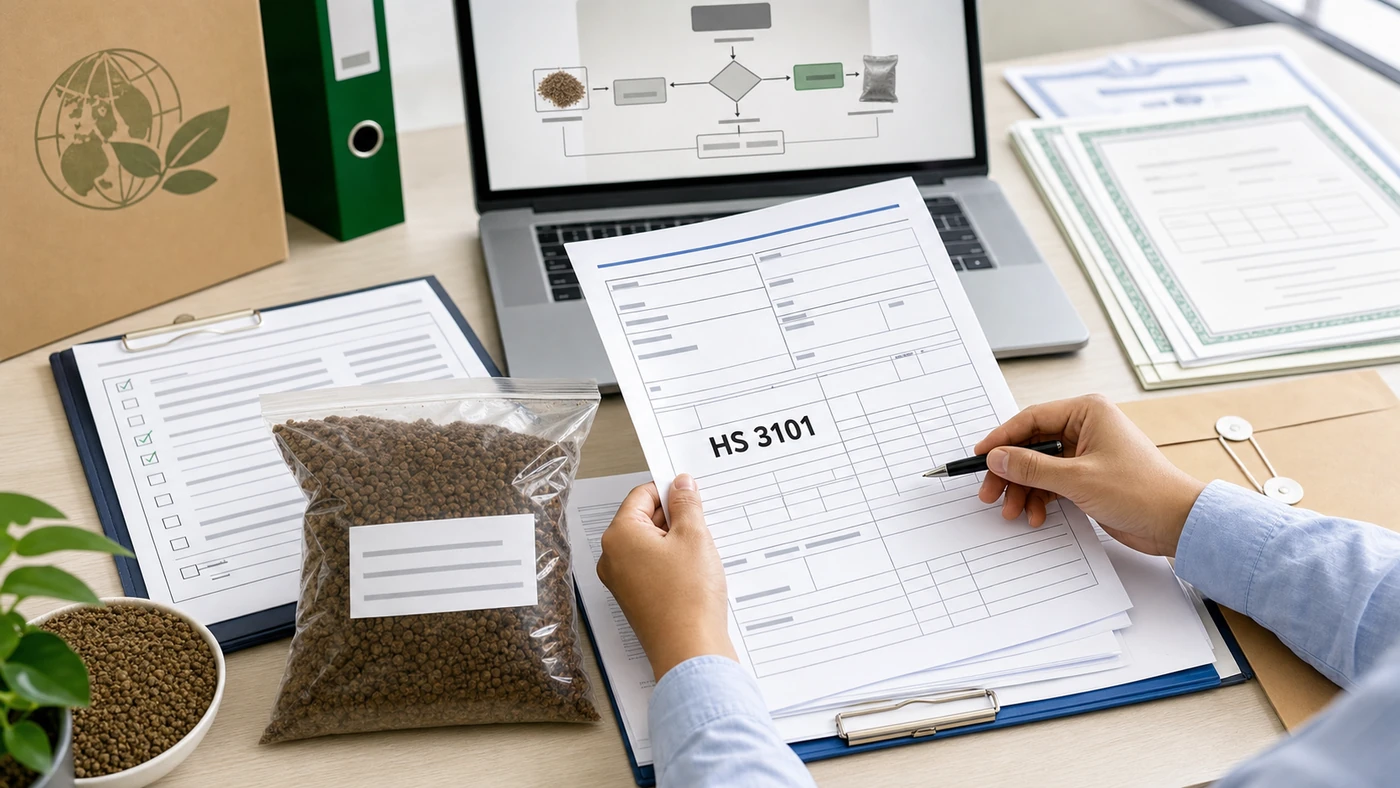
一箱有机肥料很少会因产品本身有问题而在边境被扣留。它之所以被扣留,是因为申报单上的HS编码与海关官员检查时所见不符——或者是因为文件中缺失了一份证书。无论哪种情况,货物都会滞留,滞期费不断累积,而买家则开始追问是谁犯了错。.
分类工作乍看之下只是个文书上的琐事,直到它导致一周的仓储成本。本指南有两个作用。首先,它说明了如何 有机肥实际上可分为以下几类——为什么大部分货物归类于HS第3101章,以及何时应转为第3105章。其次,该文件列出了用于清关的文件清单,其中包括最常让初次进口商感到困惑的那一份:植物检疫证书。.
简要信息
| 问题 | 简答 |
|---|---|
| Core HS 进军有机肥料领域 | 3101 — “动物或植物肥料”(子目 3101.00) |
| 什么时候会涨到3105? | 含有2至3种氮(N)、磷(P)、钾(K)成分的复合肥——或任何净重≤10千克的肥料 |
| 代码中有多少是通用的? | 前6位数字;后2至6位数字由国家统一规定 |
| 最常缺失的文件 | 植物或动物源性投入品的植物检疫证书 |
| 最终的代码由谁决定? | 进口国的海关——通过具有约束力的关税裁定加以锁定 |
核心代码:为什么有机肥的编号从3101开始
大多数有机肥料归类于《协调制度》第3101项。第31章的 《协调关税表》 该条目涵盖肥料,而第3101项是针对有机物质的条目:“动物或植物肥料,无论是否混合或经过化学处理;通过混合或化学处理动物或植物产品制成的肥料。” 堆肥、粪肥、鸟粪、用作肥料的海藻、血粉和骨粉均符合该描述。.
该子目编号为3101.00。 在所有采用《协调制度》的国家中,该六位数代码均保持一致,这正是将其作为报价或形式发票起点的可靠依据。但当产品属于混合物或包装零售商品时,这种可靠性便不再成立——相关内容将在接下来的两节中详细说明。.
有机肥的HS编码是什么?
对于动物或植物来源的生有机肥料或堆肥有机肥料,其HS编码为3101(子目3101.00)。该编码涵盖粪肥、堆肥、鸟粪、海藻以及作为肥料销售的经加工的动物或植物原料。 混合型NPK产品和小包装零售产品则归类不同——详见下文。最终的国家代码(8位、10位或更多位)由目的地国确定。.
“6位数握手”:代码究竟是如何确定的
任何HS编码的前六位数字是出口商和进口商可以达成一致的部分;之后的部分则由各国自行决定。 不妨称之为“6位数握手”。世界海关组织将200多个经济体的税则号列和子号列统一为6位数,因此“3101.00”在青岛、鹿特丹和杰贝阿里所指的都是同一种有机肥料。 正是由于这一共同的根基,形式发票上才应始终标注六位数代码——它能通过一个数字,准确地告诉您的买家您正在运输的是什么货物。.
不过,关税和清关事宜则由“握手”后的数字决定。欧盟在其《综合商品名称及编码》中将编码扩展至八位;美国在《协调关税表》(HTS)中采用十位编码;部分海湾合作委员会(GCC)成员国则进一步扩展了编码位数。 这些国家代码决定了关税税率及任何进口管制措施。因此,出口商的职责仅限于提供准确的六位数商品编码和真实的产品描述——国家后缀则由进口商的报关行确定。.
实际上,我们曾遇到过买家向我们提供了一个全球范围内正确的六位数代码,但将其与错误的十位数美国商品编码配对,导致应缴关税发生变化。 解决办法不是通过博客来猜测国家代码,而是申请“约束性关税裁定”——即由进口国海关当局(美国为CBP,欧盟为BTI)在货物运输前出具的书面裁定,以确定商品的分类。.
哪种HS税目适用于哪种有机投入品
化肥厂发出的并非所有产品都会归入3101项。归类取决于两个因素:该产品是纯有机物质还是混合物,以及其包装方式。下表列出了常见有机原料及其通常的归类——请将“待确认”行仅视为参考,而非最终裁定。.
| 产品 | 常规的HS章节标题 | 注 |
|---|---|---|
| 未加工/堆肥的有机肥料、畜粪 | 3101 | 动物源性或植物源性 |
| 海鸟粪 | 3101 | 植物/动物肥料原料 |
| 血粉、骨粉、鱼粉 | 0511 / 0506 / 2301 / 3101 — 确认 | 血粉不属于第31章(注1(a))→ 0511;鱼粉有其独立的税则号2301.20;简单加工的骨粉归入0506——经化学处理的粉类可归入3101 |
| 将海藻用作肥料 | 1212(原生/干燥)或 3101(加工)——请确认 | 未加工或仅经干燥处理的海藻仍归入第1212项;经堆肥处理或化学处理后则归入第3101项。若标注为生物刺激剂,其归类可能再次发生变化 |
| 腐植酸/富里酸 | 3101 或 3105/3824——请确认 | 这取决于呈现方式和各国的观点简体中文(大陆) |
| 氨基酸肥料 | 3101 还是 3105 — 请确认 | 关于构图与形式 |
| 有机NPK复合肥(N/P/K比例为2–3) | 3101(纯有机) / 3105(有机-矿物) | 3101 涵盖“无论是否混合”的有机材料;若添加矿物或化学营养素,则该混合物归入 3105 类,作为“其他肥料”。” |
| 任何净重≤10公斤的肥料 | 3105.10 | 美国国际贸易委员会(USITC)将重量≤10公斤的第31章商品(包括片剂)归入子目3105.10 |
| 生物刺激剂(非肥料宣称) | 3824 可能——具有约束力的裁决 | 有争议的灰色地带 |
这里主要有两条规则起决定性作用。一种含有氮、磷、钾这三种肥料元素中任意两种或三种的混合物,其数值会从3101变为 商品编码 3105, ,该条目还涵盖“其他肥料”,以及——这一点常让人感到意外——总重10公斤或以下的第31章所列任何商品(美国国际贸易委员会将其列在子目3105.10下)。 因此,同一种有机混合肥料,若以5公斤零售袋形式装入,可能归类于3105.10;但若装入25公斤出口大袋,其归类则可能不同。请确保申报成分与您的 分析证书; ;与COA不符的申报,正是导致在检验时重新分类的原因。.
一种有机NPK复合肥应归类为3101还是3105?
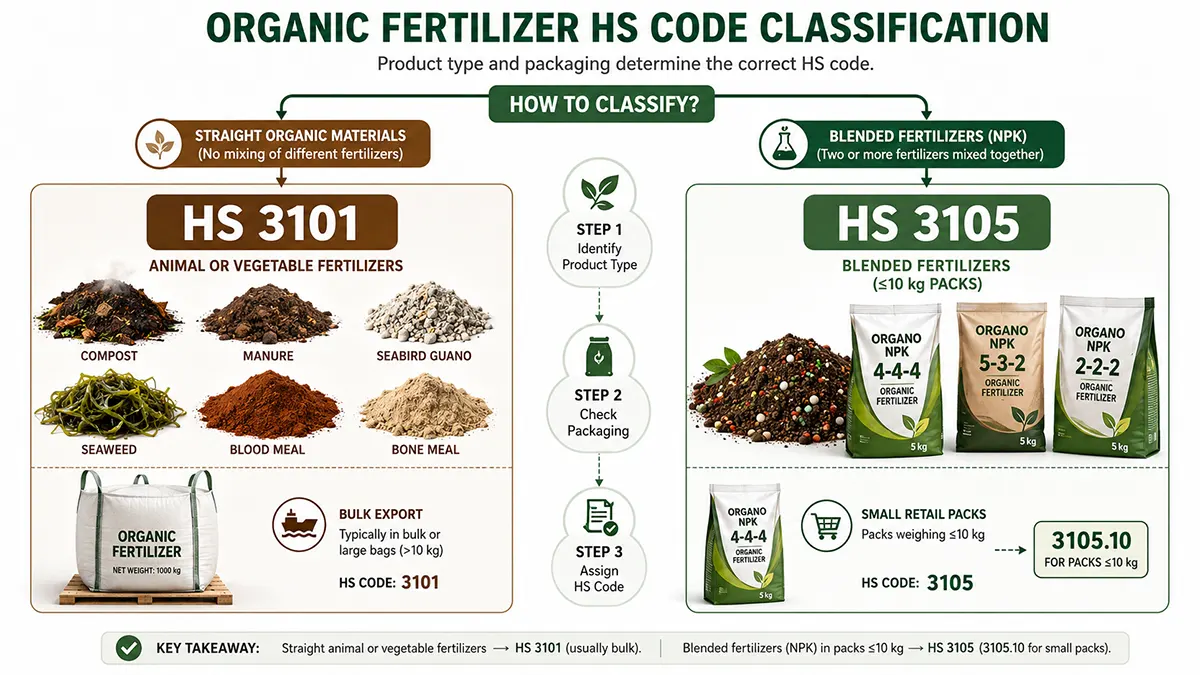
有机NPK复合肥通常归类为3105,而非3101。第3105项涵盖含有氮、磷、钾中任意两种或三种的肥料,以及“其他肥料”,此外还包括总重量为10公斤或以下的任何包装产品。 单一的纯有机物质仍归入3101;一旦进行混合以达到特定的氮-磷-钾比例,或采用小包装零售形式,则应归入3105。请通过进口国的关税表确认确切的子目。.
⚠️ 现场笔记: 生物刺激剂确实处于一个灰色地带。一些主管部门将其归类为第31章下的肥料;而另一些主管部门则在标签上标注的是植物刺激作用而非营养成分时,将其归入第3824项(未在其他地方列明的化学制品)。 切勿仅凭产品页面信息来确定分类。对于腐植酸、富里酸、氨基酸及生物刺激剂产品线,请在首次大批量订购前获取具有约束力的裁定——不同章节之间的关税差异不容小觑。.
真正用于清关的文件
即使申报文件不完整,只要商品编码正确,货物仍会被扣留。商品编码向海关说明了货物性质;相关文件则用于证明这一点,并满足该商品编码所对应的进口管制要求。以有机肥料为例,其申报文件比惰性工业产品更为繁琐,因为在多数市场中,植物和动物源性材料属于受管制商品。.
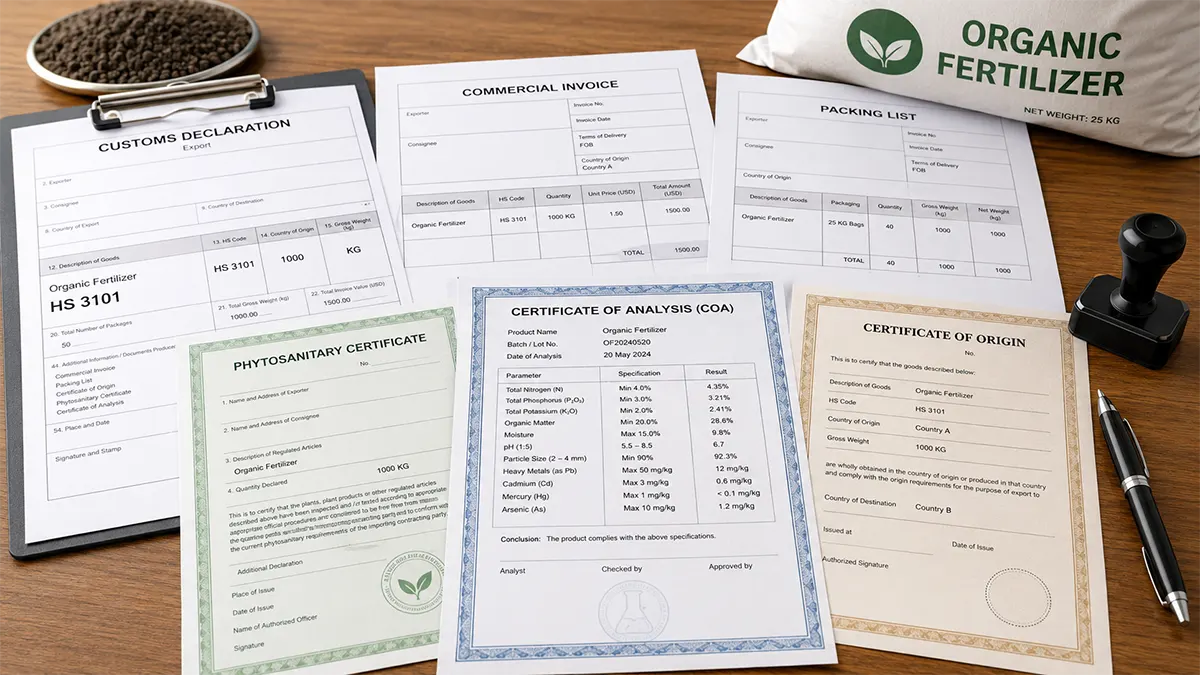
一套完整的有机肥料出口包装通常包括:
- 商业发票和装箱单——货值、重量及申报的HS编码。.
- 提单或空运单——运输合同及所有权凭证。.
- 原产地证书(A表或适用优惠待遇时的自贸协定证书)——用于确定关税税率。.
- 分析证书(COA)——声明中的成分必须与之相符。.
- 植物检疫证书——适用于植物或动物源性材料(见下文)。.
- 熏蒸证书——当木质包装或原产地有此要求时。.
- 有机认证(ECOCERT, CERES,, 或美国农业部国家有机计划(USDA NOP)——即买方将该产品作为有机产品销售的情况。.
- MSDS/SDS,以及在目的地国家或地区有要求的情况下,需提供进口许可证或肥料登记证。.
如果文件之间存在矛盾,或者与法规不符,那么即使文件资料齐全也不够。海关会通读整个文件,因此只要有一行内容与其他内容相矛盾,就会导致原本顺利的通关变成需要接受检查。以下这些不一致之处最常导致有机肥料货运受阻:
| 文档 | 应携带哪些物品 | 导致容器停滞的不匹配情况 |
|---|---|---|
| 商业发票 | 产品名称、申报的HS编码、数量、价值、原产地、国际贸易术语 | 没有等级的通用“有机肥料”——或者其质量证书(COA)未支持的HS编码 |
| 装箱单 | 袋子尺寸、净重/毛重、袋数、托盘及集装箱详情 | 申报为25公斤出口袋装,而标签或照片显示的是5公斤零售包装(触发3105.10税则) |
| COA | 批号、NPK、有机质、水分、pH值、重金属 | 显示的是配方型NPK混合肥,而发票上标注的却是3101单质肥料 |
| 原产地证书 | 出口商、原产地、发票编号、产品描述 | 产品名称与发票或提单上的名称不一致 |
| 有机/投入物证书 | 买方销售时所采用的确切SKU和标准 | 该证书涵盖的是另一个SKU或仅针对该公司,而非本产品 |
进口有机肥料需要植物检疫证书吗?
对于植物或动物源性肥料,通常是需要的。许多进口国主管部门将其视为受管制物品,要求提供由出口国植物保护组织签发的植物检疫证书,根据 IPPC框架. 该证书证明货物未携带受管制有害生物。这也是首次订购时最常被遗漏的文件——而其缺失绝非仅仅是文件上的小过失:根据许多海关部门适用的规定,未附有效植物检疫证书的货物可能会被退回或销毁,而不仅仅是被罚款。.
要求因目的地而异,且会发生变化。该 美国农业部动植物卫生检验局(APHIS)植物出口计划 此外,进口国自身的检疫规定会明确证书必须包含的内容——甚至细致到需列明生产和仓储设施的名称及其注册编号。请在货物订舱前(而非抵达后)确认目的地要求的确切措辞。.
更改后缀的区域规则——美国、欧盟、海湾合作委员会
品名是全球通用的;后缀和相关文件则因地而异。同一种3101.00有机肥料,根据集装箱的卸货地点不同,需符合三套不同的法规要求。.
- 美国:通过……将商品归入完整的十位数《协调关税表》(HTS)税则号 美国国际贸易委员会日程安排, ,并做好正式清关的准备——2025年“微量豁免”政策的收紧意味着,低价值包裹将不再像以往那样免于缴纳关税和提交相关文件。请向报关行或美国海关与边境保护局(CBP)确认当前的清关规定。.
- 欧盟:在《综合商品名称及编码》(可在TARIC中查询)中,该代码长达八位,作为有机产品销售的商品必须符合以下标签和监管规定: 欧盟法规(EU)2018/848. 基于提取物的输入物质也可能引发与REACH相关的问题。.
- 海湾合作委员会(GCC)国家:部分成员国的国家代码超过8位,且具体后缀因国家而异。请勿直接采用第三方网站提供的GCC号码——应向该特定市场的进口商代理确认当前有效的代码。.
这些后缀都不值得死记硬背,因为税率和子目都会进行修订。真正值得培养的是这种习惯:先确认六位数的税目代码,然后在发货时核对国家代码和文件清单。.
预订集装箱之前
- 按六位数商品编码进行分类——纯有机物料归类为3101,NPK混合肥或≤10公斤装产品归类为3105——然后由进口商的报关行确认国家后缀。.
- 对于任何植物或动物源性产品,在目的地规定未作其他说明之前,均应假定需要提供植物检疫证书。.
- 将申报的成分与分析证书(COA)相核对。申报内容与分析证书不符,将导致在检验时被重新分类。.
- 对于“灰色地带”的进口商品——生物刺激剂、腐植酸、富里酸和氨基酸——请在首次大批量订购前获取具有约束力的裁定。.
然后将其转化为供应商指导说明。将这些内容粘贴到您的询价单中,以便在生产前就完成文件编制——而不是在集装箱预订后仓促拼凑。这些内容应与完整的 供应商尽职调查检查表:
- 请根据产品成分和用途,说明拟定的六位数HS编码及其依据。.
- 请发送最新一批的合格证书(COA)和产品规格书,以便我们的经纪人确认商品分类。.
- 确认每袋或每箱的净重和毛重——小包装可能需归入3105.10项下。.
- 请列出您能为该产品及目的地提供的所有出口文件,包括适用的植物检疫证书、熏蒸证书和有机认证证书。.
- 请确认有机或投入品证书是否涵盖了报价中涉及的具体SKU。.
常见问题
有机肥的HS编码是什么?
动物或植物来源的未加工或堆肥有机肥料归入HS第3101章,子目3101.00。 其中包括用作肥料的粪肥、堆肥、鸟粪、海藻、血粉和骨粉。混合型NPK产品以及10公斤及以下的包装产品归入3105。最终的8至10位国家代码由进口国确定。.
堆肥与NPK肥的HS编码是否相同?
不。堆肥和其他单一有机物料归入3101;而含有氮、磷、钾中任意两种或三种元素的复合肥料则归入3105。区分标准在于该产品是单一有机物料还是经过配制的混合物。 小包装零售产品(毛重10公斤或以下)也会使该产品归入3105类,无论其成分如何。.
中国供应商应提供哪些文件用于清关?
至少需提供:商业发票、装箱单、提单、原产地证书和分析证书,此外,若货物为植物或动物源性材料,还需提供植物检疫证书。若买方将产品作为有机产品销售,则需补充有机认证证书和材料安全数据表(MSDS)。部分目的地还要求提供进口许可证或肥料登记证。 请在询价单(RFQ)中要求提供全套文件,以便在发货前准备就绪。.
有机肥料需要植物检疫证书吗?
通常情况下,植物或动物源性肥料需要。大多数进口国主管部门将其视为受管制物品,要求提供出口国植物保护部门出具的植物检疫证书。 缺少该证书风险极高:货物可能会被退回或销毁,而不仅仅是被罚款。在预订集装箱之前,请确认目的地要求证书的具体措辞。.
如何确认我所在国家的确切10位代码?
从六位数的税则号(3101 或 3105)开始,然后在您所在国家的关税表中查找相应的国家子税则号——美国为 USITC HTS,欧盟为 TARIC。 为确保万无一失,请向进口地海关当局申请具有约束力的关税裁定。如果日后海关官员对商品分类提出异议,该书面裁定将为您提供保障。.
下一步:请提供产品信息、成分及目的地国家,我们将返回六位数的商品编码、针对该市场的文件清单草案,以及 包含出口单据的报价单. 如果您想先看看格式,, 下载出口文件核对表 并将其与您上次发货的记录进行核对。.
— Rutom Bio. 技术供应
关于本指南
由 Rutom Bio. Technical Supply 审核。Rutom Bio. 生产并出口有机肥料原料,并为每笔订单准备出口文件套件。 本指南旨在提供商品分类和采购指导,并非海关或法律建议:最终的HS编码由进口国海关当局决定,并通过具有约束力的关税裁定予以确认,且文件要求会因目的地和时间而异。下文所列的关税和植物检疫参考资料均来自公开来源,供买家核实各项内容。 最后更新日期:2026-07-07。.
参考文献与来源
- 美国国际贸易委员会(USITC)—— 《美国协调关税表》 (第31章,肥料)
- 世界海关组织 — 《协调制度》商品名称
- 美国农业部动植物卫生检验局(USDA APHIS)—— 植物及植物产品出口认证
- 粮农组织/国际植物保护公约 — 植物检疫证书的要求
- 欧盟法规(EU)2018/848 关于有机生产和标签
- 美国海关与边境保护局 — 进口到美国




 English
  Spanish
  French
  Japanese
  Korean
  German
  Portuguese
  Italian
  Indonesian
  Vietnamese
  Turkish
  Persian
  Russian
  Chinese