
table des matières
- Le cacao est une culture qui a besoin de beaucoup de potassium et qui est sensible au cadmium
- La chaîne du cadmium : pourquoi la source de phosphate détermine l'accès au marché
- La nutrition fait partie intégrante de votre stratégie de protection contre la pourriture noire et la sécheresse
- Pourquoi la matière organique a toute sa place dans les sols cacaoyers
- Avant de passer commande : les contrôles spécifiques au cacao
- Les éléments à ne pas négliger dans un programme consacré au cacao
- Questions fréquemment posées
- Quelle quantité de potassium une culture de cacao absorbe-t-elle par saison ?
- Quelle source de phosphate présente le moins de risques liés au cadmium pour le cacao ?
- Une fertilisation excessive en potassium peut-elle entraîner une carence en magnésium chez le cacaoyer ?
- La nutrition permet-elle réellement de réduire les pertes dues à la pourriture noire ?
- About this guide
- Références et sources
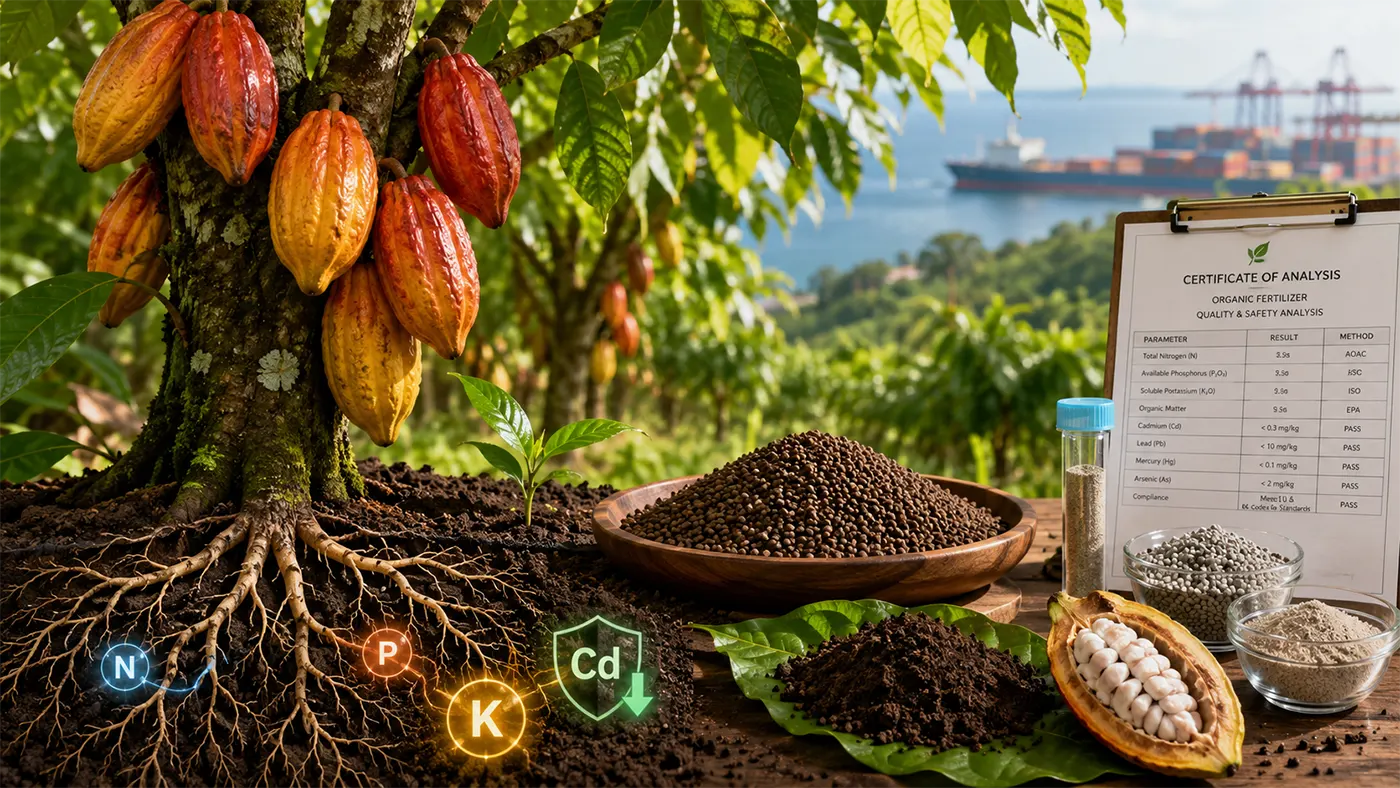
À chaque récolte, les cabosses de cacao emportent une quantité considérable de potassium hors des champs, et ces mêmes arbres poussent souvent sur des sols comptant parmi les plus riches en cadmium des régions tropicales. Si vous choisissez le mauvais phosphate pour remédier à un problème de rendement, vous risquez de créer insidieusement un problème d’accès au marché : l’UE fixe des limites maximales de cadmium dans le chocolat fini, et tout dépassement important de cette limite entraîne la perte du marché alors que la récolte est déjà effectuée.
Ce guide présente les besoins nutritionnels du cacaoyer à chaque stade de sa croissance, identifie la décision essentielle pour préserver l’accès au marché européen et indique quels intrants biologiques répondent à ces besoins à chaque période. Il s’adresse aux producteurs, aux gestionnaires de plantations et aux importateurs qui s’approvisionnent en engrais pour le cacaoyer en grande quantité — et non pas aux amateurs de plantes d’intérieur.
En bref
| Nutriment principal | Le potassium : favorise le remplissage des gousses, le poids des haricots et la tolérance à la gousse noire et à la sécheresse |
|---|---|
| Nutriment à surveiller | Magnésium — un apport important en potassium le inhibe (la courbe K:Mg) |
| Risque lié à la conformité commerciale | Cadmium provenant des sources de phosphate — L’UE fixe des limites maximales pour le cadmium dans le cacao et le chocolat |
| Cible au sol | Profond, bien drainé, pH compris entre environ 6,0 et 7,0 |
| La plus grande source gratuite de K | Coques de cosses vides |
Le cacao est une culture qui a besoin de beaucoup de potassium et qui est sensible au cadmium
Deux éléments déterminent tout choix d'engrais pour le cacaoyer : cette culture est très gourmande en potassium, et les fèves de cacao absorbent le cadmium plus facilement que presque toutes les autres cultures commerciales.
- Le potassium (K) — le nutriment phare. Il favorise le remplissage des gousses, le poids des haricots et la résistance à la pourriture noire des gousses et à la sécheresse. À chaque récolte, les gousses évacuent de grandes quantités de potassium.
- Azote (N) — contribue à la formation de la couronne et de la ramification en jorquette qui caractérisent un arbre productif ; les besoins sont les plus importants pendant la phase d'établissement et les années de croissance végétative.
- Le phosphore (P) — qui joue un rôle essentiel dans l'enracinement et la formation des gousses à partir des fleurs — est nécessaire en plus petite quantité que le potassium (K), mais la source a son importance en ce qui concerne le cadmium.
- Magnésium (Mg) — facilement sujet à une carence en cas d'apport excessif en potassium. L'équilibre K:Mg est un véritable enjeu de gestion pour le cacao, et non une simple note de bas de page.
- Le zinc et le bore — deux éléments essentiels à la floraison et à la formation des cabosses ; des carences fréquentes dans les cultures de cacao d'Afrique de l'Ouest et d'Asie du Sud-Est.
Le cacao se développe mieux dans des sols profonds et bien drainés, dont le pH est compris entre légèrement acide et quasi neutre, soit environ 6,0 à 7,0. Le fait de réincorporer les coques vides permet de recycler une grande partie du potassium prélevé par la culture — un élément qu’il convient de préserver dans tout programme d’engrais, car cela réduit la quantité de potassium que vous devez acheter.
Quel est le meilleur rapport NPK pour les cacaoyers ?
Il n’existe pas de ratio unique valable toute l’année. Apportez de l’azote pendant la phase d’implantation et la phase de croissance végétative, augmentez les apports en phosphore au moment de la floraison, puis passez à un mélange à dominante potassique jusqu’à la phase de remplissage des gousses. Le nutriment dont l’apport est le plus souvent insuffisant lors du remplissage est le potassium — et c’est précisément à ce stade que se déterminent le poids des haricots et votre prix de vente. Surveillez les apports en magnésium, car un excès de potassium peut en limiter l’absorption.
Adapter les moyens mis en œuvre au stade de croissance
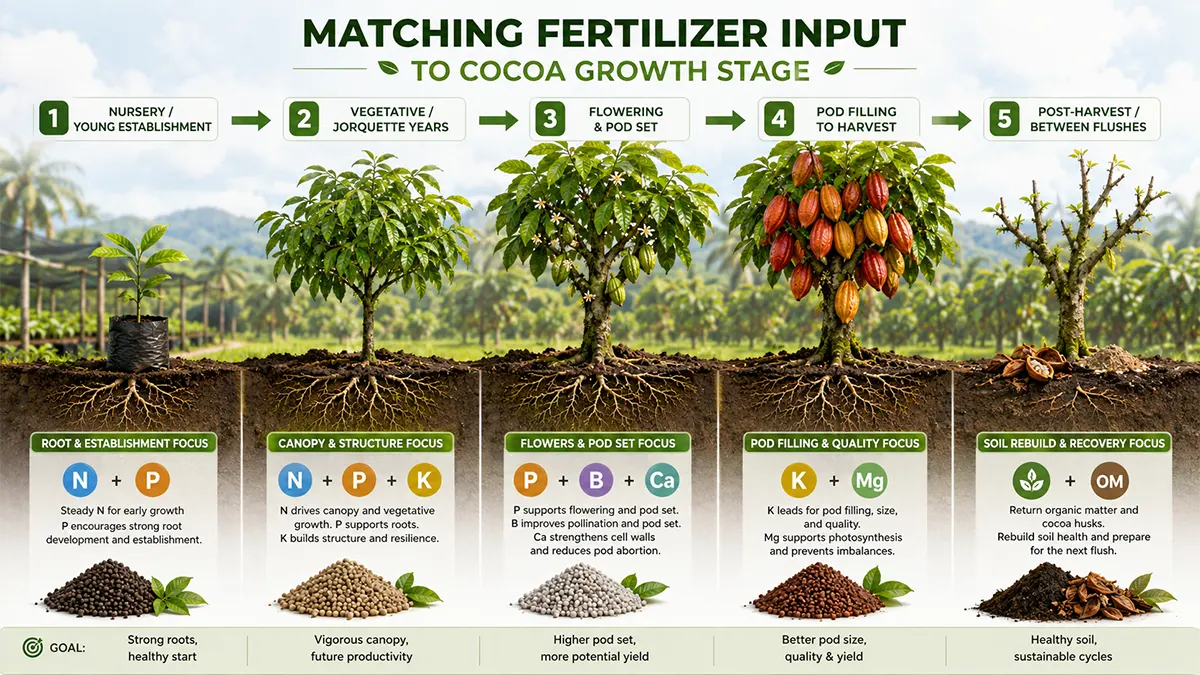
La demande en azote du cacaoyer varie considérablement entre la phase de mise en place et la phase de pleine production. Un mélange uniforme appliqué à chaque cycle entraîne un excès d’azote au début et un déficit en potassium au moment du remplissage des cabosses.
Tableau des besoins alimentaires du cacaoyer — par stade de croissance
| Phase de croissance | Priorité en matière de nutriments | Le rôle des intrants biologiques |
|---|---|---|
| Pépinière / jeune plantation | P + N constant, masse racinaire | Substrat granulaire composté + guano riche en phosphore ; acide humique pour favoriser le développement racinaire à l'ombre |
| Années de croissance végétative / jorquette | N-led, avec K | Granulés organiques riches en azote ; application foliaire d'acides aminés pour stimuler la croissance de la structure |
| Floraison et formation des gousses | P, ainsi que du bore et du calcium | Oiseau marin à forte teneur en phosphore Le guano et l'apport en B et Ca ont permis de limiter les pertes dues au flétrissement de Cherelle |
| Remplissage des cosses jusqu'à la récolte | K-led, regarder Mg | Mélange organique à très forte teneur en potassium ; magnésium pour maintenir l'équilibre K:Mg |
| Après la récolte / entre deux poussées | Équilibré + matière organique | Restaurer le carbone du sol ; incorporer les cosses de gousses récupérées |
⚠ Note de terrain. L’erreur la plus fréquente observée dans les cultures de cacao des petits exploitants est une fertilisation trop riche en azote, qui provoque un feuillage luxuriant mais n’apporte que peu de rendement supplémentaire, tandis que le potassium — l’élément nutritif qui limite réellement le remplissage des cabosses — n’est jamais apporté. Un feuillage luxuriant ne rapporte rien ; ce sont les cabosses bien remplies qui rapportent.
La chaîne du cadmium : pourquoi la source de phosphate détermine l'accès au marché
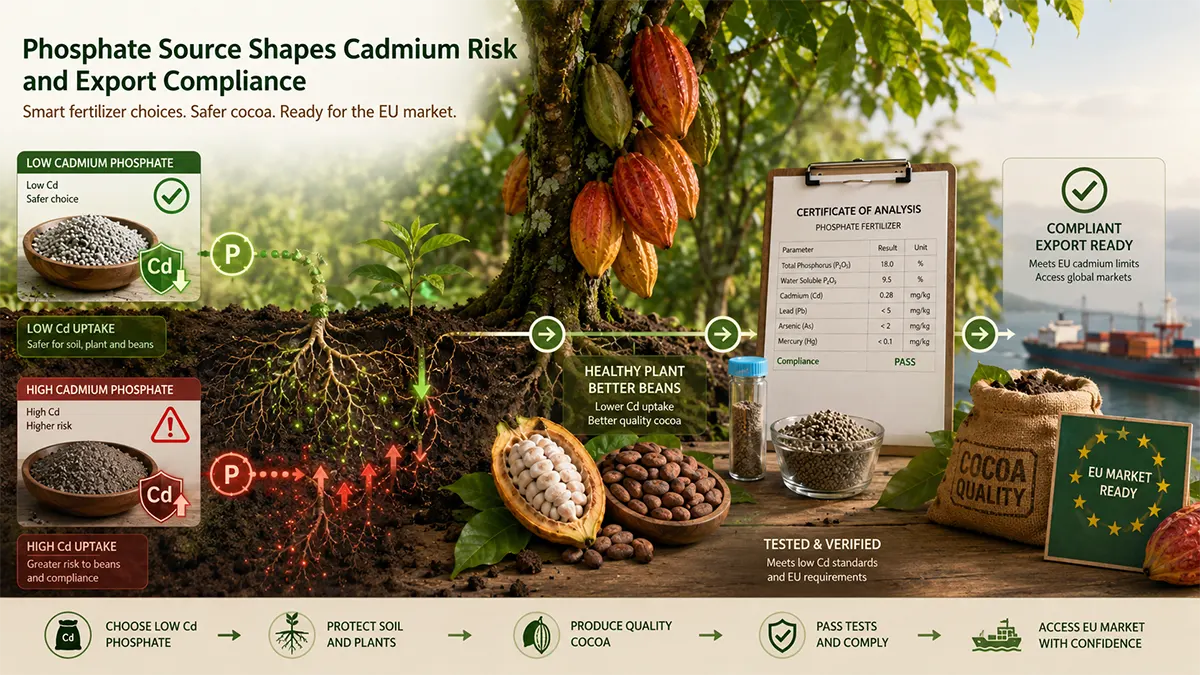
Voici un extrait d’une brochure sur un programme consacré au cacao. Le cadmium s’accumule dans les fèves de cacao, et l’UE a fixé des teneurs maximales en cadmium pour les produits à base de cacao et de chocolat en vertu du règlement (UE) n° 488/2014 de la Commission, en vigueur depuis janvier 2019. Les lots dépassant ces limites sont exclus du marché européen — une fois la récolte effectuée. L’engrais est l’un des facteurs contrôlables dans cette équation.
La règle de décision : en ce qui concerne le cacao, le choix de la source de phosphate relève d'une décision liée au respect des règles commerciales, et pas seulement d'une décision agronomique.
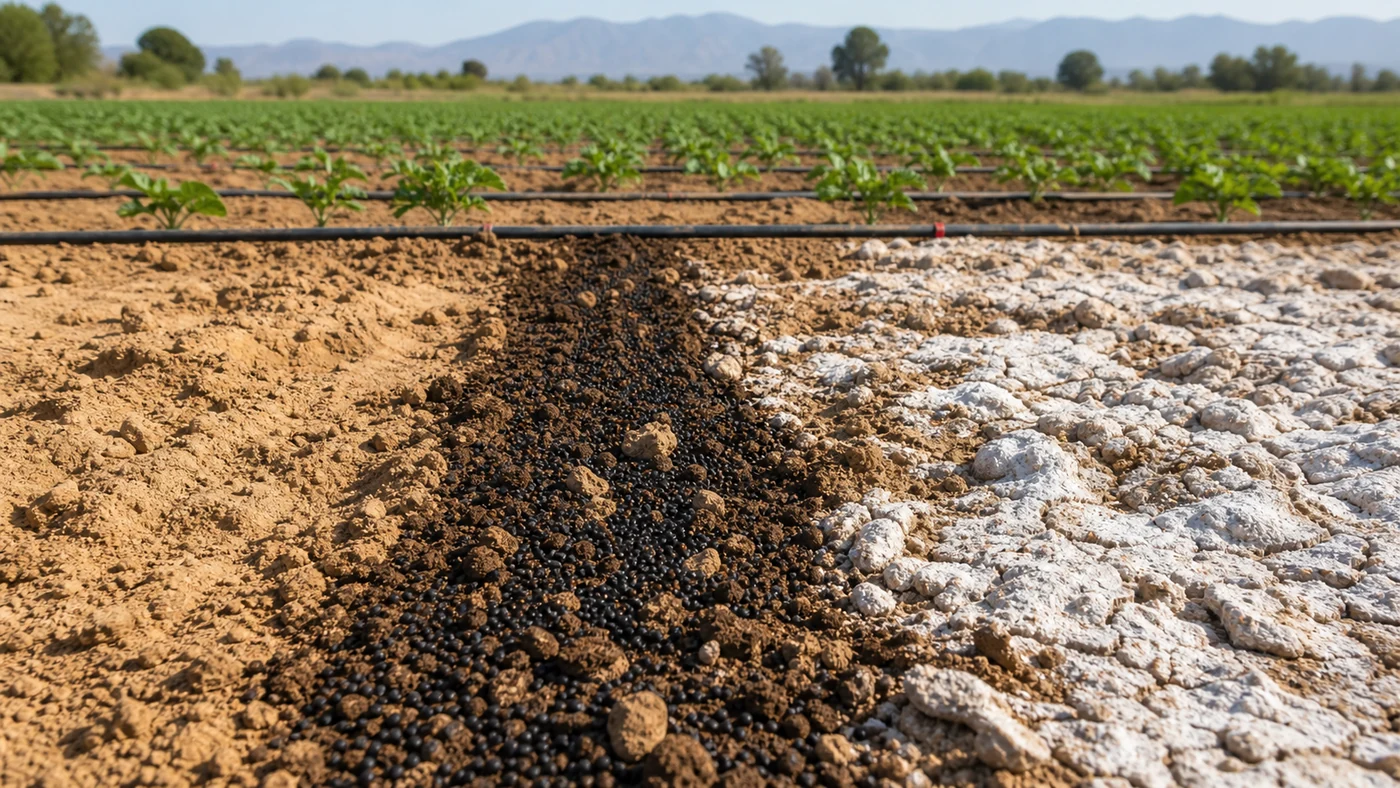
- Les apports en phosphate constituent la principale voie d'introduction du cadmium dans un système ; le phosphate naturel et le guano de qualité inférieure peuvent contenir des quantités importantes de Cd.
- Le règlement (UE) 2019/1009 fixe une limite maximale pour la teneur en cadmium des engrais phosphatés commercialisés dans l'UE — une référence utile à laquelle comparer tout apport en phosphore, quel que soit le lieu où vous exercez votre activité agricole.
- Sur les sols naturellement riches en cadmium — notamment dans certaines régions de l'Équateur, du Pérou et d'autres pays d'Amérique latine —, chaque milligramme de Cd ajouté au sol a son importance ; c'est pourquoi l'utilisation d'une source de phosphate à faible teneur en Cd est indispensable.
- Demandez un résultat concernant la teneur en cadmium par lot pour chaque expédition de phosphate et conservez le certificat avec le dossier d'exportation. Vous ne savez pas exactement quelles autres informations ce certificat doit contenir ? Voici Comment vérifier la teneur en cadmium sur le certificat d'analyse (COA) de chaque lot aux côtés des autres lignes.
Nous n'approuverions pas l'utilisation de guano ou de phosphate naturel pour une parcelle de cacao sans une valeur actuelle de cadmium (Cd) par lot indiquée sur le certificat d'analyse.
Les engrais ont-ils une incidence sur la teneur en cadmium des fèves de cacao ?
Oui. Les engrais phosphatés constituent l’une des principales voies par lesquelles le cadmium pénètre dans la chaîne « du sol à la fève ». L’Union européenne ayant fixé des limites maximales de teneur en cadmium dans le cacao et le chocolat (règlement (UE) n° 488/2014, applicable depuis 2019), l’utilisation d’une source de phosphate à faible teneur en cadmium et la réalisation d’un test de détection du cadmium par lot sont indispensables pour respecter ces limites, en particulier sur les sols d’Amérique latine qui présentent naturellement une teneur élevée en cadmium.
La nutrition fait partie intégrante de votre stratégie de protection contre les Black Pod et la sécheresse
Les engrais ne permettent pas de guérir la pourriture noire des cabosses, mais un arbre présentant des carences subit des pertes de récolte plus importantes à cause de cette maladie. Le potassium et le calcium renforcent la résistance des cabosses et des parois cellulaires, ce qui aide le cacaoyer à mieux résister à la pression du Phytophthora et aux périodes de sécheresse.
- Le potassium favorise la régulation hydrique et est régulièrement associé à une meilleure résistance à la pourriture noire et à la sécheresse, deux des principaux risques pesant sur les rendements du cacao en Afrique de l'Ouest et en Asie du Sud-Est.
- Le calcium renforce la structure des gousses et des parois cellulaires, ce qui explique en partie pourquoi l'apport en calcium pendant la phase de floraison est si important.
- Les carences en bore aggravent le flétrissement de la cherelle et nuisent à la formation des gousses ; l'apport en oligo-éléments est donc un facteur déterminant pour le rendement, et non une simple touche finale.
Dans les parcelles touchées par la maladie chronique des gousses noires, nous prenons en compte l'apport en potassium et en calcium dans le cadre de la gestion de la maladie. Cela ne remplace pas les mesures phytosanitaires — élimination des gousses infectées, amélioration de la circulation de l'air — mais les arbres mal nourris cèdent davantage de terrain face à la même pression.
Pourquoi la matière organique a toute sa place dans les sols cacaoyers
Le cacao est cultivé à l'ombre, dans des environnements chauds, humides et fortement lessivés où les nutriments solubles ne restent pas en place. L'argument en faveur de l'agriculture biologique repose ici spécifiquement sur le mode de culture du cacao, et non sur un discours général concernant la santé des sols.
- Les cosses de gousses recyclées constituent la base du système. Elles réintègrent dans le bloc le principal élément nutritif exporté — le potassium —, et une base organique le retient en place, empêchant ainsi la prochaine averse de l'emporter loin des racines.
- Le système d'ombrage et de litière est autosuffisant. Le carbone présent dans le sol sous le couvert forestier du cacaoyer favorise l'activité microbienne qui libère le phosphore fixé dans les sols acides, en interaction avec la litière de feuilles déjà tombées par le cacaoyer.
- Une libération progressive correspond à une longue saison de production des gousses. Le cacao remplit les gousses au fil des mois ; une base biologique à libération progressive répartit l'apport sur toute cette période, plutôt que de fournir une dose unique qui s'épuise rapidement.
Sur un sol lessivé, nous préférons répartir un engrais organique à libération lente tout au long de la saison plutôt que d’appliquer une seule dose d’engrais soluble avant qu’un orage n’en emporte la majeure partie loin des racines. Une analyse du sol et des feuilles permet tout de même de déterminer les doses à appliquer.
Créer un programme Cocoa à partir de sources brutes
On met en place un programme de culture du cacao ; on ne se contente pas d'acheter un seul sac. Les intrants s'intègrent tout au long de la saison, chacun étant choisi tant pour son profil de résidus que pour ses analyses.
L'origine détermine la composition de l'apport. Le cacao d'Afrique de l'Ouest, cultivé sur des sols anciens et lessivés, nécessite généralement de reconstituer les couches de potassium et de magnésium ; le cacao d'Amérique latine, cultivé sur des sols à forte teneur en cadmium, exige une gestion très rigoureuse des sources de phosphate. Mettez en place une base organique et ajustez les couches de potassium, de magnésium et de phosphate en fonction de l'origine et des résultats de vos propres analyses foliaires.
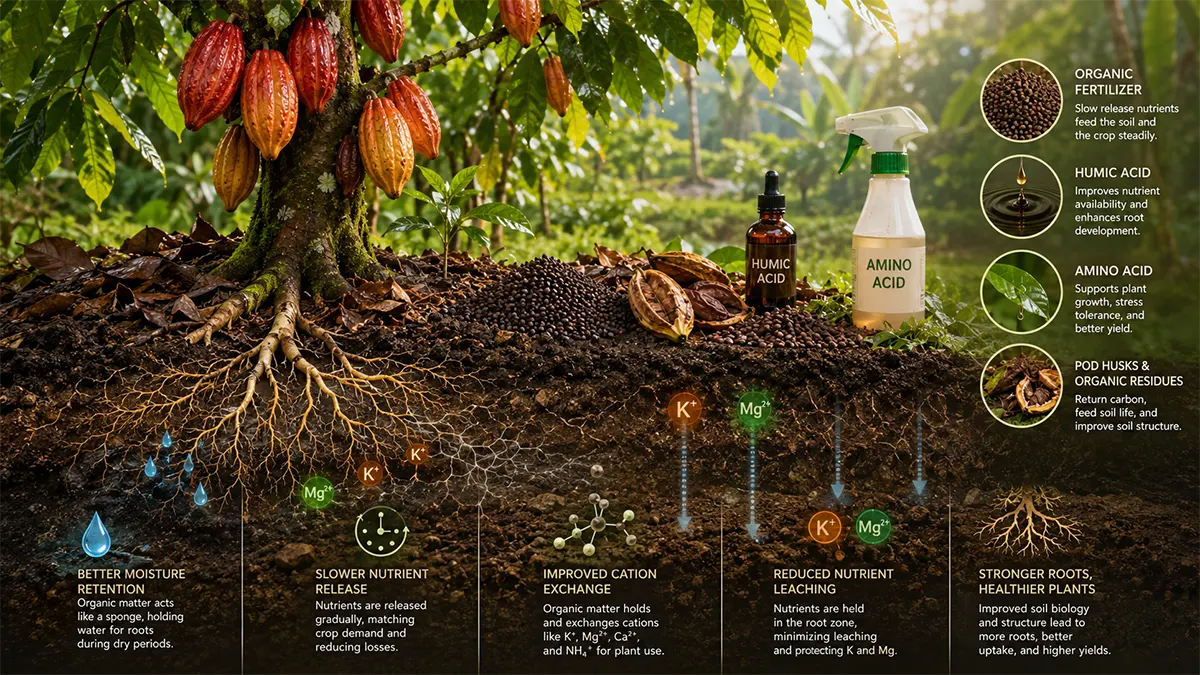
| Intrants biologiques | Rôle dans un programme consacré au cacao | CConfirmer sur le COA |
|---|---|---|
| Guano d'oiseaux marins à forte teneur en phosphore | Apport de phosphore et de calcium par cosses | Teneur garantie en P₂O₅ et teneur en Cd par lot ; champ d'application de la certification — à vérifier par rapport à la fiche technique en vigueur |
| Liquide à base d'acides aminés | Apport rapide d'azote foliaire et récupération rapide après un épisode de stress lors de la poussée de croissance | Teneur garantie en N % et mode d'emploi pour l'application foliaire et la fertirrigation — conformément à la fiche technique en vigueur |
| Acide humique | Développement racinaire et rétention des nutriments sur les sols lessivés | Humiques/fulviques % |
| Base NPK organique granulée | Structure à libération prolongée ; la couche K pour le remplissage des gousses | Teneur garantie en N-P-K + matière organique %, une variété à forte teneur en K, teneur déclarée en Cd |
L'emplacement est tout aussi important que le produit. Les racines du cacaoyer sont peu profondes et concentrées près de la surface ; il faut donc épandre l'engrais en bandes dans la zone racinaire et répartir les apports en fonction des pluies — un épandage à la volée sur l'ensemble de la parcelle entraîne un ruissellement et un lessivage importants.
Avant de passer commande : les contrôles spécifiques au cacao
Les règles générales du COA — composition garantie avec unités de mesure, limites d'humidité, champ d'application de la certification, conditions commerciales — s'appliquent à tous les intrants et sont détaillées dans notre engrais organique guide d'approvisionnement. En ce qui concerne le cacao, trois critères s'ajoutent à ces exigences de base et sont non négociables :
- Teneur en cadmium par lot, indiquée par écrit — ainsi que pour le plomb (Pb), l'arsenic (As) et le mercure (Hg). C'est cette mesure qui garantit la qualité des exportations de cacao ; il faut inscrire la limite de cadmium dans le cahier des charges d'achat et exiger le certificat avant l'embarquement du conteneur.
- Champ d'application de la certification pour la référence exacte : vérifiez que le produit en question figure bien dans la liste de votre organisme de certification (ECOCERT, CERES, ou une homologation OMRI conforme aux normes UE 2018/848 / NOP / JAS), et pas seulement le fait que l'entreprise soit certifiée.
- Granulométrie adaptée à la méthode : poudre de l'ordre du micron pour l'application foliaire et l'irrigation goutte-à-goutte, granulés de 2 à 4 mm pour une application au sol ; une granulométrie inadaptée obstrue le système de fertirrigation et entraîne un gaspillage de produit.
Un acheteur qui considère le cadmium comme un problème relevant du fournisseur en hérite dès son arrivée au port d'importation.
Les éléments à ne pas négliger dans un programme sur le cacao
- Privilégiez l'apport en potassium pendant la phase de remplissage des cabosses, et surveillez l'équilibre K/Mg : un excès de potassium peut entraîner une carence en magnésium.
- Considérez la source de phosphate comme un critère de conformité commerciale : exigez un résultat concernant la teneur en cadmium par lot, conformément à la référence fixée par le règlement (UE) 2019/1009.
- N'oubliez pas la limite applicable au produit fini : l'UE fixe une limite maximale pour la teneur en cadmium dans le cacao et le chocolat en vertu du règlement (UE) n° 488/2014 ; les lots dépassant cette limite ne peuvent pas être commercialisés.
- Recyclez les coques de fèves et préparez un sol riche en matière organique pour retenir le potassium et le magnésium et éviter leur lessivage sur les sols chauds et humides des plantations de cacao.
- Vérifiez que chaque intrant figure bien dans la liste de votre organisme de certification et qu'il est conforme aux normes UE 2018/848, NOP ou JAS — l'agrément s'applique par produit et non par entreprise.
Questions fréquemment posées
Quelle quantité de potassium une culture de cacao absorbe-t-elle par saison ?
Le cacao figure parmi les cultures arboricoles qui exportent le plus de potassium, la majeure partie de celui-ci quittant le champ chaque saison sous forme de cabosses récoltées. Le fait de réintroduire les coques vides permet de recycler une grande partie de ce potassium ; c’est pourquoi la gestion des coques et un programme d’engrais axé sur le potassium sont généralement planifiés conjointement plutôt que séparément.
Quelle source de phosphate présente le moins de risques liés au cadmium pour le cacao ?
Il n’existe pas de source universellement “ sûre ” : il s’agit d’un résultat propre à chaque lot, et non d’une catégorie. Le phosphate naturel et le guano de qualité inférieure peuvent contenir des teneurs importantes en cadmium ; par conséquent, la seule réponse fiable est un certificat Cd récent, établi lot par lot pour le produit concerné, et conforme aux critères du règlement (UE) 2019/1009, en particulier pour les sols d’Amérique latine à forte teneur en cadmium.
Une fertilisation excessive en potassium peut-elle entraîner une carence en magnésium chez le cacaoyer ?
Oui. Le potassium et le magnésium sont en concurrence pour l'absorption ; ainsi, un programme de fertilisation axé sur le potassium peut entraîner une carence en magnésium si ce dernier n'est pas apporté en parallèle. Sur le cacaoyer, cela se traduit par un jaunissement internervaire des feuilles les plus âgées ; il convient donc de maintenir l'équilibre K:Mg en apportant du magnésium plutôt qu'en augmentant uniquement la teneur en potassium.
La nutrition permet-elle réellement de réduire les pertes dues à la pourriture noire ?
Cela ne guérit pas la pourriture noire des gousses, mais cela permet de limiter les pertes qu’elle entraîne. Le potassium et le calcium renforcent la résistance des gousses et des parois cellulaires ; ainsi, un arbre bien nourri et équilibré conserve une plus grande partie de sa récolte face à la pression exercée par le Phytophthora. La nutrition vient en complément des mesures phytosanitaires — élimination des gousses et aération — et ne les remplace pas.
Vous recherchez des intrants biologiques pour un bloc de cacao cette saison ? Indiquez-nous vos valeurs cibles en NPK, vos exigences en matière de certification et la teneur maximale en cadmium, et notre service vous fournira un certificat d'analyse (COA) par lot ainsi qu'un échantillon correspondant à la phase de production — demander un devis.
À propos de ce guide
Révisé par le service d'approvisionnement biotechnique de Rutom — approvisionnement en intrants biologiques et contrôle qualité. Dernière mise à jour : 10 juin 2026. Ce guide présente le point de vue des exportateurs et des acheteurs sur la fertilisation du cacao ; les doses agronomiques définitives doivent être déterminées à partir de vos propres analyses de sol et de feuilles, et l'acceptation de la certification relève de la compétence de votre organisme de certification.
Références et sources
Règlement (UE) n° 488/2014 de la Commission — teneurs maximales en cadmium dans le cacao et le chocolat
Règlement (UE) 2019/1009 — Règlement sur les produits fertilisants ; limites pour le cadmium
Règlement (UE) 2018/848 — production biologique et étiquetage
Programme national de l'agriculture biologique de l'USDA, 7 CFR, partie 205
OMRI — Institut d'évaluation des matériaux organiques
A propos de l'auteur : Rutom




 English
  Spanish
  French
  Japanese
  Korean
  German
  Portuguese
  Italian
  Indonesian
  Vietnamese
  Turkish
  Persian
  Russian
  Chinese