
table des matières
Mise à jour en juillet 2026.
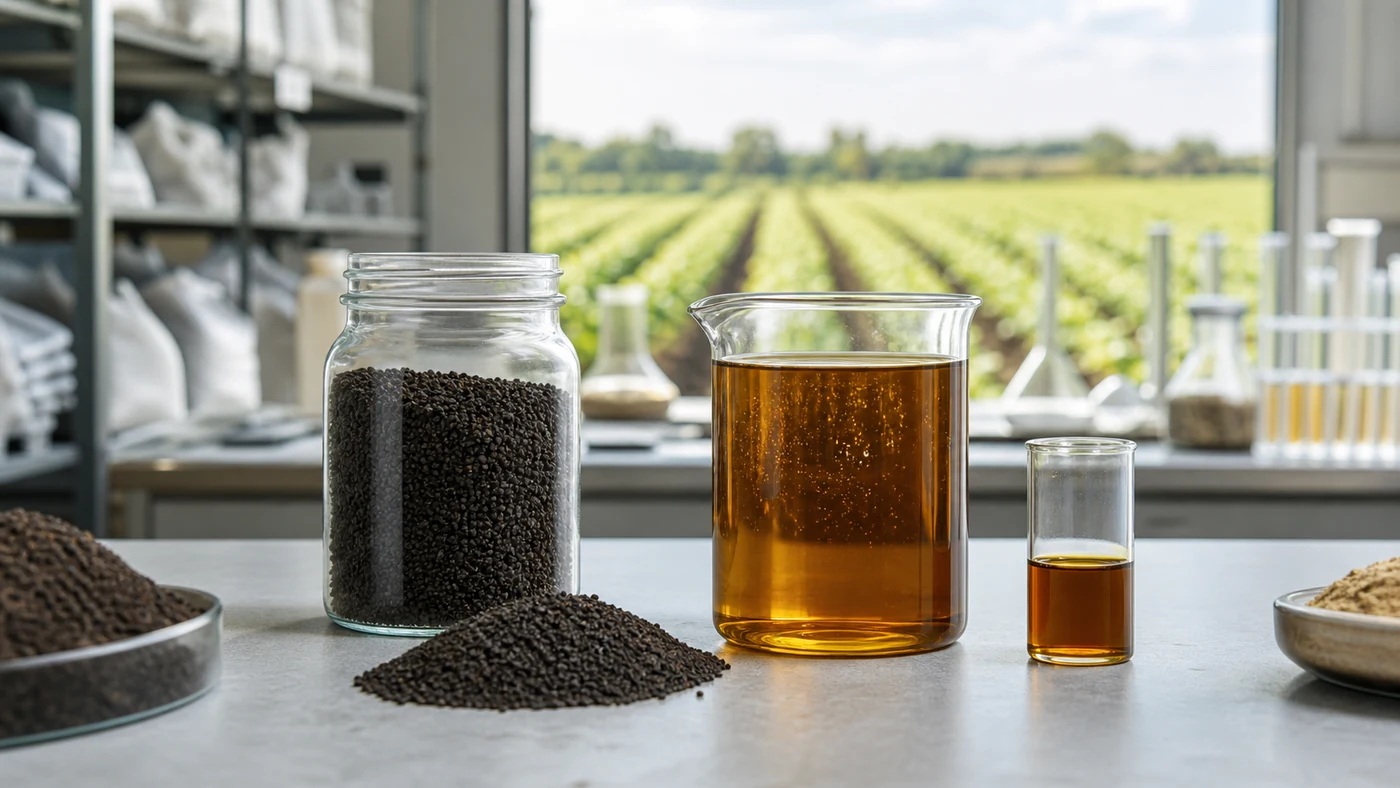
La plupart des acheteurs considèrent cela comme une question de qualité : lequel est le meilleur, l’humique ou le fulvique ? Ce n’est pas la bonne question. Les deux proviennent de la même roche et figurent l’un à côté de l’autre sur la liste des prix, mais ce sont deux fractions différentes qui remplissent deux fonctions distinctes. L'humique agit sur le sol. Le fulvique agit à l'intérieur de la plante. La vraie question n'est donc pas de savoir lequel est le meilleur, mais de déterminer ce dont votre sol ou votre culture manque actuellement : de structure ou de rapidité. Si vous commandez la mauvaise fraction, le problème n'est pas une question de qualité. Vous avez simplement acheté le mauvais outil.
Ce guide vous aide à faire la distinction entre les différents produits, à déterminer quand utiliser chacun d'entre eux, comment les appliquer et les associer, ainsi que la qualité à privilégier pour les achats en gros. Les doses recommandées pour chaque culture sont disponibles sur nos pages associées. Ici, l'essentiel est de faire le bon choix.
Acide humique ou acide fulvique : la réponse en bref
Ces deux éléments sont des fractions de substances humiques, et une caractéristique physique les distingue l'un de l'autre : taille des molécules. Les composés humiques ont un poids moléculaire élevé — leurs valeurs varient entre environ 10 000 et 100 000 daltons, bien qu’elles puissent varier en fonction de la source et de la méthode d’analyse. Les composés fulviques représentent une fraction de cette valeur, allant d’environ un millier à quelques milliers. Tout le reste se situe entre ces deux extrêmes. La fraction de grande taille ne peut pas rester en solution ; elle reste donc dans le sol, fixe les cations et renforce la structure au fil des saisons. La fraction de petite taille se dissout quel que soit le pH et pénètre directement dans la plante, en entraînant les nutriments avec elle.
Pour un acheteur, cette distinction n'est pas purement théorique : elle se répercute directement sur la qualité et la forme, ce qui est précisément le sujet sur lequel porte ce guide.
| Propriété | Acide humique | Acide fulvique |
|---|---|---|
| Taille moléculaire | Polymères de grande taille et complexes (environ 10 000 à 100 000 Da) | Petites molécules (environ 1 000 à 10 000 Da) |
| Solubilité | Soluble dans les alcalis, précipite en milieu acide | Soluble à tous les pH |
| Couleur en solution | Du marron foncé au noir | Jaune à ambre clair |
| Où cela fonctionne | Dans le sol (structure, CEC) | Dans la plante (absorption au niveau cellulaire) |
| Emploi principal | Améliore la qualité du sol, retient l'eau et les nutriments | Transporte les nutriments, chélate les oligo-éléments |
| Vitesse | Des semaines qui s'enchaînent au fil des saisons | Jours, réponse rapide |
| Meilleure livraison | Incorporation au sol ou arrosage | Application foliaire ou fertigation |
Que sont les substances humiques ?
Commencez par clarifier la généalogie ; cela élimine la plupart des confusions liées aux étiquettes avant même que vous n’ayez lu la moindre citation. Les substances humiques et fulviques ne sont pas deux produits chimiques issus de deux chaînes de production distinctes. Ce sont deux fractions d’une même substance : les substances humiques, cette matière organique sombre et stable qui subsiste après la décomposition des plantes et des micro-organismes au cours des époques géologiques. Ce qui les distingue, ce n’est pas un niveau de gamme, mais un seul test en laboratoire. Il suffit de modifier le pH d’un extrait, d’observer ce qui reste dissous et ce qui précipite, pour que les fractions se définissent d’elles-mêmes. Le marketing n’a pas son mot à dire ici.
Effectuez ce test et trois fractions se précipitent. Acidifiez l’extrait et l’acide humique se précipite hors de la solution — c’est sa signature. L’acide fulvique, lui, ne bouge pas ; il reste dissous sur toute la plage de pH, qu’elle soit acide ou alcaline. La troisième, l’humine, ne se dissout jamais, quel que soit le pH ; elle reste emprisonnée dans le sol et n’apparaît jamais dans la composition d’un produit. C’est pourquoi l’International Humic Substances Society établit ses classifications en fonction de la solubilité, et non d’une formule unique : les substances humiques sont des mélanges, et non une molécule isolée. Conséquence pratique : ne vous attendez pas à ce que l’acide humique de deux fournisseurs présente des résultats chimiques identiques, et ne considérez pas un pourcentage comme s’il l’était.
Un mot figurant sur l’étiquette attire particulièrement l’attention : « humate ». Un humate n’est autre qu’un sel d’acide humique — généralement de l’humate de potassium, obtenu en faisant réagir de l’acide humique issu de la léonardite avec de l’hydroxyde de potassium jusqu’à ce qu’il se dissolve complètement dans l’eau. En procédant de la même manière avec l’acide fulvique, on obtient un fulvate. Donc, de haut en bas : les substances humiques constituent le groupe parent ; les deux fractions que l’on achète concrètement sont l’acide humique et l’acide fulvique ; l’humine est la partie qui ne quitte jamais le sol ; l’humate et le fulvate sont les formes salines hydrosolubles que l’on retrouve sur une fiche technique. Avant de comparer deux devis côte à côte, précisez clairement à laquelle de ces substances correspond le prix indiqué dans chacun d’eux. Elles ne sont pas interchangeables.
La relation taille-solubilité : une seule différence détermine toutes les autres
Presque toutes les différences concrètes qui les opposent se résument à une seule bifurcation. Je l'appelle la « bifurcation taille-solubilité » : les deux voies divergent en fonction de la taille des molécules, et la solubilité imposée par cette taille détermine où chacune peut aller et ce qu'elle fait une fois arrivée à destination.
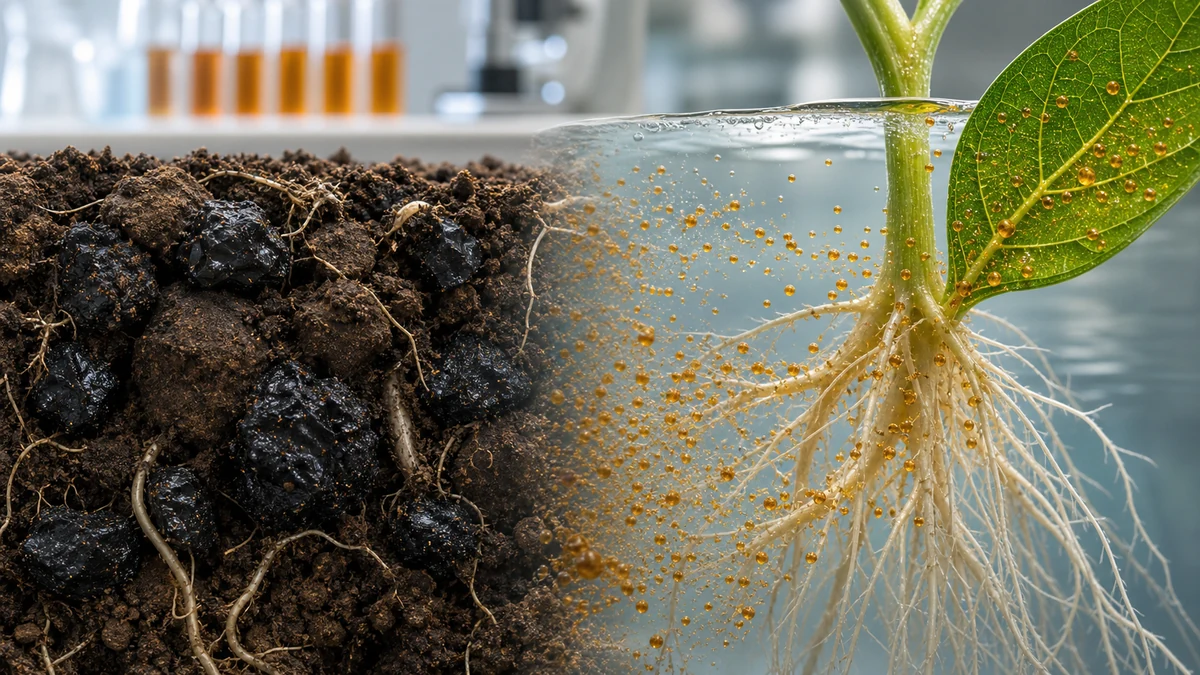
Cette distinction n'est pas un argument marketing. Il s'agit de la définition même. Le Société internationale des substances humiques On les distingue en fonction de leur solubilité : lorsqu’on acidifie un extrait jusqu’à un pH d’environ 1, l’acide humique précipite, tandis que l’acide fulvique reste dissous sur toute la plage de pH. L’humine, la troisième fraction, ne se dissout dans aucun des deux et ne quitte jamais le sol.
La suite est logique. Une grosse molécule humique qui précipite en milieu acide est conçue pour rester en place, pour lier des particules et retenir des cations sur ses sites chargés, et pour rester dans le sol. Une petite molécule fulvique, qui reste dissoute quel que soit le pH, est conçue pour se déplacer, à travers l’eau du sol, traverser la cuticule d’une feuille et pénétrer dans une cellule racinaire. Le choix entre les deux dépend donc de l’endroit où l’action doit se produire. Problème de sol : humique. Problème d’absorption : fulvique.
Là où la chimie se divise : groupes fonctionnels et charge
La taille fait la une ; la chimie de surface explique l'intrigue. Ces deux fractions regorgent de groupes fonctionnels — ces sites réactifs qui captent et libèrent les nutriments. Deux d'entre eux assurent l'essentiel du travail : les groupes carboxyle et hydroxyle phénolique, qui, dans le sol, sont tous deux chargés négativement. Il suffit de compter les sites chargés pour que le reste du comportement s'explique de lui-même.
L'acide fulvique contient davantage de ces groupes porteurs d'oxygène par gramme que l'acide humique. Il en découle deux conséquences. D'une part, il reste soluble quel que soit le pH ; d'autre part, il chélate facilement les oligo-éléments — un plus grand nombre de sites chargés sur une petite molécule mobile signifie davantage d'endroits pour capter le fer, le zinc et le manganèse et les acheminer vers la plante. Il présente également une couleur jaune pâle, et non noire, car les molécules plus petites et plus oxydées absorbent moins la lumière. Ainsi, lorsqu’un fournisseur vous montre un liquide sombre, de couleur goudron, et le qualifie de « qualité fulvique », demandez-lui le pourcentage de fulviques avant de vous fier à l’étiquette.
L'humique suit une approche inverse : moins de groupes par gramme, mais une masse bien plus importante sur un squelette aromatique et condensé. Cela le destine à remplir une fonction opposée. Répartissez une charge négative sur une grosse molécule et vous obtenez capacité d'échange cationique — il retient le calcium, le magnésium et le potassium à la surface du sol au lieu de les laisser s'infiltrer au-delà des racines. La structure aromatique résiste également à la dégradation, de sorte que les avantages structurels s’accumulent saison après saison au lieu de disparaître entre deux applications. Lorsque l’objectif est d’améliorer la qualité du sol, demandez la valeur de la CEC. C’est ce chiffre qui vous indique la capacité de rétention réelle que vous achetez.
Il faut lire la description détaillée, et pas seulement le pourcentage indiqué dans le titre. La léonardite — un lignite tendre fortement oxydé — a déjà subi un long processus naturel d’humification ; elle présente donc une forte concentration en groupes chargés et une teneur élevée en acide humique ; la tourbe plus jeune ou le lignite brut en contiennent moins. Cela signifie que deux produits peuvent afficher le même pourcentage d’acide humique tout en différant quant à leur degré réel d’oxydation et de réactivité ; il convient donc d’examiner de plus près la matière première indiquée sur la fiche technique plutôt que le chiffre figurant sur l’étiquette. Les analyses au four et les analyses chimiques aboutissent au même verdict : l’acide fulvique se déplace et se transporte, tandis que l’acide humique reste en place.
L'acide humique : son rôle dans le sol
L'acide humique est avant tout un amendement du sol. Ses grosses molécules sont parsemées de charges négatives, et ces sites retiennent le calcium, le magnésium, le potassium et l'ammonium lorsque l'eau s'écoule, puis les restituent aux racines. Ces mêmes molécules agglomèrent les particules libres en agrégats, ce qui permet d’améliorer la structure du sol, sa capacité de rétention d’eau et son aération.
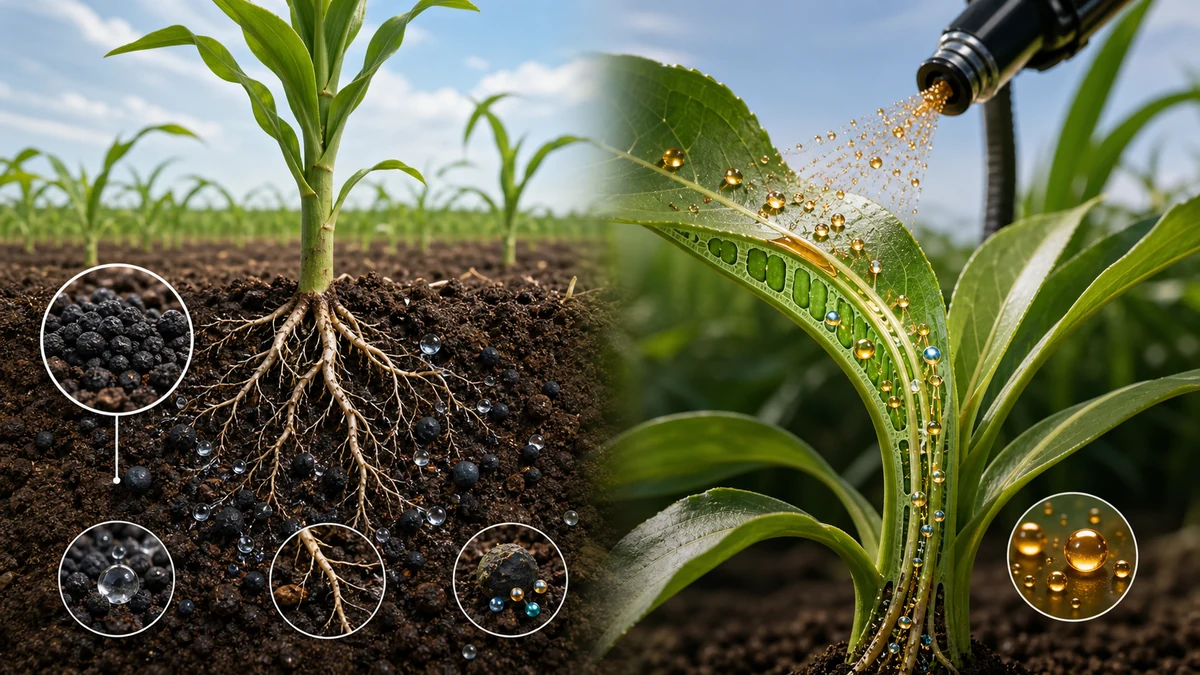
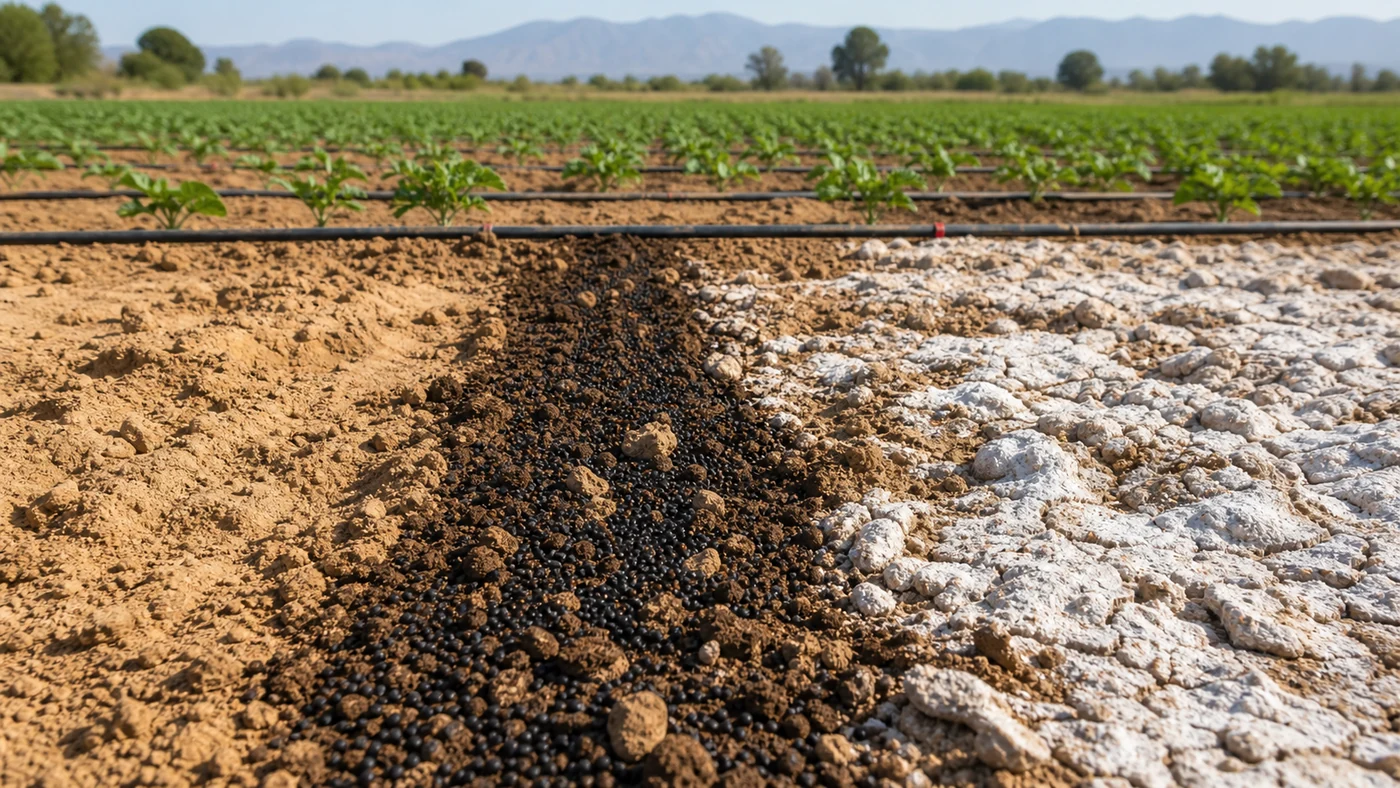
C’est pourquoi cette méthode s’avère particulièrement efficace sur les sols sableux ou appauvris, où la capacité d’échange cationique est déjà faible au départ. Le changement est structurel et s’opère sur une à plusieurs saisons plutôt que du jour au lendemain, car il s’agit de régénérer le sol plutôt que d’appliquer une solution miracle. Notre guide sur l'acide humique comme amendement du sol va plus loin sur les sols problématiques, et les bases en science des sols se trouvent dans sol humifère.
L'acide humique améliore la capacité de rétention du sol. Il n'est pas absorbé rapidement par la plante, et ce n'est pas la solution qu'il faut si vous avez besoin d'un effet immédiat. En termes chiffrés, l'acide humique issu de la léonardite présente une capacité d'échange cationique comprise entre 350 et 450 meq/100 g ; les sites chargés de sa structure aromatique à haut poids moléculaire retiennent ces cations supplémentaires, et c’est ce même carbone à libération lente qui alimente l’activité microbienne du sol.
L'acide fulvique : son rôle dans la plante
L'acide fulvique agit là où l'acide humique ne peut pas atteindre. Composé de petites molécules solubles à n'importe quel pH, il se déplace dans l'eau du sol et pénètre dans les tissus végétaux en entraînant avec lui les nutriments. Il chélate les oligo-éléments qui posent le plus de problèmes aux agriculteurs (fer, zinc, manganèse), en les maintenant sous une forme assimilable par la plante, et les fait passer à travers les membranes cellulaires.
Ce qui frappe, c'est la rapidité d'action. L'humate agit en quelques semaines ; le fulvate, quant à lui, fait généralement effet en quelques jours, ce qui explique pourquoi il est particulièrement adapté aux situations de stress, aux carences en oligo-éléments et à la fertilisation foliaire. Il renforce également la tolérance de la plante à la chaleur et à la salinité lorsque les conditions climatiques deviennent difficiles.
L'acide fulvique agit-il plus rapidement que l'acide humique ?
Oui, et cela tient davantage à la mobilité qu’à la puissance. L’acide fulvique est de petite taille et soluble ; il pénètre donc dans la plante et lui apporte des nutriments en quelques jours. L’acide humique est de grande taille et se fixe au sol ; ses effets se manifestent progressivement au fil des semaines et des saisons, à mesure que la structure du sol et la capacité d’échange cationique (CEC) s’améliorent. Utilisez l’acide fulvique pour une action rapide et l’acide humique pour une action à long terme, et ne comptez pas sur l’un pour remplacer l’autre.
À quelle vitesse fonctionne chacune d'entre elles, et où va-t-elle ?
Deux questions se posent immédiatement après “ quel est l'effet de chacun ” : à quelle vitesse agit-il, et où va-t-il ? Les deux relèvent de cette distinction. L'acide fulvique agit en quelques jours, car il pénètre dans la plante. L'acide humique agit au fil des saisons, car il reste dans le sol et contribue à sa régénération.
| Cadre temporel | Acide humique | Acide fulvique |
|---|---|---|
| Jours | Peu de changements visibles ; cela agit sur le sol, pas sur la plante | L'absorption des nutriments et la réponse au stress se manifestent |
| Semaines | La structure, l'agrégation et le CEC commencent à se mettre en place | Absorption durable grâce à des applications foliaires ou par fertigation répétées |
| Une à quelques saisons | Renforcement des acquis en matière de structure et de capacité d'accueil | Les bienfaits s'estompent entre deux applications ; ils ne s'accumulent pas. |
L'application suit la même logique. L'humique est incorporé dans le sol, mélangé à la zone racinaire avant ou au moment de la plantation, ou épandu le long de la ligne de goutte-à-goutte dès le début pour renforcer la capacité de rétention. Il n'est pas nécessaire qu'il soit soluble foliaire pour cela, c'est pourquoi un granulé brut suffit. L'acide fulvique s'applique sur la plante ou dans l'eau, par pulvérisation foliaire ou fertirrigation, où ses petites molécules solubles traversent la cuticule et sont entraînées par le flux d'irrigation. Appliquez l'acide humique là où il ne risque pas d'être lessivé. Appliquez l'acide fulvique là où il doit se déplacer. Pour connaître les doses et les périodes d'application spécifiques à chaque culture, acide humique pour les plantes a les chiffres.
Le test rapide : si les résultats doivent être visibles cette semaine, il s'agit d'acides fulviques. Si le sol est de meilleure qualité la saison prochaine, il s'agit d'acides humiques.
Lequel choisir ? Une décision d'approvisionnement
Il ne s'agit pas ici d'une distinction abstraite entre humiques et fulviques. Il faut déterminer de quel problème il s'agit et sur quelle surface. Il suffit de mettre la situation en perspective par rapport à la fraction concernée pour que la décision d'achat s'impose d'elle-même.
| Votre situation | Cliquez sur | Pourquoi ? |
|---|---|---|
| Sol sableux ou appauvri, pauvre en matière organique | Humique | Renforce la capacité d'échange cationique et la structure permettant de retenir l'eau et les nutriments |
| Sol en croûte ou compacté, mauvaise infiltration | Humique | L'agrégation redéfinit la structure au fil du temps |
| Amélioration à long terme des sols au fil des saisons | Humique | Reste dans le sol et dans les composés |
| Carence visible en micronutriments (fer, zinc, manganèse) | Fulvique | Il chélate et achemine les micro-éléments vers la plante en quelques jours |
| Culture soumise à un stress thermique, salinique ou lié à la repique | Fulvique | Assimilation rapide et tolérance au stress quand on n'a pas le temps d'attendre |
| Programme de pulvérisation foliaire | Fulvique | Soluble au pH des feuilles, pénètre dans la cuticule |
| La fertirrigation, qui achemine les nutriments jusqu'aux racines | Fulvic, avec des substances humiques incorporées dans le sol | Chélates et transports ; les substances humiques retiennent ce qui leur est apporté |
| Absorption lente due au froid ou au début de la saison | Fulvique | Transporte les nutriments lorsque l'activité racinaire est faible |
| Vous recherchez à la fois une structure et une assimilation rapide | Les deux | Des acides humiques dans le sol, des acides fulviques sur les feuilles |
La règle de base est simple : les humiques pour le sol, les fulviques pour les plantes. Si votre programme prévoit les deux, achetez-les séparément et ne payez pas plus cher pour un mélange en partant du principe qu’il remplit les deux fonctions.
Les associer : un programme saisonnier
Les acides humiques et fulviques sont complémentaires, et la plupart des programmes efficaces prévoient leur utilisation conjointe. Répartis sur toute la saison, c'est assez simple à mettre en œuvre, et cela permet de suivre les deux traitements.
Les humates sont les premiers à être incorporés dans le sol. Incorporez un produit granulé dans la zone racinaire au moment de la plantation ou avant, ou appliquez un humate soluble le long de la ligne de goutte dès le début, afin de développer la structure et la capacité de rétention dont la culture aura besoin par la suite. C'est la base, et elle se met en place au fil des semaines.
Le Fulvic s'accumule sur la plante tout au long de la saison. Pulvérisez-le ou appliquez-le par fertirrigation aux stades de croissance clés et chaque fois que la culture subit un stress, afin d'apporter rapidement les nutriments nécessaires. L’un alimente les réserves ; l’autre les puise. Déterminez les doses et le calendrier en fonction de votre culture et de l’analyse de sol plutôt que selon un calendrier fixe, car le programme adapté varie en fonction de la culture, du stade de croissance et des conditions météorologiques.
Peut-on mélanger de l'acide humique et de l'acide fulvique dans le même réservoir ?
Faites attention et surveillez le pH. Les acides fulviques restent solubles sur toute la plage de pH ; les acides humiques précipitent en milieu acide. Si vous versez un produit à base d’acides humiques dans un réservoir acide, il risque de précipiter et d’obstruer les pulvérisateurs et les émetteurs. Si vous effectuez un mélange en cuve, vérifiez d'abord la compatibilité et le pH, évitez d'associer l'humique à des mélanges fortement acides, et en cas de doute, appliquez l'humique sur le sol et réservez le fulvique pour la pulvérisation foliaire ou la fertigation acide.
Les erreurs courantes qui font gaspiller de l'argent
La majeure partie de l'argent gaspillé pour ces deux aspects provient du fait qu'on demande à l'un de faire le travail de l'autre. Les erreurs se répètent, et elles trouvent toutes leur origine dans cette même distinction entre taille et solubilité.
On a tendance à se tourner vers les humiques quand on a besoin de résultats rapides. Or, il s'agit d'un investissement dans le sol qui porte ses fruits au fil des semaines ; il ne permettra donc pas de remédier à une carence chez les cultures dès cette semaine. C'est là le rôle des fulviques, et le fait d'utiliser des humiques à la place ne fait que retarder la correction.
On s'attend à ce que les acides fulviques améliorent la structure du sol. Or, ils traversent le sol et pénètrent dans la plante ; ils ne restent pas dans le sol pour en améliorer la structure ou augmenter la capacité d'échange cationique (CEC). Si vous appliquez uniquement des acides fulviques sur un sol sableux à faible CEC, vous ne faites que traiter le symptôme, tandis que le sol reste fragmenté.
Acheter un mélange peu concentré et compter sur lui pour remplir ces deux fonctions. De nombreux mélanges “ humiques et fulviques ” sont suffisamment dilués pour ne pas apporter la dose nécessaire pour les deux actions à la fois. Vérifiez les concentrations réelles en humiques et en fulviques, et non la concentration combinée indiquée, et assurez-vous que le produit est suffisamment concentré pour le traitement que vous souhaitez effectuer.
On verse de l'humique dans une cuve acide. Il se précipite et obstrue la conduite. Ce n'est pas un lot défectueux, c'est une erreur de manipulation.
Et faire le mauvais choix coûte plus cher qu’un résultat médiocre. Pour les travaux de sol, le fret est facturé à la tonne ; ainsi, expédier un engrais soluble dont vous n’aviez pas besoin, ou une fraction destinée à un usage inapproprié, se traduit par un surcoût par unité de matière active utile, et parfois par une saison perdue alors que le véritable problème persiste. Adaptez la fraction au chantier avant d’adapter le devis au budget.
Quelle classe et quelle section choisir ?
Pour un acheteur, le choix entre humique et fulvique se résume à une question de qualité et de forme, et ce sont le transport et la fonctionnalité qui tranchent. La règle est la même que ci-dessus : pour les travaux de terre, il faut de l’humique sec que l’on peut incorporer au sol ; pour l’absorption, il faut une qualité qui se dissolve parfaitement.
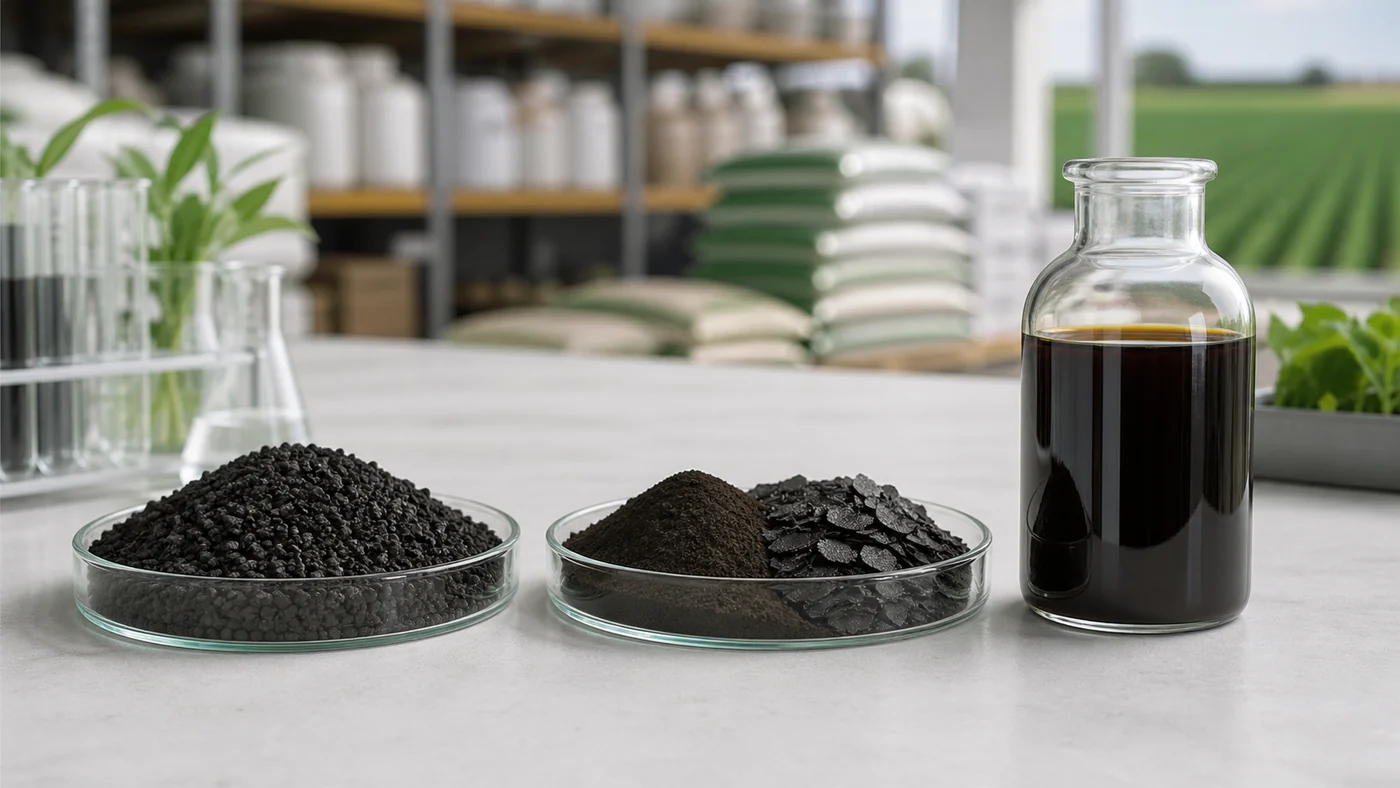
Pour l’apport d’humus au sol à grande échelle, les granulés d’acide humique brut constituent la solution la plus efficace. C’est le moyen le moins coûteux d’introduire de la matière humique dans le sol, et ils n’ont pas besoin de se dissoudre pour être incorporés au sol. La léonardite, cette lignite oxydée dont sont issus la plupart des humiques minéraux, contient généralement entre 40 et 80 % d’acide humique ; ce qui importe donc dans un devis, c’est la teneur en acides humiques et fulviques indiquée sur le certificat d’analyse (COA), et non sur l’étiquette ; notre propre grade d’acide humique affiche, selon le COA du lot, 48,35 % d’acide humique et 12,12 % d’acide fulvique. Ce grade est conçu dans un seul but : améliorer votre sol au fil des saisons. Si votre seul problème est d’apporter une correction rapide en cours de saison, notre humique granulaire n’est pas le bon choix, et nous préférons vous le dire dès maintenant. Optez plutôt pour une qualité à base d’acide fulvique. Les granulés à 48,35 % d’acide humique font leurs preuves dans le sol, et non sur une culture que vous devez redresser cette semaine. Lorsque le programme nécessite un produit soluble pour l’irrigation goutte à goutte ou l’application foliaire, les flocons ou la poudre d’humate de potassium s’appliquent sans problème, et la matrice complète de la qualité se trouve sur notre engrais à base d'acide humique page d'approvisionnement. Pour les applications foliaires rapides et la fertirrigation, achetez un produit spécifique engrais à base d'acide fulvique qualité plutôt que de se fier à la faible teneur en fraction fulvique d'un produit humique.
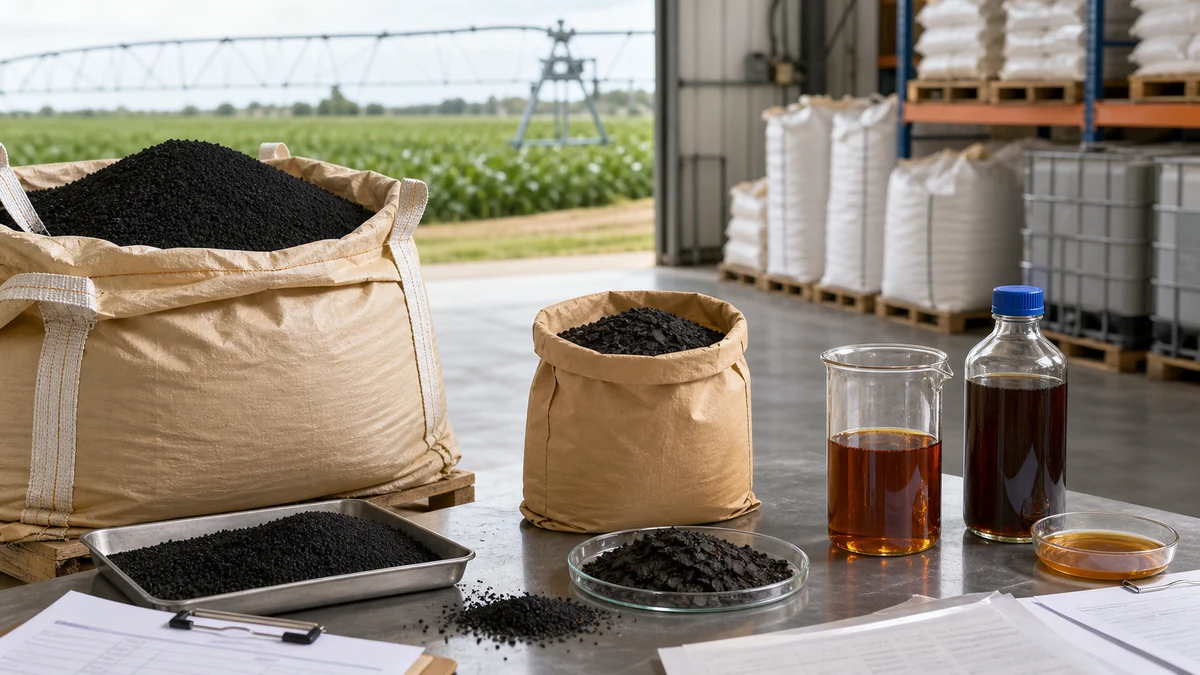
Il convient toutefois de faire preuve de prudence avec tout produit à base de léonardite. La matière première étant du lignite, demandez à ce que le certificat d'analyse (COA) mentionne la teneur en métaux lourds, un risque particulièrement important lorsque le produit est épandu en grande quantité sur le sol, année après année. Et comparez les produits en fonction du coût unitaire de matière humique ou fulvique active, et non en fonction du pourcentage indiqué ou du prix du sac.
Comment interpréter une fiche technique sur les acides humiques ou fulviques
Une fois que vous aurez déterminé à quoi correspond chaque fraction, reportez-vous à la fiche technique, car deux produits peuvent paraître identiques alors qu’ils ne se comportent pas du tout de la même manière. Ce sont quelques chiffres qui font la différence. Lisez-les dans l’ordre.
La teneur en acide humique et la teneur en acide fulvique figurent en première ligne, exprimées en pourcentage, et ne sont pas interchangeables. Une qualité à 70 % d’acide humique et une autre à 12 % d’acide fulvique sont destinées à des usages différents, et non à des niveaux de qualité différents ; veillez donc à vérifier à quelle fraction se rapporte un pourcentage avant de comparer deux devis. Faites également attention à la base de calcul : un chiffre exprimé « à l'état sec » et le même chiffre « tel que livré » ne correspondent pas une fois la teneur en humidité prise en compte, et un granulé contenant 15 % d'eau renferme moins d'acide humique actif que ne le suggère son étiquette « à l'état sec ».
La solubilité constitue l'autre critère pratique. Un granulé d'humate brut est destiné à être incorporé au sol et ne se dissoudra pas entièrement ; il est donc normal qu'il présente un taux élevé d'insolubilité dans l'eau, ce qui n'a aucune incidence sur l'application au sol ; en revanche, un humate de potassium en paillettes ou une poudre fulvique est conçu pour être appliqué à l'aide d'un pulvérisateur ; pour une application foliaire ou par fertigation, c'est donc le taux d'insolubilité dans l'eau qu'il convient de surveiller. La manière la plus honnête de comparer deux fournisseurs consiste à mettre en parallèle les pourcentages d’acide humique, d’acide fulvique et de matière organique sur une base comparable, et à demander un certificat d’analyse (COA) par lot qui les indique. Notre propre grade d’acide humique est accompagné d’un certificat d’analyse (COA) par lot ; un lot récent a été analysé à 48,35 % d’acide humique, 12,12 % d’acide fulvique, 76,28 % de matière organique et 9,23 % d’humidité.
Questions fréquemment posées
Quelle est la principale différence entre l'acide humique et l'acide fulvique ?
La taille des molécules et la solubilité qui en découle. Les humiques constituent la fraction de grande taille : ils précipitent en milieu acide, restent dans le sol et contribuent à la structure de celui-ci ainsi qu'à sa capacité d'échange cationique. Les fulviques sont suffisamment petits pour rester solubles quel que soit le pH ; ils pénètrent donc dans la plante et y transportent les nutriments. La rapidité d'action et la méthode d'application découlent toutes deux de cette distinction.
Qu'est-ce qui est le mieux pour les plantes : l'acide humique ou l'acide fulvique ?
Ce n'est pas la bonne question, franchement — ils ont des rôles différents. L'acide humique améliore le sol ; il est donc plus efficace en termes de structure, de rétention d'eau et de fertilité à long terme. L'acide fulvique améliore l'absorption ; il est donc plus efficace en termes de rapidité, de nutrition foliaire et de correction des carences en oligo-éléments. Pour la plupart des programmes, la vraie réponse est « les deux », chacun étant conçu pour l’usage qui lui est destiné.
Peut-on utiliser conjointement de l'acide humique et de l'acide fulvique ?
Oui, c'est le cas de la plupart des programmes. Incorporez les humiques dans le sol pour améliorer sa capacité de rétention ; appliquez les fulviques par pulvérisation foliaire ou fertirrigation pour faire pénétrer les nutriments dans la plante. Une mise en garde toutefois : surveillez le pH du mélange, car les humiques peuvent précipiter dans des mélanges acides tandis que les fulviques restent solubles.
L'acide fulvique est-il simplement une version plus petite de l'acide humique ?
Plus petites — et c'est précisément cette taille qui fait toute la différence. Les deux proviennent des mêmes substances humiques, mais les petites molécules des acides fulviques se dissolvent quel que soit le pH et pénètrent dans les tissus végétaux, tandis que les grosses molécules des acides humiques restent dans le sol. C'est précisément cette différence qui explique pourquoi l'un nourrit le sol et l'autre nourrit la plante.
Les acides humiques et fulviques vendus sous forme de compléments alimentaires pour l'homme sont-ils identiques à ceux destinés à l'agriculture ?
Non. Tous les produits destinés au grand public sont formulés et purifiés en vue de cet usage. Les produits proposés ici sont destinés à l'agriculture (sols et intrants végétaux), et c'est la seule utilisation pour laquelle nous les fabriquons et les fournissons. Il faut bien distinguer les deux.
Quelle catégorie de produit dois-je choisir pour un programme agricole en vrac ?
Choisissez la formulation adaptée à l'application visée. Pour l'amendement du sol, un granulé d'acide humique brut offre la plus forte concentration d'acide humique actif par tonne de produit. Pour l'irrigation goutte à goutte ou l'application foliaire, optez pour un humate de potassium soluble. Pour une absorption rapide par les plantes, privilégiez une formulation spécifique à base d'acide fulvique. Vérifiez la teneur en substance active sur le certificat d'analyse (COA) et comparez les produits en fonction du coût par unité de substance active plutôt que du prix au sac.
— Révisé par le service d'approvisionnement technique de Rutom Bio
Dernière mise à jour : 22 juillet 2026
L'acide humique, c'est la même chose que l'humus ?
Non, même si ces termes sont souvent confondus. L’humus est le terme générique désignant la matière organique stabilisée présente dans le sol, qui se forme in situ à mesure que les résidus se décomposent. L’acide humique est une fraction spécifique que l’on peut extraire de l’humus ou, plus souvent dans le cadre d’un produit commercial, de la léonardite. On peut acheter de l'acide humique dans le commerce. L'humus, en revanche, doit se constituer au fil des années.
En quoi l'acide humique diffère-t-il du compost ?
Le compost est une matière organique en vrac qui doit encore se décomposer dans le sol ; son action est donc lente et on l'applique par tonnes. L'acide humique, quant à lui, est la fraction concentrée et déjà humifiée, que l'on applique au kilo et qui agit immédiatement sur la structure du sol et l'échange cationique. Ces deux éléments sont complémentaires et non substituables : le compost apporte la matière organique brute, tandis que l'acide humique est la fraction finie qui en a déjà été extraite.
Articles connexes
- Engrais à base d'acide humique : fournisseurs, qualités et approvisionnement en vrac, la page dédiée à l'humus. Utilisez-la lorsque vous avez opté pour l'humus et que vous souhaitez comparer les différentes qualités et demander un devis.
- Engrais à base d'acide fulvique, la fraction fulvique. À utiliser en cas d'absorption rapide, d'application foliaire ou de fertirrigation.
- Acide humique pour les plantes, les détails agronomiques. Utilisez cette section lorsque vous souhaitez savoir comment l'acide humique se comporte selon les cultures.
- L'acide humique comme amendement pour les sols salins et sableux. Utilisez cette option lorsque le problème lié au sol concerne la salinité ou la présence de sable, plutôt que le choix entre humiques et fulviques.
Vous cherchez à vous approvisionner en humiques ou en fulviques en vrac ?
Indiquez-nous la culture concernée, le problème lié au sol ou à l'absorption que vous cherchez à résoudre, ainsi que le type de produit dont vous avez besoin (granulés humiques à incorporer dans le sol, humate soluble, produit de type fulvique ou une combinaison de ces produits) ; nous vous ferons parvenir, dans les 24 heures, une recommandation sur le type de produit, un devis FOB ajusté en fonction du taux d'humidité et un échantillon du certificat d'analyse (COA).
Demander une recommandation de qualité et un devis FOB →
À propos de ce guide
Révisé par le service technique de Rutom Bio. Dernière mise à jour le 22 juillet 2026. La distinction entre substances humiques et fulviques présentée ici suit les définitions opérationnelles fondées sur la solubilité utilisées par l’International Humic Substances Society ; les informations relatives aux catégories et à l’origine proviennent de nos propres données produit publiées. Nous fabriquons à la fois les qualités humiques et fulviques mentionnées ici, c’est pourquoi ce guide commence par aborder le choix de la provenance, un aspect que les pages consacrées à chaque produit ne mentionnent pas. Vérifiez les doses d’application en fonction de votre propre analyse de sol et de votre culture.
Références et sources
- Que sont les substances humiques ? — Société internationale des substances humiques : définitions de l'acide humique, de l'acide fulvique et de l'humine fondées sur la solubilité opérationnelle.
- Rutom Bio a publié les fiches techniques de ses produits — données relatives aux granulés d'acide humique, à l'humate de potassium et à l'acide fulvique.
- Comprendre le rôle des acides humiques dans le rendement des cultures et la santé des sols — Ampong, Thilakaranthna et Gorim, Frontiers in Agronomy 4:848621 (2022).
- Préparation et caractérisation de la structure moléculaire de l'acide fulvique extrait de différents types de tourbe — Wu et al., Molecules 28(19):6780 (2023).
A propos de l'auteur : Rutom




 English
  Spanish
  French
  Japanese
  Korean
  German
  Portuguese
  Italian
  Indonesian
  Vietnamese
  Turkish
  Persian
  Russian
  Chinese