
table of contents
- El mapa de alimentación de café de 4 ventanas
- Por qué la materia orgánica se ha ganado un lugar en los suelos tropicales donde se cultiva café
- Dividir el programa en dos partes
- En el caso del café certificado, se audita la lista de insumos
- Creación de un programa de café a partir de fuentes ecológicas
- Qué hay que comprobar antes de realizar un pedido al por mayor
- Rutom Bio – Insumos ecológicos para programas de café
- Principales conclusiones
- Preguntas Frecuentes
- ¿Puedo mantener la certificación de café ecológico si utilizo guano y abonos a base de aminoácidos?
- ¿Qué granulometría debo pedir para el riego por goteo en comparación con la aplicación al suelo?
- ¿Cuántas aplicaciones de fertilizante necesita un cultivo de café por temporada?
- ¿Aporta el guano de aves marinas suficiente potasio para el relleno de cerezas?
- ¿Qué metales pesados debe indicar el informe de análisis de un fertilizante para café?
- Acerca de esta guía
- Referencias y fuentes
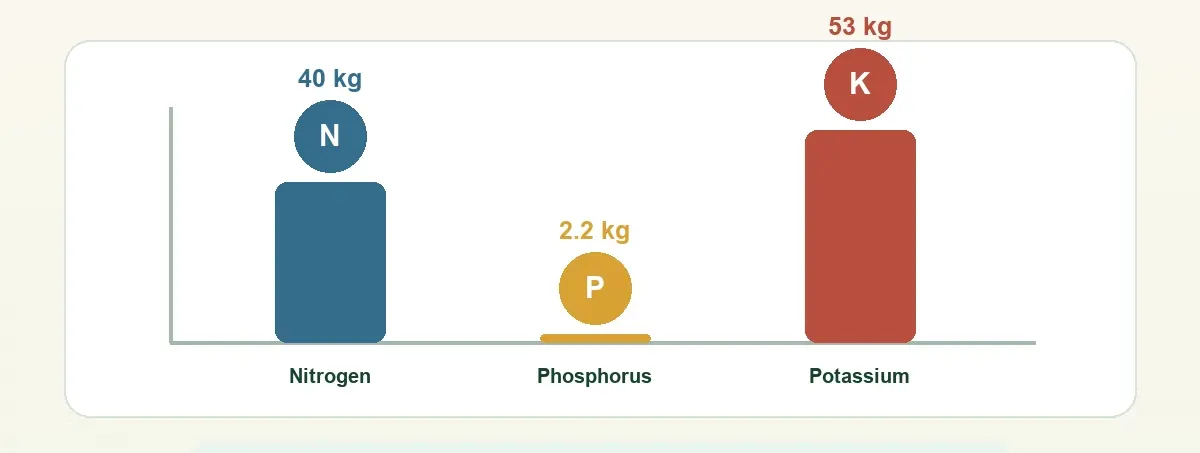
Coffee is a nitrogen- and potassium-led crop. A tonne of green bean carries off roughly 53 kg of potassium and 40 kg of nitrogen, against only about 2.2 kg of phosphorus (FAO Arabica Coffee Manual) – so both N and K have to be put back every season, and potassium, the larger export, is the one most programs under-supply. What trips up most programs is timing, not total. Potassium demand concentrates during cherry filling, when the tree is building bean weight and ripening fruit, and a generic “balanced” blend almost never lifts K for that one window. The result is a confident vegetative flush followed by thin, uneven beans at harvest.
This guide maps coffee nutrient demand onto four growth windows, names the rule that decides bean weight, and shows what to check on the COA before you commit a container. It is written for growers, estate managers, and importers sourcing organic inputs at volume, not for the houseplant shelf.
Quick Facts
| Nutrient removal (per t green bean) | ~53 kg K, ~40 kg N, ~2.2 kg P (FAO) – K is the largest export |
|---|---|
| Best NPK approach | No single year-round ratio: N-led in vegetative growth, P at flowering, K-led through cherry fill |
| Signature rule | K-Peak at Cherry Fill: lift potassium when beans are gaining weight |
| Soil pH target | 5.0-6.0 (slightly acidic) |
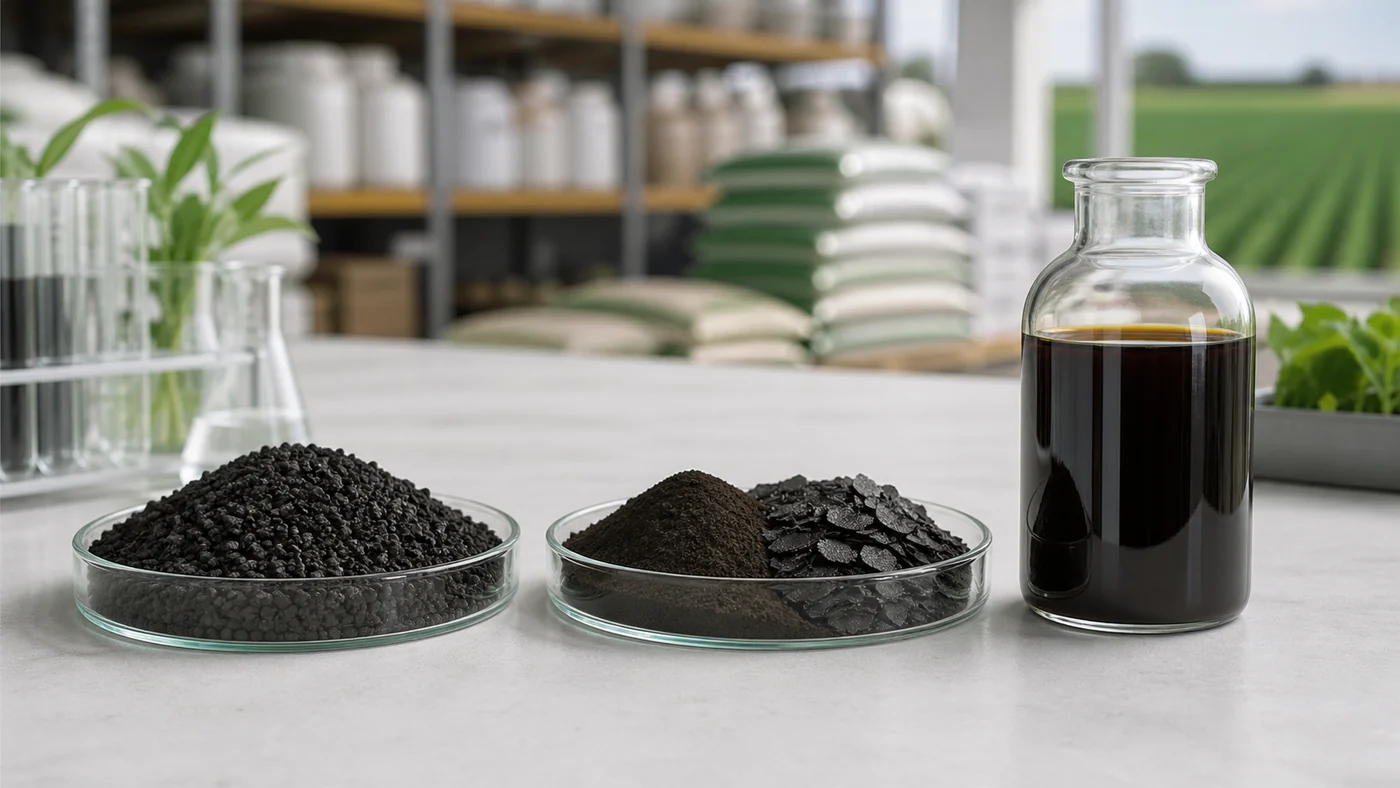
| Core organic inputs | Seabird guano (P+Ca), amino-acid liquid (foliar N), humic acid (CEC), granular organic NPK base |
| Certification rule | Approval is per product, per certifier: EU 2018/848 / USDA NOP / JAS |
| #1 residue risk | Cadmium via phosphate: request a per-lot COA (EU 2019/1009) |
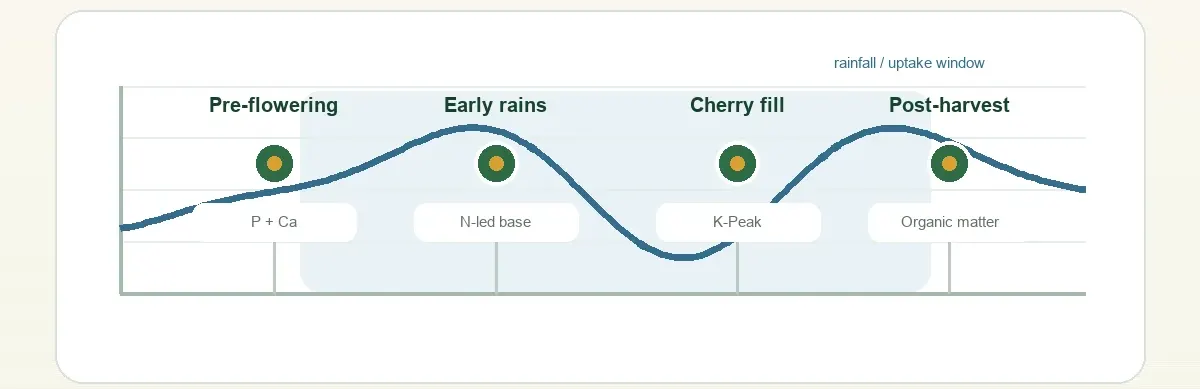
The 4-Window Coffee Feeding Map
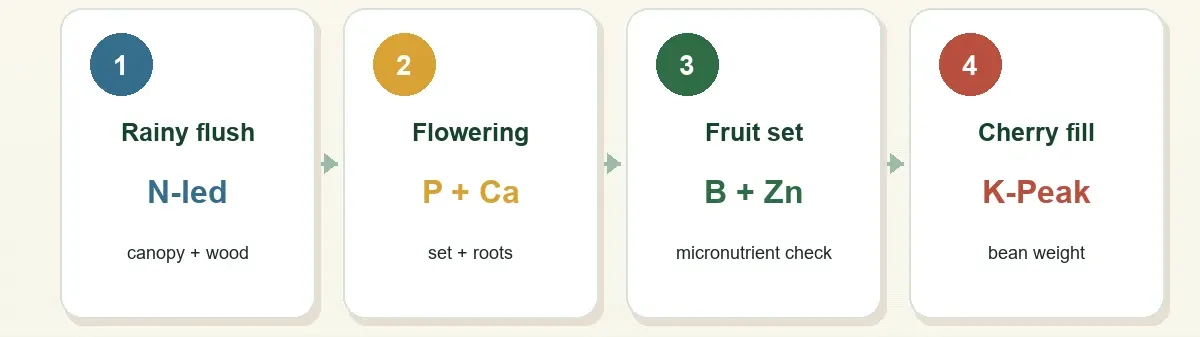
Feed coffee by window, not by bag. The crop demand curve has four distinct windows, and the cheapest yield gains come from feeding each one for what it actually needs rather than spreading the same flat NPK every round.
| Growth window | Nutrient priority | Organic input role |
|---|---|---|
| 1. Nursery / establishment | Phosphorus + steady N for root mass | Composted granular base + high-P guano; humic acid for root volume |
| 2. Vegetative growth (rains) | Nitrogen-led | N-rich organic granules; amino-acid foliar during the fast flush |
| 3. Flowering & fruit set | Phosphorus, plus boron & calcium | High-phosphorus seabird guano; Ca and B support set |
| 4. Cherry fill to harvest | Potassium-led, sustain N | Highest-K organic blend you can source; keep nitrogen steady |
| Post-harvest | Balanced + organic matter | Rebuild reserves and soil carbon before the next cycle |
Field Note – the flat-blend trap. The most common error on estates fed by whatever the local depot stocks is one flat NPK every round. It produces a green, confident-looking flush, then a disappointing fill, because potassium was never lifted for the single window that sets bean weight. That window is window 4. Miss it and you pay for canopy you cannot sell.
What NPK ratio works best for coffee plants?
There is no single year-round ratio. Lead with nitrogen during vegetative growth, raise phosphorus at flowering, then shift to a potassium-led blend through cherry filling. K is the nutrient most often under-supplied at the fill stage, and the fill stage is where bean weight, and your price, is decided.
Why Organic Matter Earns Its Place on Tropical Coffee Soils
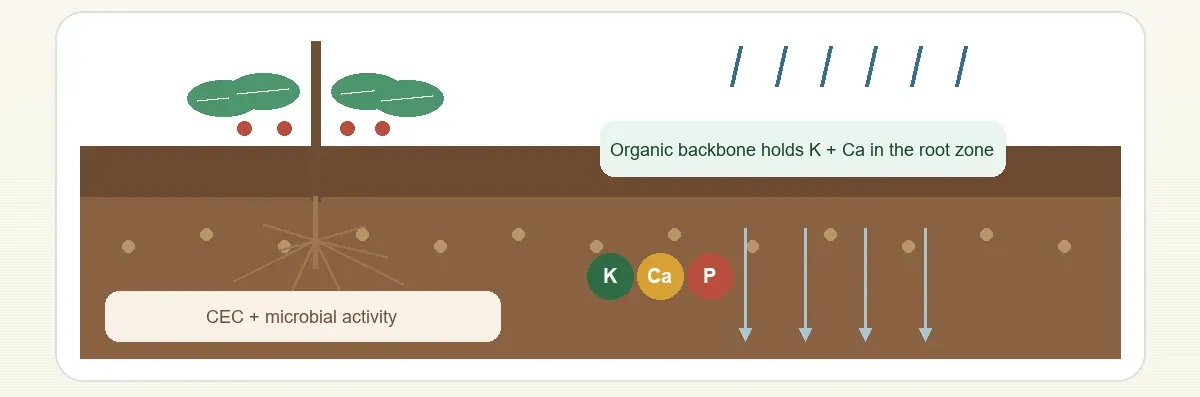
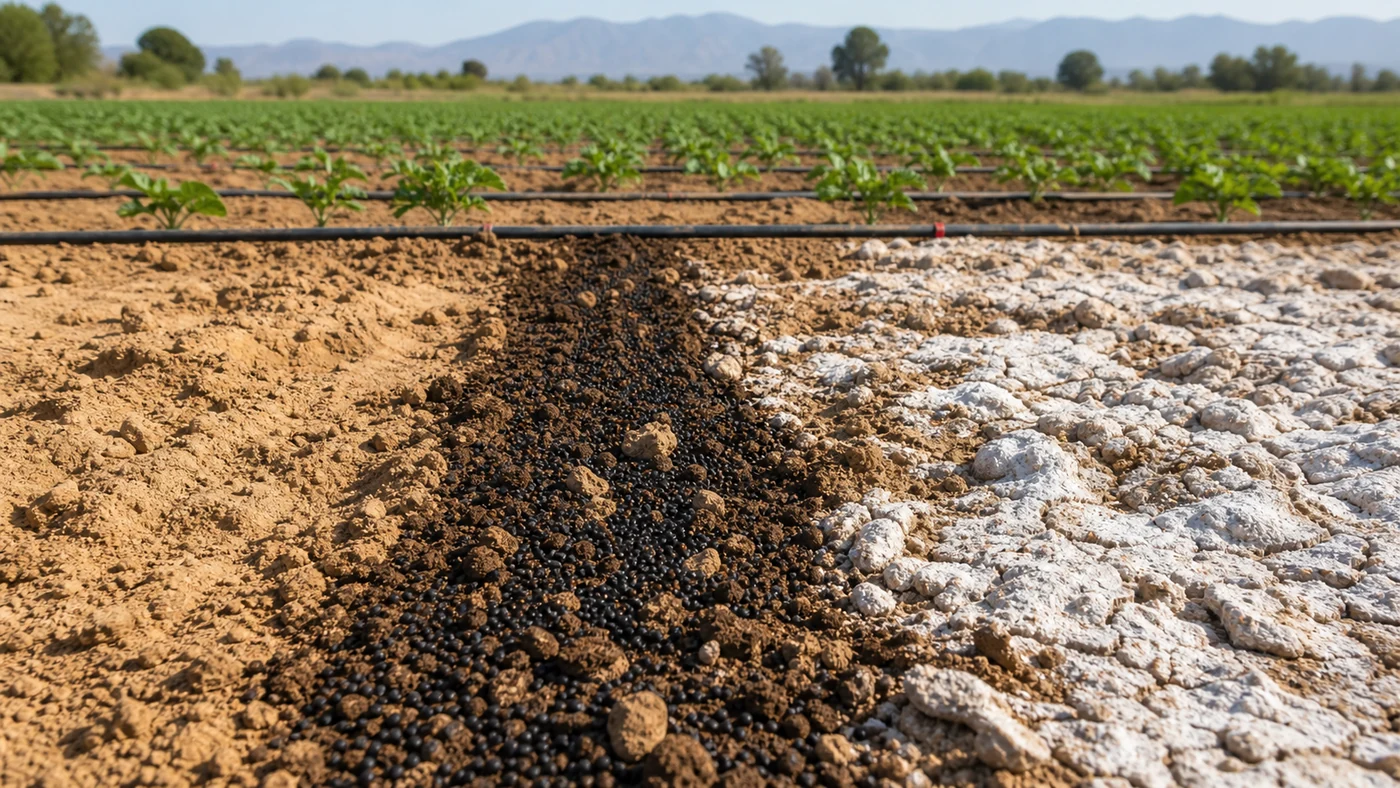
Coffee mostly grows where it rains hard and the soil is acidic, weathered, and low in cation exchange capacity. On that kind of ground a single soluble dose does not sit still: potassium and calcium can leach past the root zone within weeks, and much of the phosphorus gets fixed by iron and aluminium before the tree can use it. This is the practical case for an organic backbone, not an ideological one.
- Raises cation exchange capacity – organic granular inputs and humic acid help the soil hold K and Ca against heavy rain.
- Slow mineralization – nutrients release over months, lining up with the long uptake season.
- Frees fixed phosphorus – soil carbon feeds the microbial activity that releases phosphorus locked in acid soil.
- Buffers pH swings – steady organic matter keeps the program available rather than chemically stranded.
Coffee performs best at roughly pH 5.0-6.0. Push the soil too far either way and phosphorus plus several micronutrients lock up no matter how much you apply, so a soil test comes before the fertilizer order, not after. Organic does not mean approximate; the soil test still drives the rates.
Split the Program with the Rains
Coffee takes up nutrients for months, so the program should be split to match: three to four applications timed to rainfall usually beat one heavy pass on the same budget.
- Time the phosphorus and calcium layer just before flowering, when set is decided.
- Carry nitrogen through the vegetative flush in the early rains, then taper as cherries form.
- Lift potassium for the filling window, split so it is present while beans gain weight (the K-Peak rule in practice).
- Use an amino-acid foliar for fast correction between soil rounds; keep the granular base for season-long supply.
Placement matters as much as timing. Banding at the drip line puts nutrients where the active roots are; piling fertilizer against the trunk burns feeder roots and wastes product.
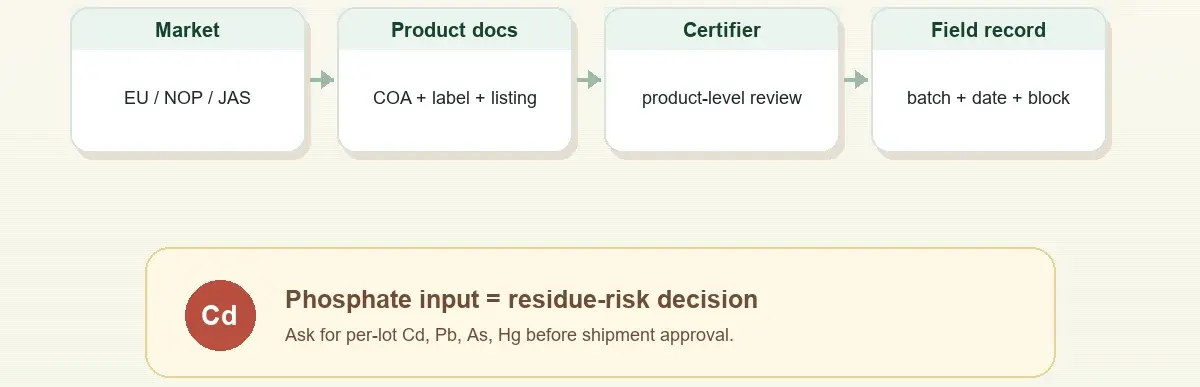
On Certified Coffee, the Input List Is Audited
If your buyer pays an organic or specialty premium, your fertilizer is part of the audit, not a back-office detail. Get the input list wrong and a certified lot can be downgraded to commodity grade after the cost is already in the ground.
- Match the standard to the market. EU-bound organic coffee must trace to inputs allowed under Regulation (EU) 2018/848; US-bound lots fall under the USDA National Organic Program, 7 CFR Part 205; Japan-bound under JAS Organic.
- Approval is per product, per certifier. Inputs must be accepted by your certifier (ECOCERT, CERES, and others), and an OMRI listing makes eligibility faster to evidence. Final acceptance rests with your certifier.
- Synthetic inputs put certification at risk. Synthetic urea or non-approved potassium sources can jeopardise organic status, depending on the standard and your certifier decision.
Why test phosphate fertilizers for cadmium on coffee?
Phosphate inputs are the main route cadmium enters a fertilizer program. Regulation (EU) 2019/1009 caps cadmium in phosphate fertilising products, so the P input you pick for flowering is also a residue-risk decision, especially with rock phosphate or lower-grade guano. Ask for a per-lot heavy-metals result (Cd, Pb, As, Hg) before approving any shipment.
Building a Coffee Program from Organic Sources
You do not need a single “coffee fertilizer” SKU. You need the right organic inputs combined across the season, each chosen for the window it serves and the residue it carries.
| Organic input | Role in a coffee program | Confirm on the COA |
|---|---|---|
| High-P seabird guano | Flowering/fruit-set phosphorus + calcium | P2O5 % and a per-lot cadmium result; Ca if you rely on it for set |
| Amino-acid liquid | Fast foliar N and stress recovery | N % and amino-acid content; labelled for foliar/fertigation |
| Humic acid | Root development, nutrient holding | Humic/fulvic %; pairs with guano so applied P is held, not lost |
| Granular organic NPK base | Slow-release season backbone | Guaranteed N-P-K + organic matter %; a K-leaning grade for fill |
How is fertilizer for robusta different from arabica?
| If you grow… | Then weight the program toward… |
|---|---|
| Robusta (heavier feeder, larger yield) | Potassium above all – push window-4 K |
| Arabica at altitude (more sensitive) | Magnesium and boron – watch the micronutrient layer |
Build one organic base and adjust the K and micronutrient layers by species and by your own leaf-analysis history; do not copy a generic ratio off a bag.
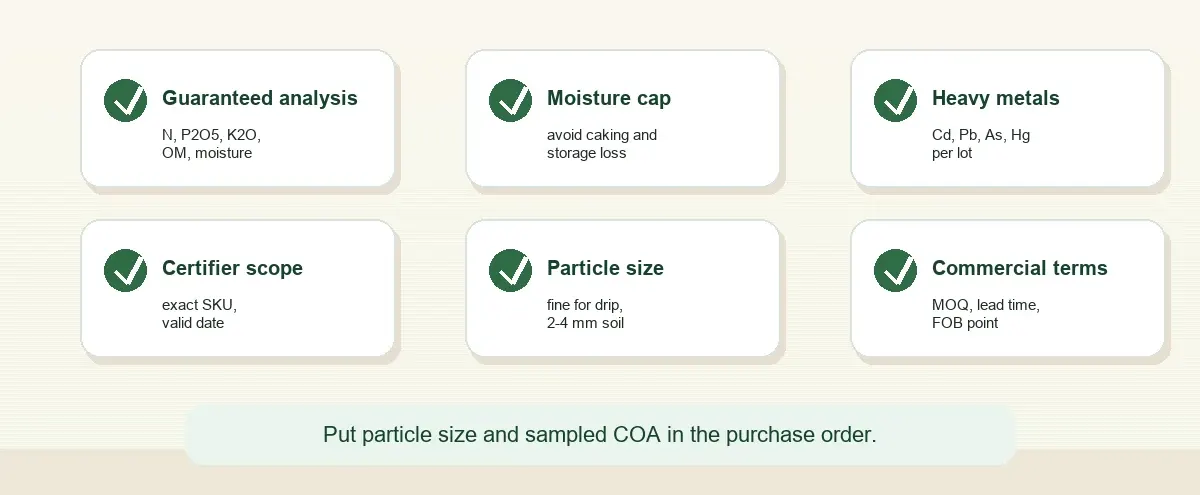
What to Verify Before a Bulk Order
The COA, not the brochure, tells you whether an input fits coffee. Before a container moves, work down this list, and ask for a current certificate plus a sample, not last year scan.
- Guaranteed analysis with units – “12% P2O5 min,” “organic matter 30% min,” never “high P.”
- Moisture under a stated cap – wet guano and granules cake and clog fertigation lines.
- Heavy metals tested per lot – Cd, Pb, As, Hg; this protects a certified phosphate input.
- Certifier scope on the exact product – confirm the specific SKU is listed, not just that the company is certified.
- Particle size matched to method – fine micron-grade for foliar/drip, 2-4 mm granule for a ground base.
- Commercial terms – MOQ, lead time, FOB point, agreed against the sampled COA.
Field Note – particle size is a spec, not a detail. A buyer orders seabird guano for a drip system, receives a coarse broadcast granule, and spends harvest season unblocking emitters. Put the particle size in the PO.
Rutom Bio – Organic Inputs for Coffee Programs
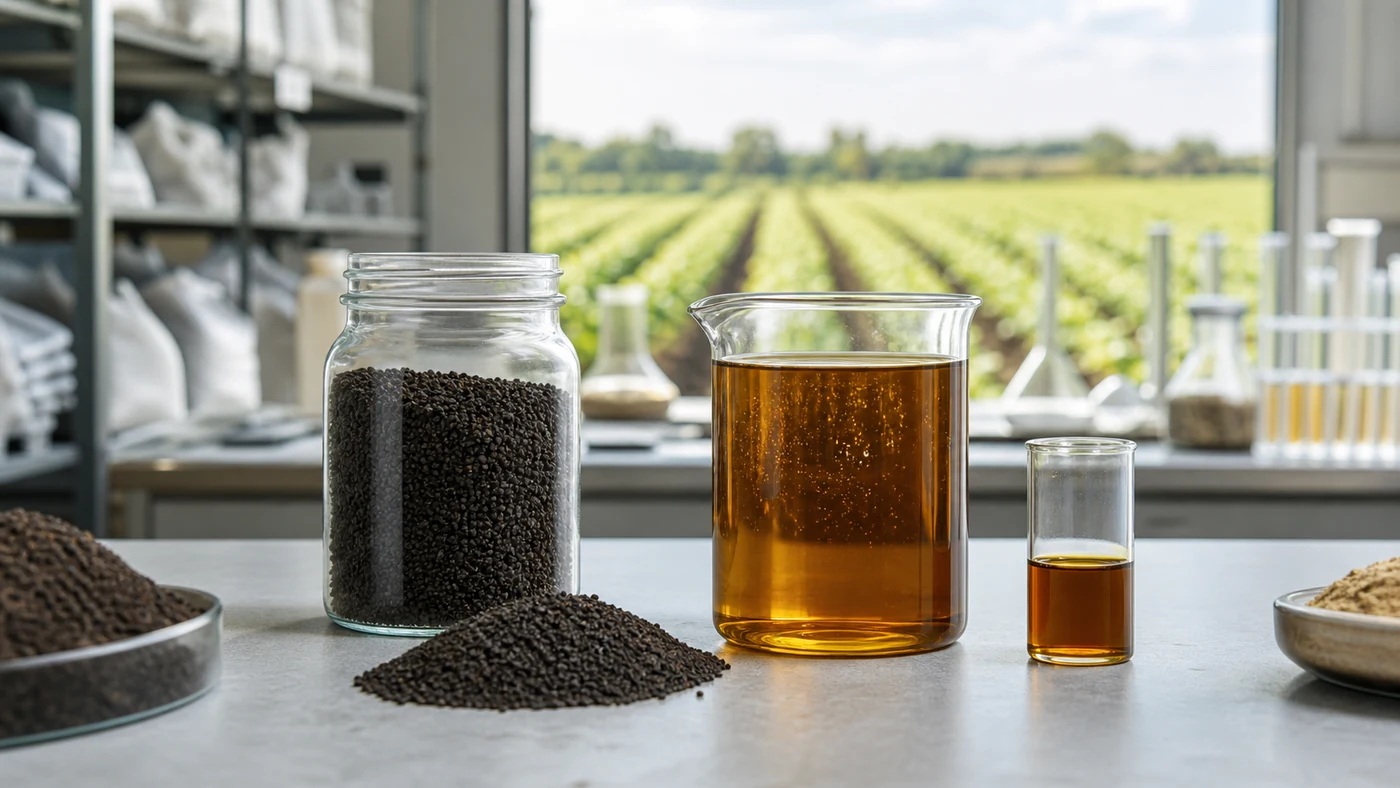
Rutom Bio supplies organic inputs that map to the four windows above, with certification documentation and per-lot COA on request. Specifications should be confirmed against the current datasheet before ordering.
- High-Phosphorus Seabird Guano – flowering/fruit-set window; phosphorus-rich, also supplies calcium. Request per-lot P2O5 and cadmium; confirm ECOCERT/CERES scope.
- Amino-Acid Liquid Fertilizer – fast foliar nitrogen and stress recovery. Confirm N % and foliar/fertigation labelling.
- Humic Acid – root development and nutrient holding on leached soils. Request humic/fulvic %.
- Granular Organic NPK Base – slow-release backbone; a K-leaning grade for cherry fill. Request guaranteed N-P-K, organic matter %, 2-4 mm particle size.
To request datasheets, per-lot COA, certification documentation, and a stage-matched sample, contact Rutom Bio. with your target NPK, certification requirement, and volume.
Key Takeaways
- Feed by window, not by bag – N for the rainy flush, P at flowering, lift K hard through cherry fill (the K-Peak rule).
- Soil-test against pH 5.0-6.0 before ordering – outside that band, applied P and micronutrients lock up.
- For certified lots, confirm each input is listed by your certifier under EU 2018/848, NOP, or JAS – per product, not per company.
- Treat the phosphate source as a residue decision – ask for a per-lot cadmium result against EU 2019/1009.
- Specify particle size on the PO – fine for fertigation, 2-4 mm for soil – and sample before the container ships.
Frequently Asked Questions
Can I keep organic coffee certification using guano and amino-acid inputs?
Yes, provided each product is listed by your certifier. Seabird guano, amino-acid liquids, and humic acid are accepted organic inputs when they carry ECOCERT, CERES, or an OMRI listing aligned with EU 2018/848 or USDA NOP. Confirm the specific SKU on the certificate, not just the supplier status; final acceptance rests with your certifier.
What particle size should I order for drip irrigation versus soil application?
Use a fine micron-grade powder for foliar spray and fertigation, and a 2-4 mm granule for a broadcast or banded soil base. Confirm the supplier stated particle size against your fertigation equipment before ordering; the wrong grade is a frequent cause of clogged emitters.
How many fertilizer applications does a coffee crop need per season?
Three to four split applications usually beat one heavy pass on the same budget: a P/Ca layer before flowering, nitrogen through the vegetative flush, and a potassium-led pass split across cherry filling. Splitting limits leaching on the acidic, high-rainfall soils where coffee grows.
Does seabird guano supply enough potassium for cherry filling?
No. Seabird guano is phosphorus- and calcium-led, which suits flowering and fruit set, not the fill window. For cherry fill, pair it with a K-leaning granular organic base or a high-K organic blend, and confirm the guaranteed potassium figure on the COA.
What heavy metals should a coffee fertilizer COA report?
At minimum cadmium, lead, arsenic, and mercury, tested per lot. Cadmium is the priority because it rides in through phosphate sources and is capped for EU market access under Regulation (EU) 2019/1009.
Decide the grade, finish, certifier scope, and particle size before the order; that protects a coffee program better than chasing the lowest price per tonne on a bag that only says “organic.”
– Rutom Bio Technical Supply Desk
About This Guide
Reviewed by the Rutom Bio. Technical Supply Desk – organic input sourcing & QC. Last updated: 2026-06-09. This guide gives an exporter/sourcing perspective on coffee fertilization; final agronomic rates require your own soil and leaf analysis, and certification acceptance rests with your certifier.
References & Sources
- Regulation (EU) 2018/848 – organic production and labelling
- Regulation (EU) 2019/1009 – Fertilising Products Regulation; cadmium limits
- USDA National Organic Program, 7 CFR Part 205
- JAS Organic (MAFF, Japan)
- OMRI – Organic Materials Review Institute
- FAO Arabica Coffee Manual – coffee nutrient removal (~40 kg N, 2.2 kg P, 53 kg K per tonne green bean)
About the Author: Rutom




 English
  Spanish
  French
  Japanese
  Korean
  German
  Portuguese
  Italian
  Indonesian
  Vietnamese
  Turkish
  Persian
  Russian
  Chinese