

sommario
Il logo ECOCERT presente sulla brochure di un fornitore e un certificato ECOCERT che copre esattamente il prodotto contenuto nel vostro contenitore non sono la stessa cosa. È proprio in questa discrepanza che risiedono i problemi di importazione: un certificato autentico rilasciato per una linea di prodotti diversa, un ambito di validità scaduto o uno standard non conforme al mercato in cui vendete.
Questa guida è rivolta all’acquirente, non all’ufficio certificazioni. Spiega cosa attesta effettivamente una certificazione ECOCERT relativa agli “input” — e cosa invece non attesta; come verificare un certificato in pochi minuti sulla banca dati pubblica di ECOCERT; e quali mercati si aprono effettivamente con ciascuno standard ECOCERT.
In breve
| Domanda | Risposta breve |
|---|---|
| Che cos’è ECOCERT? | Un ente indipendente di ispezione e certificazione (Francia, con oltre 30 anni di esperienza) attivo in più di 130 paesi |
| Cosa certifica per quanto riguarda i fertilizzanti? | Che il prodotto sia un “fattore di produzione per l’agricoltura biologica” approvato ai sensi di una norma specifica, e non che si tratti di un prodotto finito “certificato biologico” |
| Dove lo verifichi? | La banca dati pubblica di ECOCERT sugli input (ap.ecocert.com/intrants) |
| Quali standard può coprire? | UE (Reg. 2018/848), USDA NOP, JAS, COR, GB, BR, NPOP |
| Le materie prime devono essere biologiche? | Non necessariamente, ma devono rispettare le regole e le restrizioni di immissione previste dallo standard, e il dato immesso deve corrispondere allo standard indicato |
Che cos’è in realtà la certificazione ECOCERT
ECOCERT è un ente indipendente di ispezione e certificazione, fondato in Francia e attivo da oltre 30 anni in più di 130 paesi. Per chi acquista fertilizzanti, il servizio di riferimento è il suo Programma "Input per l'agricoltura biologica": ECOCERT valuta un fertilizzante o un ammendante in base a uno standard biologico e, se risulta conforme, lo inserisce nell’elenco dei prodotti che gli agricoltori biologici sono autorizzati a utilizzare. I prodotti conformi vengono pubblicati in una banca dati accessibile al pubblico, in modo che la certificazione sia verificabile dall’agricoltore, dal commerciante e dall’acquirente.
Quest'ultimo punto è più importante del logo. Il valore che ECOCERT ha per te non sta nel marchio riportato sulla confezione, ma nel fatto che un ente indipendente abbia verificato il prodotto in base a uno standard ben definito e abbia pubblicato il risultato in un luogo in cui puoi verificarlo.
Cosa significa che un fertilizzante è “certificato ECOCERT”?
Significa che il fertilizzante è stato valutato in base a uno standard biologico e approvato come fattore di produzione che gli agricoltori biologici possono utilizzare. Non significa che il fertilizzante sia un “prodotto biologico certificato” allo stesso modo in cui lo è un alimento etichettato come biologico. Per un importatore, l’interpretazione pratica è più semplice: il prodotto è autorizzato all’uso nella produzione biologica secondo lo standard indicato nel certificato e solo secondo quello standard.
“Fattori di produzione per l’agricoltura biologica” non equivale a “certificato biologico”
È proprio questa distinzione a creare confusione nella maggior parte degli acquirenti, quindi vale la pena chiarirla una volta per tutte: una certificazione ECOCERT relativa alle materie prime attesta che il prodotto è ammesso nella produzione biologica; non equivale però all’affermazione che un prodotto finito rechi l’etichetta biologica.
La regola alla base di tutto ciò è ben precisa. Le materie prime utilizzate per produrre un input di solito non devono essere a loro volta certificate biologiche, ma sia le materie prime che i coadiuvanti tecnologici devono rispettare le norme e le restrizioni relative agli input biologici, e l’input finito deve corrispondere allo standard indicato. Pertanto, un produttore può disporre di un’iscrizione ECOCERT del prodotto finale del tutto legittima anche se le sue materie prime non sono “certificate biologiche”. È così che è concepito il sistema dei prodotti finali; non si tratta di un campanello d’allarme. Ciò che occorre verificare è che il prodotto finale figuri nell’elenco di conformità relativo allo standard in base al quale opera il proprio cliente.
⚠️ Nota sul campo — La trappola dell’ambito: Il problema più comune relativo ai certificati non è la contraffazione. Si tratta infatti di un certificato autentico il cui ambito di applicazione copre una linea di prodotti diversa da quella oggetto del preventivo. Un fornitore in possesso di una certificazione ECOCERT valida per una miscela potrebbe proporvi una seconda miscela che non è mai stata certificata. Verificate sempre che l’ambito di applicazione del certificato corrisponda esattamente al nome del prodotto e alla formulazione indicati nel vostro ordine di acquisto.
Verifica dei 4 campi del certificato: verifica di un dato ECOCERT
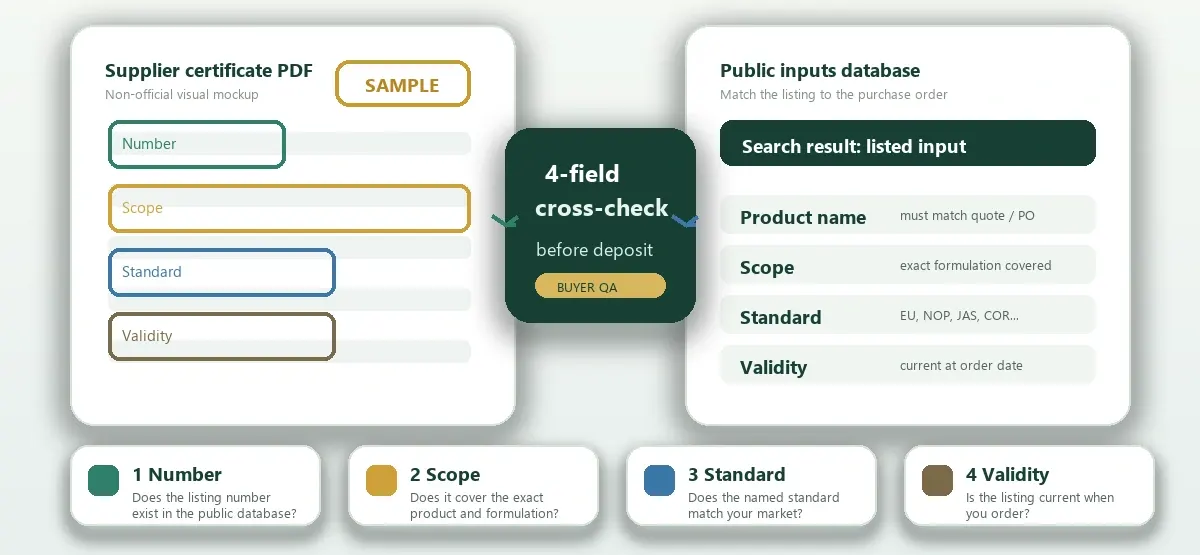
È possibile verificare un dato ECOCERT in pochi minuti, senza bisogno di inviare e-mail a nessuno, controllando quattro campi nel database pubblico di ECOCERT. Controllate sempre gli stessi quattro campi: è il modo più veloce per distinguere una certificazione autentica da un semplice logo incollato su un opuscolo.
- Numero — il numero del certificato o della registrazione esiste effettivamente nel database pubblico degli input?
- Ambito di applicazione — L’inserzione riguarda il nome esatto del prodotto e la formulazione che stai acquistando, e non una linea affine presente nel catalogo?
- Standard — è certificato secondo lo standard richiesto dalla vostra destinazione (UE, NOP, JAS…), e non secondo uno diverso?
- Validità: il certificato è ancora valido o è scaduto?
ECOCERT pubblica l'elenco dei prodotti conformi nel proprio database pubblico dei contributi (inputs.bio / intrants.bio, oltre 11.000 riferimenti). Se un prodotto che un fornitore definisce “certificato ECOCERT” non è presente in tale database in una categoria corrispondente al vostro ordine, considerate tale affermazione come non comprovata finché non vi venga mostrata la scheda del prodotto, e non una semplice immagine scannerizzata del logo.
Come posso verificare l'autenticità di un certificato ECOCERT?
Verifica il numero, l’ambito di applicazione, lo standard e la validità confrontandoli con la banca dati pubblica di ECOCERT. Se il prodotto è elencato in un ambito di applicazione che corrisponde al tuo ordine e a uno standard riconosciuto dal tuo mercato, la dichiarazione è valida. Se non è presente nell’elenco, o se l’ambito di applicazione riguarda un prodotto diverso, il certificato non copre il tuo acquisto — indipendentemente dall’aspetto ufficiale del PDF. Questa è la versione specifica per i certificati della più ampia lista di controllo per la verifica dei fornitori ogni acquirente di prodotti biologici dovrebbe farlo.
Non tutti i documenti ECOCERT attestano la stessa cosa
Un fornitore può inviarti diversi documenti “ECOCERT”, che però non hanno tutti lo stesso peso ai fini della decisione di acquisto. Interpretare un certificato a livello aziendale come se fosse un’approvazione del prodotto è uno degli errori più comuni che un acquirente commette nel verificare la documentazione. Metti in ordine i documenti in base a ciò che ciascuno di essi dimostra effettivamente:
- Certificato aziendale/operativo — attesta che un’entità è certificata nell’ambito di un programma. È utile per identificare l’azienda certificata; non garantisce tuttavia che tutti i prodotti da essa venduti siano coperti dalla certificazione.
- Certificato di prodotto o ambito di applicazione del prodotto — collega la norma a prodotti o classi specifici. Si tratta del documento che deve corrispondere al nome del prodotto riportato nel preventivo e nella fattura proforma.
- Revisione documentale — una valutazione preliminare basata esclusivamente sull’esame dei documenti. Adatta per una selezione preliminare; non equivale a un audit.
- Attestazione in fase di inserimento: una verifica più approfondita che, oltre all’esame della documentazione, prevede un’ispezione in loco e un controllo di tracciabilità.
- Inserimento in un database pubblico: conferma che il prodotto, la categoria, il Paese e la norma siano coerenti con quanto dichiarato dal fornitore, e chiunque può verificarlo.
- Certificato di analisi del lotto — un documento relativo alla singola spedizione (sostanze nutritive, umidità, pH, metalli pesanti, numero di lotto). Fornisce risposte a diverse domande e non sostituisce la certificazione.
La regola pratica: verifica quale livello ti è stato fornito prima di considerarlo una prova. Un certificato aziendale e un certificato di analisi (COA) di lotto non equivalgono a una certificazione di prodotto conforme allo standard richiesto dal tuo mercato — e solo quest’ultima copre effettivamente il tuo ordine.
Per quale mercato è valido? ECOCERT in tutta l'UE, NOP, JAS e altri
Un certificato ECOCERT è utile solo se rilasciato secondo lo standard riconosciuto dal proprio mercato. ECOCERT può certificare i prodotti in base a diverse normative biologiche, tra cui quella europea (Regolamento (UE) 2018/848), statunitense (USDA NOP), giapponese (JAS), canadese (COR), cinese (GB), brasiliano (BR) e indiano (NPOP), tra gli altri. La dicitura “certificato ECOCERT”, se utilizzata da sola, è praticamente priva di significato se non viene specificato lo standard di riferimento.
La conseguenza per gli appalti è diretta: l'inserimento nell'elenco sotto il regolamento dell'UE sul biologico non garantisce automaticamente lo sdoganamento di una spedizione negli Stati Uniti nell'ambito del programma NOP, e viceversa. Prima di effettuare un ordine, verifica che lo standard indicato sul certificato corrisponda al mercato di destinazione. Se non corrispondono, il certificato è autentico ma non è la chiave giusta per la tua porta.
Gli Stati Uniti aggiungono una fase che spesso sfugge agli acquirenti. Anche un dato valido, rientrante nell’ambito di applicazione del NOP, non è automaticamente pronto per l’uso: ai sensi del Programma nazionale per l'agricoltura biologica dell'USDA (7 CFR Parte 205), una sostanza utilizzata in un’azienda biologica deve essere approvata dall’ente di certificazione di tale azienda prima dell’uso. Il documento ECOCERT fornito dal fornitore supporta tale verifica, ma non la sostituisce. Pertanto, per gli ordini destinati agli Stati Uniti, il certificato va considerato come un requisito necessario ma non sufficiente: spetta all’ente di certificazione dell’acquirente decidere in via definitiva se il prodotto può essere utilizzato.
ECOCERT, CERES, OMRI e USDA NOP per i fattori di produzione biologici
Spesso gli acquirenti considerano questi quattro nomi come sinonimi, ma non lo sono. Due sono organismi di certificazione, uno è un istituto di revisione dei dati e uno è uno standard nazionale. Sapere quale è quale ti evita di richiedere al fornitore il documento sbagliato.
| Nome articolo | ECOCERT | CERES | OMRI | USDA NOP |
|---|---|---|---|---|
| Che cos’è | Ente di certificazione | Ente di certificazione | Istituto di revisione degli input (senza scopo di lucro) | Standard nazionale per i prodotti biologici (USA) |
| Ruolo degli input | Certifica la conformità degli input a diverse norme | Certifica la conformità degli input a diverse norme | Nelle recensioni e negli elenchi è indicato come “certificato OMRI”.” | Lo standard a cui gli altri si attengono per ottenere la certificazione |
| Focus sul mercato | UE, NOP, JAS, COR, GB, BR, NPOP | UE, NOP, JAS | Stati Uniti (conformità alle norme NOP) | Stati Uniti |
| Dove verificare | Banca dati degli ingredienti ECOCERT | Certificato / pacchetto CERES | Elenco dei prodotti OMRI | Documentazione dell’ente di certificazione + USDA |
| Le materie prime sono biologiche? | Non richiesto; deve rispettare le regole di immissione | Non richiesto; deve rispettare le regole di immissione | Non richiesto (verificato ai fini del NOP) | Dipende dalla categoria di prodotto |
Per una parte della nostra gamma disponiamo delle certificazioni ECOCERT e CERES La certificazione — che copre mercati sovrapposti ma non identici — e l’attuale ambito di applicazione del certificato, non il logo, determinano quali caratteristiche possano essere dichiarate per un determinato prodotto. Pertanto, la domanda giusta da porre in una richiesta di preventivo non è “Siete certificati?”, bensì “Quale certificato copre questo prodotto per il mio mercato?”.”
ECOCERT è equivalente alla certificazione USDA Organic?
No. Il NOP dell’USDA è lo standard biologico degli Stati Uniti; ECOCERT è un ente di certificazione che può certificare un prodotto secondo il NOP, oltre che secondo altri standard. La dicitura ’Certificato ECOCERT secondo lo standard NOP“ coincide con la certificazione ”USDA Organic“; la dicitura ”Certificato ECOCERT secondo il regolamento UE“ invece no. Quando un fornitore menziona ”ECOCERT“, la domanda successiva da porre dovrebbe essere: ”Secondo quale standard?»
Cosa non è coperto dal certificato ECOCERT
Un elenco degli ingredienti certificato ECOCERT risponde a una domanda — questo prodotto è consentito nell’agricoltura biologica secondo una determinata norma? — ed è facile estrapolarne risposte che non ha mai fornito. Conoscere i suoi limiti ti impedisce di scartare documenti di cui hai ancora bisogno.
- Limiti relativi ai metalli pesanti. L'elenco dei dati in ingresso non costituisce un test in batch sui metalli pesanti. Il cadmio, il piombo e l'arsenico devono comunque essere controllati per ogni singolo lotto. certificato di analisi o un rapporto di una terza parte: il risultato organico non lo sostituisce.
- Classificazione doganale e sdoganamento. Il certificato non stabilisce il codice SA e non sostituisce il certificato fitosanitario né il resto della documentazione di importazione. Lo status biologico e lo status doganale sono due questioni distinte.
- Rendimento agronomico. La certificazione è una dichiarazione di conformità, non una promessa di resa. Conferma che il prodotto è ammesso nella produzione biologica; non dice nulla sul fatto che sia adatto alla vostra coltura e al vostro terreno.
- Qualsiasi elemento che esuli dall'ambito indicato nella scheda di prodotto. Il certificato copre esclusivamente il prodotto e la formulazione indicati nella scheda. Una nuova miscela, una riformulazione o una confezione diversa costituiscono un prodotto diverso che richiede una propria scheda di prodotto.
Prima di accettare un preventivo “certificato ECOCERT”
- Chiedete in base a quale standard sia stato rilasciato il certificato — UE, NOP, JAS — e verificate che corrisponda al vostro mercato di destinazione.
- Verifica tu stesso la presenza dell’azienda nel database pubblico di ECOCERT prima di versare un acconto; non accettare un logo scannerizzato come prova.
- Assicurati che l'ambito di validità del certificato corrisponda esattamente al prodotto e alla formulazione indicati nel tuo ordine di acquisto, e non a una voce diversa presente nel catalogo.
- Ricordate che un elenco degli ingredienti non equivale a una dichiarazione di “prodotto biologico certificato”: non esagerate nel presentarlo ai vostri clienti.
- Chiedi il certificato e un lotto certificato di analisi insieme, in modo che i documenti e il prodotto fisico corrispondano.
Domande Frequenti
Cosa significa che un fertilizzante è “certificato ECOCERT”?
Significa che il fertilizzante è stato valutato in base a uno standard biologico e approvato come input che gli agricoltori biologici possono utilizzare — non che si tratti di un prodotto finito “certificato biologico”. Il certificato è valido solo per lo standard in esso indicato (UE, NOP, JAS e così via). Verificate lo standard esatto prima di dare per scontato che il prodotto sia idoneo al vostro mercato.
ECOCERT è equivalente alla certificazione USDA Organic?
No. Il NOP dell’USDA è lo standard biologico nazionale degli Stati Uniti; ECOCERT è un ente di certificazione che può certificare i prodotti secondo il NOP e secondo altri standard, come il regolamento UE e il JAS. Un certificato ECOCERT rilasciato secondo il NOP coincide con la certificazione “USDA Organic”; uno rilasciato secondo lo standard UE, invece, no. Verificate sempre quale standard sia indicato nel certificato.
Come posso verificare se un certificato ECOCERT è autentico?
Verifica i seguenti quattro campi confrontandoli con la banca dati pubblica di ECOCERT relativa ai fattori di produzione (inputs.bio): il numero di registrazione, l’ambito di applicazione, la norma e la data di validità. Se il prodotto in questione è presente nell’elenco con un ambito di applicazione e una norma che corrispondono al tuo ordine, la dichiarazione è valida. Se non è presente nell’elenco, considerarla non comprovata, indipendentemente dall’aspetto ufficiale del PDF.
Le materie prime contenute in un fertilizzante certificato ECOCERT devono essere biologiche?
Di solito no. Le materie prime che compongono un ingrediente non devono generalmente essere certificate come biologiche, ma devono rispettare le norme e le restrizioni relative agli ingredienti previste dallo standard a cui il prodotto è soggetto, e l’ingrediente finito deve essere conforme a tale standard. Si tratta di una scelta deliberata: l’indicazione di un ingrediente certifica che il prodotto finito è consentito nell’agricoltura biologica, non che ogni singolo ingrediente sia dotato di un proprio certificato biologico.
Il certificato ECOCERT mi permette di vendere il fertilizzante come prodotto biologico nel mio Paese?
Solo se il certificato è rilasciato secondo lo standard riconosciuto dal tuo Paese. Una certificazione UE favorisce le vendite nei canali biologici dell’Unione Europea; una certificazione NOP favorisce il mercato statunitense. Un certificato rilasciato secondo uno standard non adeguato è autentico, ma non ti apre le porte del mercato di destinazione. Verifica che lo standard corrisponda a quello richiesto dal mercato di destinazione prima di effettuare l’ordine e verifica separatamente eventuali norme locali in materia di etichettatura.
Passo successivo: comunicateci lo standard richiesto dal vostro mercato e il prodotto di cui avete bisogno, e vi invieremo il certificato corrispondente, la relativa scheda nel database e un certificato di analisi (COA) del lotto — oppure Scopri la gamma certificata ECOCERT e richiedere contemporaneamente il certificato e l'analisi.
— Ufficio forniture tecniche Rutom
Informazioni su questa guida
A cura di Rutom Bio. Technical Supply. Rutom Bio. produce ed esporta apporti di fertilizzanti organici e possiede le certificazioni ECOCERT e CERES per una parte della propria gamma. La presente guida illustra il funzionamento generale della certificazione ECOCERT relativa alle materie prime; il nostro ambito di certificazione è definito dai nostri certificati attuali e dalla loro registrazione nella banca dati pubblica, non dal presente articolo, e gli acquirenti dovrebbero sempre verificare la conformità rispetto allo standard richiesto dal proprio mercato. I riferimenti ECOCERT e normativi riportati di seguito provengono da fonti pubbliche. Ultimo aggiornamento: 06/07/2026.
Riferimenti e fonti
- Ecocert — Fattori di produzione per l'agricoltura biologica
- Ecocert — Che cos’è un input?
- Regolamento (UE) 2018/848 sulla produzione biologica e l'etichettatura
- USDA — Programma nazionale per l'agricoltura biologica
- eCFR — Programma nazionale per l'agricoltura biologica, 7 CFR Parte 205
- Ecocert — Database degli input
- OMRI — Istituto per la valutazione dei materiali organici
Informazioni sull'autore: Rutom




 English
  Spanish
  French
  Japanese
  Korean
  German
  Portuguese
  Italian
  Indonesian
  Vietnamese
  Turkish
  Persian
  Russian
  Chinese