
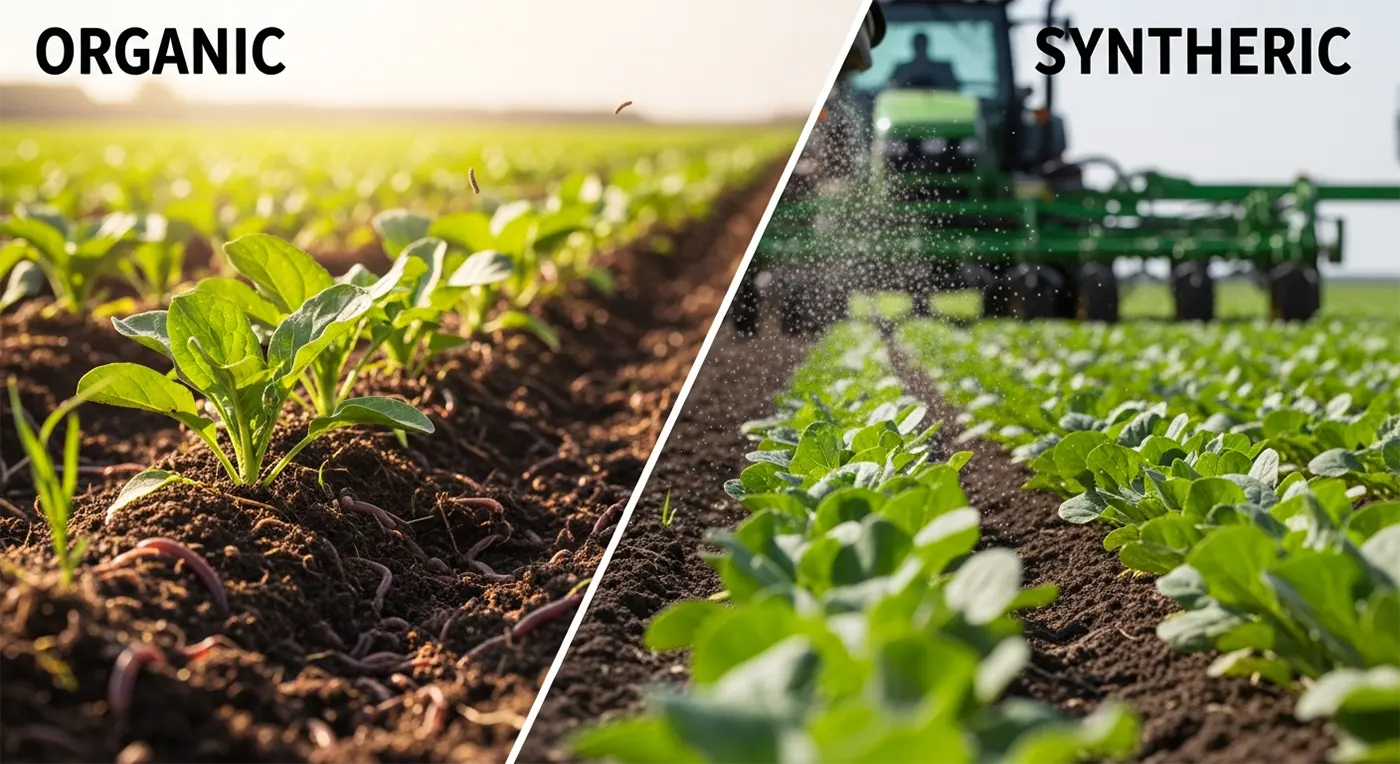
table of contents
In the spring of 2022, one of our long-term wholesale customers — a mid-sized grain and vegetable operation in central Illinois — called us in a state of controlled panic. Urea had just cracked $1,000 per metric ton. His fertilizer line item, which had been running at roughly $180 per acre, was suddenly looking at $310. He needed to know, fast, whether there was a viable path that didn’t involve absorbing that entire cost increase or walking back his planting program.
That conversation forced us to work through the organic vs synthetic question more rigorously than we had in years. Not as a sustainability talking point — as a procurement problem. Could a partial or full shift to organic inputs pencil out? Under what conditions? What would break if he tried to move too fast?
This guide is the framework that came out of those conversations, updated with current research and market data. We compare organic and synthetic fertilizers on the factors that actually determine outcomes for commercial buyers: cost structure, nutrient delivery, soil effects, equipment compatibility, regulatory compliance, and long-term ROI. The goal is a decision framework you can use, not a verdict.
Key takeaway up front: neither type is universally better. The right answer depends on your crop, your soil history, your equipment, and your time horizon. Most well-run commercial operations use both — but the split and the sequencing matter significantly.
How Each Type Actually Works
The fundamental difference is not just where the nutrients come from — it is how and when the plant gets them.
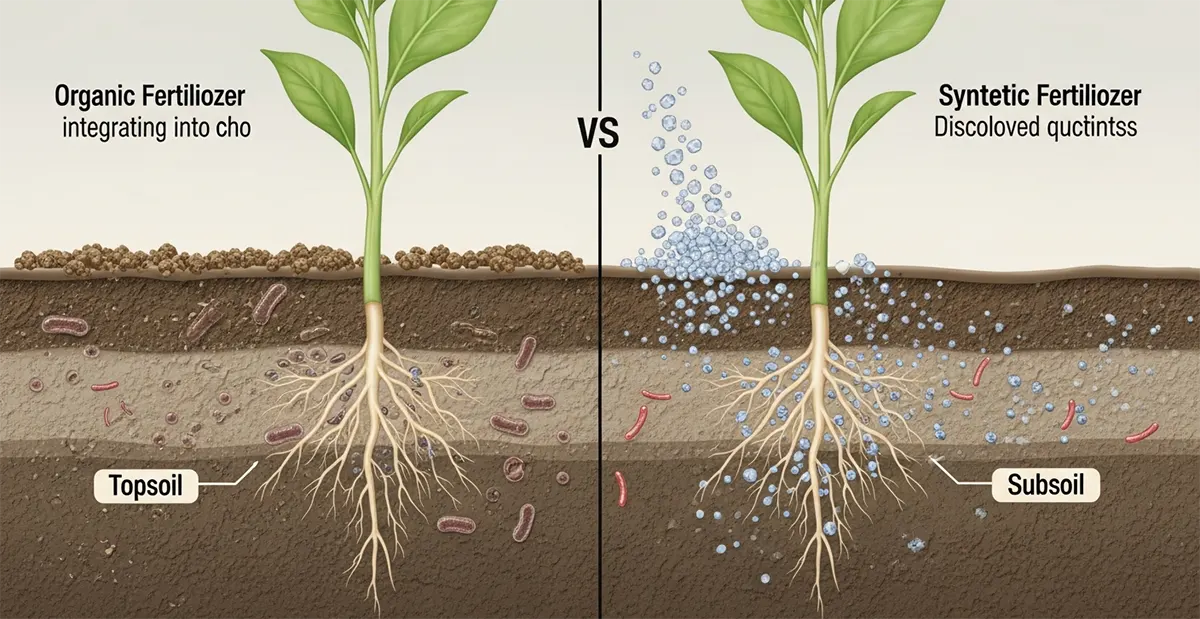
Organic fertilizers: feeding the soil, not the plant
Organic fertilizers — derived from composted plant matter, animal manure, bone meal, blood meal, fish emulsion, kelp, and similar sources — do not deliver nutrients directly to the plant. They deliver organic matter. Soil microbes must first break that matter down, converting it into soluble mineral forms the plant can absorb. This is why results take weeks rather than days.
The upside of that delay is what happens to the soil in the process. As organic matter decomposes, it builds soil structure — improving water retention, aeration, and drainage. It feeds the microbial population that drives nutrient cycling. It adds trace minerals and secondary nutrients that synthetic products typically lack. Over time, repeated organic applications measurably increase soil organic matter content, which correlates with higher water-holding capacity and lower susceptibility to compaction.
Oregon State University Extension Service research confirms that organic fertilizers tend to have lower NPK concentrations but a broader nutrient profile, and that their nutrients must be converted by soil microbes — a process that slows significantly in cold soil early in the season.
Synthetic fertilizers: direct, fast, and precise
Synthetic fertilizers are manufactured from mineral sources and atmospheric nitrogen through processes like the Haber-Bosch reaction. Their nutrients are water-soluble and immediately plant-available — roots can absorb them within days of application. That speed is their primary advantage.
Synthetics also come in precise, consistent formulations. A bag labeled 20-10-5 contains exactly 20% nitrogen, 10% phosphorus, and 5% potassium, every bag, every batch. That predictability is valuable for precision nutrition programs where you are targeting specific deficiencies based on soil tests.
The tradeoff is that synthetics do not contribute to soil organic matter. Long-term heavy reliance on synthetic-only programs is associated with reduced microbial activity, declining soil structure, and in some cases rising soil acidity — effects that can gradually increase input volume needed to achieve the same yield.
One mental model that has held up across the operations we work with: organic fertilizers invest in the soil infrastructure; synthetics draw on it. Heavy synthetic use without organic replenishment is, over a long enough time horizon, spending down a balance that eventually needs to be rebuilt — at higher cost than maintaining it would have required.
Cost Comparison: What Bulk Buyers Actually Pay
The sticker price comparison almost always favors synthetics — per unit of nitrogen, phosphorus, or potassium delivered, synthetic fertilizers are cheaper. But that comparison misses several costs that compound over time.
| Cost factor | Organic | Synthetic |
|---|---|---|
| Purchase price per unit of N | Higher per ton — lower NPK concentration means more product moved per acre | Lower — concentrated formulas, less volume required |
| Application frequency | 1–2× per season; slow release feeds for 2–6 months | 2–4× per season; nutrients deplete quickly on sandy soils and after heavy rain |
| Soil amendment savings | Builds soil structure over time — reduces need for additional conditioners over a 3–5 year horizon | Minimal — does not add organic matter; may require supplemental soil inputs as structure degrades |
| Price volatility exposure | Low — feedstocks (manure, plant residues) are not coupled to natural gas markets | High — urea and other nitrogen fertilizers closely track natural gas; hit $1,000+/ton in 2022 |
| Runoff and leaching waste | Lower runoff risk; nutrients bind to organic matter and release slowly | Higher leaching risk on sandy soils and in high-rainfall windows |
| Organic certification value | Enables USDA Organic, OMRI-certified programs — 20–100% crop price premium potential | Not compatible with NOP organic certification requirements |
The USDA Economic Research Service has tracked fertilizer costs at 33–44% of corn operating costs and 34–45% of wheat operating costs in recent years. That single number explains why the 2022 price spikes hit farm budgets so hard. The Illinois operation mentioned above had no organic component in their program and absorbed the full cost impact. A neighboring farm that had shifted roughly 35% of their acres to an organic foundation program the previous season had meaningful insulation — their per-acre cost increase was under $60, compared to $130+ for full synthetic operations in their area.
The practical cost question for bulk buyers is not just what does a ton cost today. It is what the full nutrient management program costs per acre over a five-year horizon, accounting for soil amendment savings, application frequency, and — if applicable — certification premium value.
Operations pursuing USDA Organic certification can command price premiums of 20–100% on certain crops, depending on the market. That premium changes the ROI math significantly for buyers in a position to pursue certification.
Soil Health: The Long Game
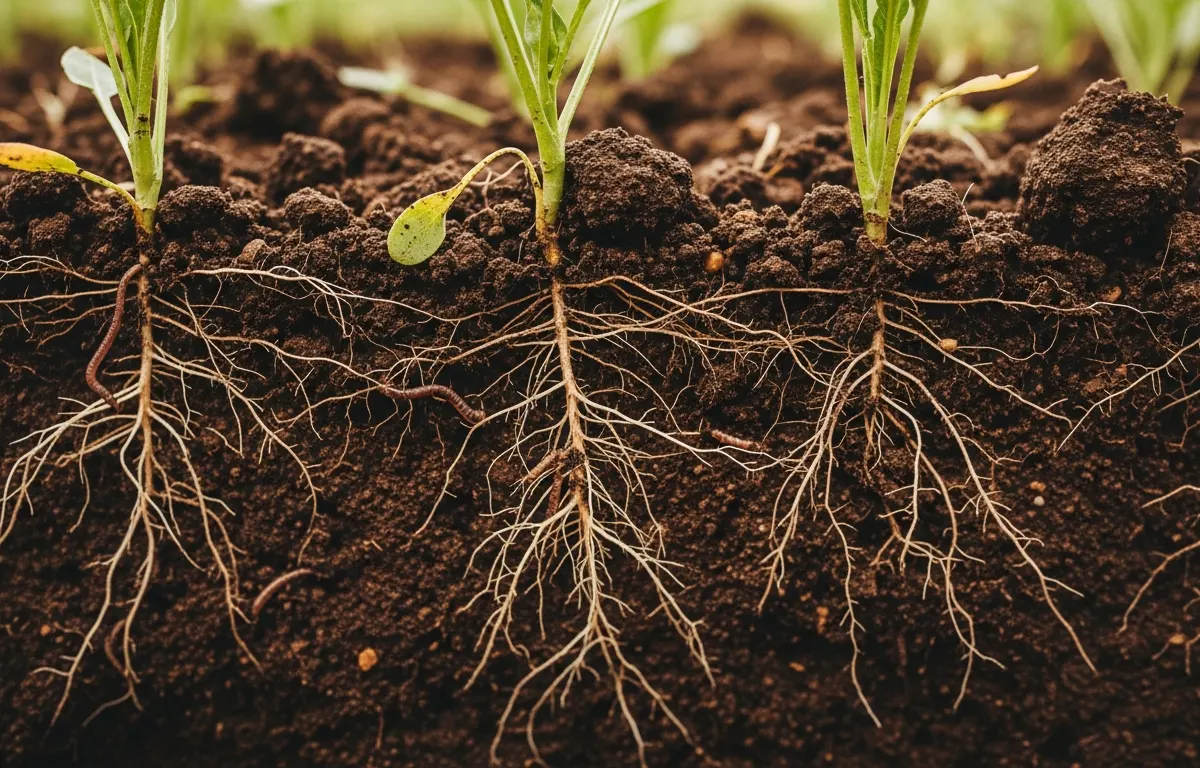
This is where the comparison becomes most consequential for operations planning beyond a single season.
Healthy soil is not just a medium for holding plants upright. It is an active biological system — a functioning community of bacteria, fungi, earthworms, and microarthropods that drives nutrient cycling, disease suppression, and water infiltration. That biological infrastructure has measurable value, and it responds differently to organic versus synthetic inputs.
What the research shows
A 2019 study reviewed in Cropler’s fertilizer research series found that organic fertilizer tends to increase soil pH and counteract acidification — a documented long-term effect of synthetic-only nitrogen programs. A 2024 study published in Heliyon provided additional evidence linking organic matter additions to improved soil microbial diversity.
More practically: fields that receive consistent organic input tend to hold water better, compact less under equipment traffic, and show better recovery after drought stress. We have seen this play out on accounts we have serviced for more than a decade. Fields that started adding compost-based organic amendments in the mid-2010s are measurably easier to manage today — lower irrigation costs, fewer compaction issues after wet springs, more consistent yields in low-rainfall years.
The microplastic concern worth monitoring
One emerging issue specific to certain synthetic fertilizer formats deserves attention. A 2025 study cited in recent agricultural research found microplastics in 78% of lettuce samples grown with polymer-coated controlled-release fertilizers — the type widely used in slow-release synthetic programs. This is preliminary research and should not drive immediate changes, but institutional buyers with food safety compliance obligations — grocery supply chains, school district procurement programs — are beginning to ask questions about it.
If you are supplying produce markets where consumer-facing certification is part of your value proposition, this is a situation worth tracking closely.
Application: What Changes on the Ground
Switching from synthetic to organic — or building a hybrid program — requires operational adjustments. These are manageable, but they need to be planned for rather than discovered at the time of first large-scale application.
Nutrient availability timing
The most significant practical difference is the lag between application and nutrient availability. Organic fertilizers need soil temperature above approximately 50°F for meaningful microbial decomposition to occur. In cooler climates, early-season applications may need to be made 3–4 weeks ahead of the growth stage where nutrients are most needed.
For operations in regions with cold springs — parts of the Midwest, New England, the northern Plains — this timing adjustment is the most common friction point in the first season of an organic program. It catches buyers off guard because the timing instinct built from years of synthetic use does not transfer directly.
Application equipment
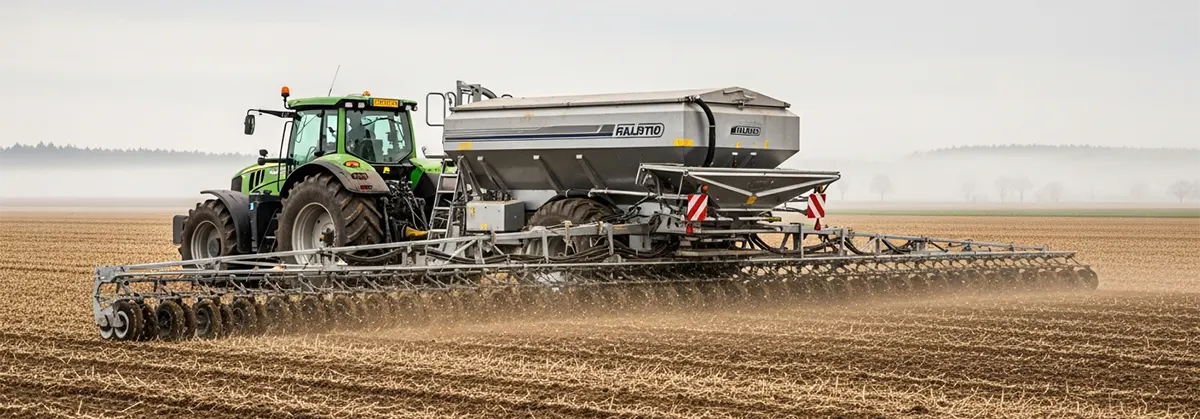
Granular organic fertilizers generally run through standard spreader equipment without modification. Liquid organics — fish emulsion, liquid compost teas, fermented plant extracts — may require line flushing after application to prevent bacterial buildup. Bulk dry organics sometimes require different spreader settings than high-concentration synthetic granules because bulk density and particle size differ.
None of these are barriers that should stop a transition. But a trial run on a smaller area before the first large-scale application is worth the time — and worth asking your supplier to support directly.
Nutrient consistency across batches
Synthetic fertilizers deliver guaranteed nutrient ratios — that 20-10-5 label means exactly that, every bag. Organic fertilizers vary by batch depending on feedstock and composting conditions. A reputable supplier will provide a certificate of analysis (COA) with each lot, and those numbers will stay within a consistent range — but the range is wider than it is for synthetics.
For precision nutrition programs that rely on exact NPK targeting, this variability requires building in a buffer when planning application rates. Ask to see COA data from multiple recent production runs before committing to a large-volume purchase. Any supplier worth working with will have this data readily available. If they do not, that is a quality control signal.
Practical tip for hybrid programs: use organic fertilizers to build baseline fertility and soil structure across the whole field; use precision synthetics to top-dress specific deficiencies or during high-demand growth stages. This is how most agronomists we work with now recommend structuring commercial programs.
Regulatory and Certification Considerations
If your buyers or your downstream market require any form of organic certification, this section is where the decision becomes binary: synthetic fertilizers simply do not qualify.
USDA National Organic Program (NOP)
The USDA NOP prohibits the use of synthetic nitrogen fertilizers in certified organic production. If you are producing for a certified organic market — organic produce, organic grain, organic livestock feed, organic turf — your fertilizer inputs must be derived from approved natural materials and, in most cases, OMRI-listed or equivalent.
Farms transitioning to organic certification must complete a three-year transition period during which no prohibited substances, including synthetic fertilizers, are used. Every month of continued synthetic input use extends that timeline. For operations considering a transition, the time to start the clock is now, not after the next contract cycle.
State-level and institutional requirements
Beyond federal NOP, a growing number of state procurement programs and large institutional buyers — school districts, municipal park systems, sports facilities — are specifying reduced or zero synthetic chemical inputs for certain applications. Organic fertilizers are often specifically required or strongly preferred in those contracts.
The EU Farm to Fork Strategy mandates a 20% reduction in chemical fertilizer use by 2030, affecting EU-based producers and importers supplying EU markets. India’s PM PRANAM scheme offers financial incentives to states that reduce synthetic fertilizer use by 50%. The regulatory direction of travel — globally — is toward reduced synthetic dependence. Operations that develop organic sourcing and application expertise now are better positioned for compliance requirements that have not yet arrived.
When to Use Which: A Decision Framework
Rather than a single recommendation, here is how we think through the right approach for different operational situations:
| Situation | Recommended approach | Rationale |
|---|---|---|
| Urgent nutrient deficiency mid-season | Synthetic — fast-acting foliar or soil drench | Time to microbial breakdown is not available; immediate uptake needed |
| Certified organic production | Organic only — OMRI-listed products | NOP compliance is non-negotiable; synthetic inputs void certification |
| Long-term field program (5+ years) | Hybrid — organic base, synthetic precision correction | Builds soil equity while maintaining yield control |
| Tight budget, short contract | Synthetic dominant, organic supplement where soil needs it most | Lower upfront cost; add organic input on fields showing structure degradation |
| High-value produce / food safety markets | Organic or verified-clean synthetic (no polymer coating) | Microplastic and residue concerns; retailer and buyer certification requirements |
| Sports turf / public spaces / schools | Organic-first or low-synthetic hybrid | Public liability; increasingly specified in institutional RFPs; low-burn risk |
| Transitioning to organic certification | Full organic — start 3-year NOP transition clock | Every month of continued synthetic use extends the transition period |
How Most Commercial Operations Actually Run This
The binary framing of “organic vs synthetic” is somewhat misleading, because most well-managed commercial operations do not use one to the complete exclusion of the other. They use both, intentionally, for different purposes.
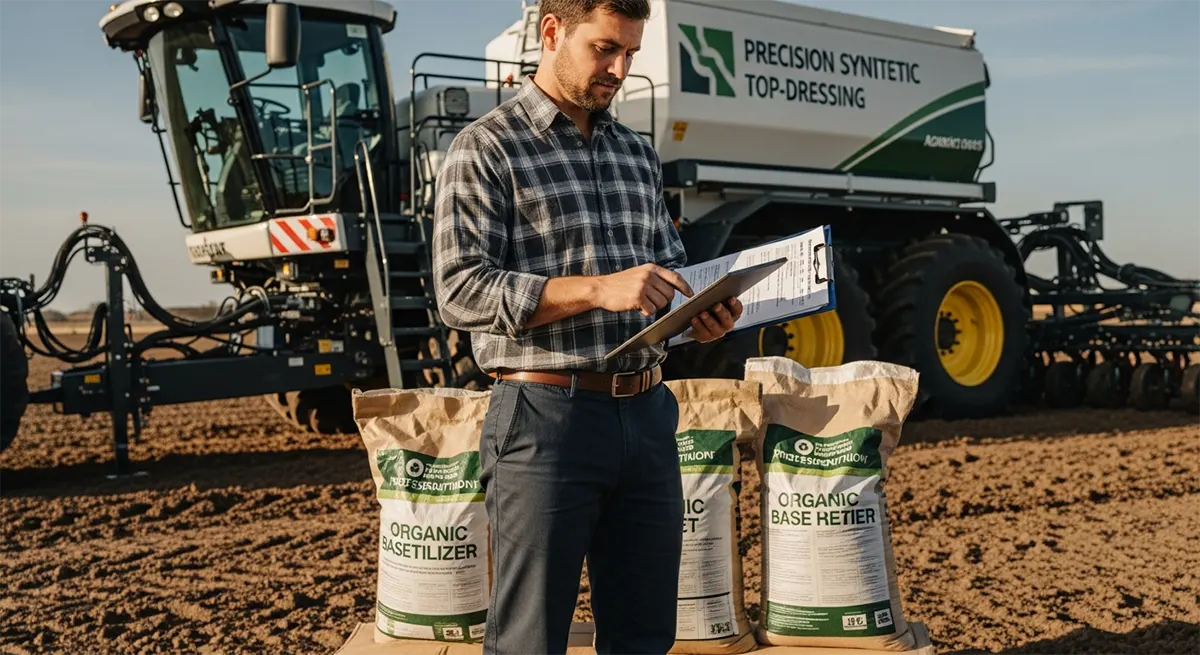
A typical approach that agronomists increasingly recommend for field crop operations:
- Pre-season: Apply organic base fertilizer — compost, pelleted manure, bone or feather meal depending on crop needs. This builds background fertility, improves soil structure, and provides slow-release nutrition through the early growth period.
- Active growth stage: Monitor with tissue testing. If specific deficiencies appear — a nitrogen shortfall during rapid vegetative growth, a phosphorus gap at flowering — apply targeted synthetic correction at precise rates.
- Post-harvest: Apply organic matter to begin decomposing through the off-season, replenishing what the crop removed and rebuilding microbial activity before the next planting.
This approach captures the soil-building benefits of organic inputs without accepting the risk of being unable to respond quickly when something goes wrong mid-season. It also makes the overall input budget more predictable: synthetic correction is applied in small, targeted doses rather than as the primary nutrition source.
Oregon State University Extension research indicates that this combined approach tends to outperform single-type programs when evaluated over multi-year trials, particularly on fields that started with degraded or depleted soil. The investment in organic matter pays dividends that compound year over year — something a single-season cost analysis does not capture.
The Illinois operation we mentioned in the introduction ended up implementing a version of this hybrid approach in 2023. They shifted roughly 40% of their total fertilizer budget to an organic foundation program on their highest-value acres — primarily compost-based pellets applied pre-season — and maintained targeted synthetic top-dressing capability for in-season correction. Their total per-acre fertilizer cost over the following two seasons was 18% lower than the 2022 peak, and their soil organic matter readings on the organic-treated fields improved measurably by the second year.
Sourcing Organic Fertilizer at Scale: What to Look For
For buyers moving from retail-sized purchases to bulk procurement — pallet quantities, tote bags, or full truckloads — the supplier selection process matters in ways that retail buying does not require.
Certification and documentation
Any organic fertilizer being used in certified organic production must come with OMRI (Organic Materials Review Institute) listing or equivalent state certification. Ask suppliers to provide the current OMRI listing certificate, not just a verbal claim. Ask for the full ingredient list and the Certificate of Analysis for the specific lot you are receiving.
The USDA National Organic Program issued recalls for several unregistered organic soil amendments in 2024 for misleading claims and contamination. For buyers running certified operations, a documentation gap in your supply chain can put your entire certification at risk. Document everything.
Consistency across lots
Request COA data from multiple recent production runs to evaluate batch-to-batch variability before committing to a volume purchase. A professional supplier will have this data readily available. Wide swings in NPK from lot to lot — greater than 15–20% variance — are a quality control concern that complicates precision application planning.
Minimum order quantities and lead time
Bulk organic fertilizer typically requires longer lead times than synthetic — particularly for composted products that go through a multi-week or multi-month production cycle. Budget 4–8 weeks for first orders from a new supplier, and establish a standing order schedule if you are running a consistent program season-over-season. Running out mid-season on an organic program is harder to recover from than running out on synthetics, where alternatives are more readily available on short notice.
Storage requirements
Granular and pelleted organic products are generally stable in dry covered storage for 12–18 months. Liquid organics — fish emulsion, liquid compost extracts — have shorter shelf lives and specific temperature storage requirements. Clarify storage specs before ordering in quantities that exceed your season’s usage. A product that breaks down in storage is money lost with no agronomic return.
The Bottom Line for Bulk Buyers
The organic vs synthetic question does not have a single right answer for every operation. It has a right answer for your operation — your soil, your crop, your market, and your time horizon.
If you are farming for certified organic markets or selling into supply chains that require reduced chemical inputs, the choice is largely made for you. If you are in conventional production without certification requirements, the question becomes one of long-term ROI: how exposed do you want to be to synthetic input price volatility, and what is your soil health worth over a five-year horizon?
The 2022 nitrogen market spike was not a once-in-a-generation event. It was a demonstration of the underlying exposure that full synthetic dependence creates. Operations with meaningful organic components in their programs had more flexibility. Those running entirely on synthetics absorbed the full cost impact.
For most commercial operations, the practical path is a hybrid program built on organic foundation fertility, with targeted synthetic applications for precision correction. That combination captures the long-term benefits of organic inputs while keeping the ability to respond quickly when crop nutrition needs change mid-season.
The soil you build over the next five years will either compound your returns or require you to keep spending more to maintain the same results. That compounding effect is what most short-term cost comparisons fail to capture — and it is the most important number in the analysis.
Sources and references
Oregon State University Extension Service, “Here’s the Scoop on Chemical and Organic Fertilizers,” extension.oregonstate.edu
USDA Economic Research Service, “Fertilizer Prices Stable at Onset of 2025 Planting Season,” ers.usda.gov
American Farm Bureau Federation, “Fertilizer Outlook: Global Risks, Higher Costs, Tighter Margins,” fb.org
UNCTAD, “Recent Developments in Global Fertilizer Markets,” September 2024
Li, Q. et al. (2022), “Organic fertilizers activate soil enzyme activities and promote the recovery of soil beneficial microorganisms after dazomet fumigation,” peer-reviewed study
Heliyon (2024), study on organic matter additions and soil microbial diversity
USDA National Organic Program (NOP) regulations, ams.usda.gov
About the Author: Rutom




 English
  Spanish
  French
  Japanese
  Korean
  German
  Portuguese
  Italian
  Indonesian
  Vietnamese
  Turkish
  Persian
  Russian
  Chinese