
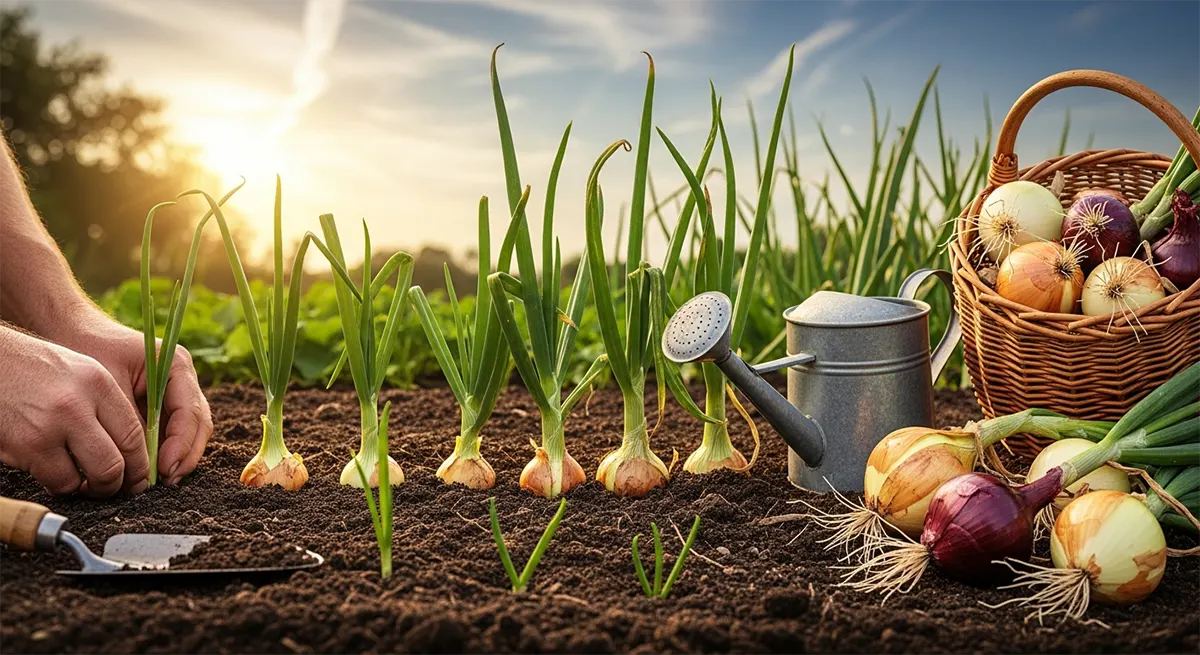
Onions are an excellent addition to any garden! They take up very little space, are easy to grow and care for, and can be stored through the winter. They also pair well with other fruits and vegetables in the garden. You can add them to sauces, salsas, and salads.
Onion planting methods
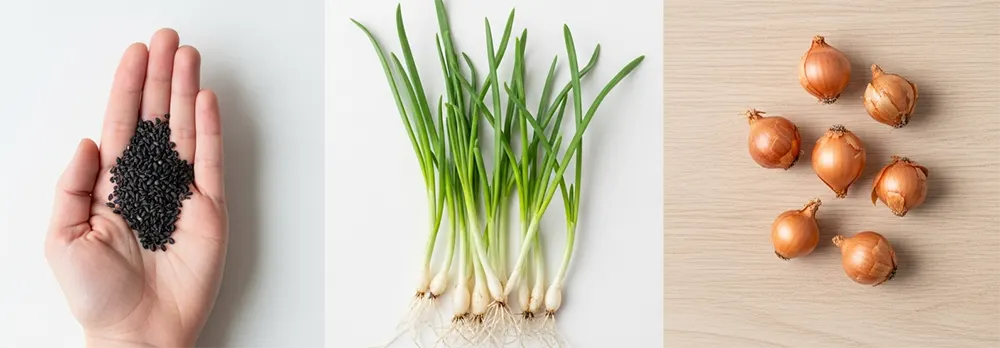
Onions can be grown from seeds, seedlings (young sprouted plants), or sets. Before planting, you should first decide which planting method to use.
Onion Seeds
Onion seeds can be stored in a cool, dry place for up to two years, with the highest germination rate in the first year. Germination declines as storage time increases. Seeds are inexpensive, but this method is more labor-intensive. Onions grown from seed have the longest growing period, usually 4–5 months. After germination, thinning is required, and bulb formation takes longer than with other methods. Seeds can also be started indoors or in a greenhouse before the soil thaws.
Onion Seedlings (Transplants)
Growing onions from seedlings (transplants) is the most time-saving and reliable method for home gardening. These seedlings are typically grown from seeds sown earlier in the year and have green shoots at the top. This method does not require thinning. Select seedlings that are 15-20 centimeters tall with healthy, intact, and white roots. Before planting, soak the roots in clean water for 1-2 hours. If the roots are too long, trim them to 2-3 centimeters. Do not trim the leaves unless they are yellowing or damaged.
Onion Sets
Onion sets are small bulbs produced in the previous season, usually 1–2.5 cm in diameter. Planting onion sets is fast, simple, and ideal for beginners. The growing cycle is relatively short, typically 8–12 weeks. Choose sets that are dry, firm, free of mold, and not soft or rotten. Sets do not need soaking or trimming before planting. Their main advantage is that they are easy to plant and space evenly, eliminating the need for thinning later.
Choose Onion Varieties Based on Day Length
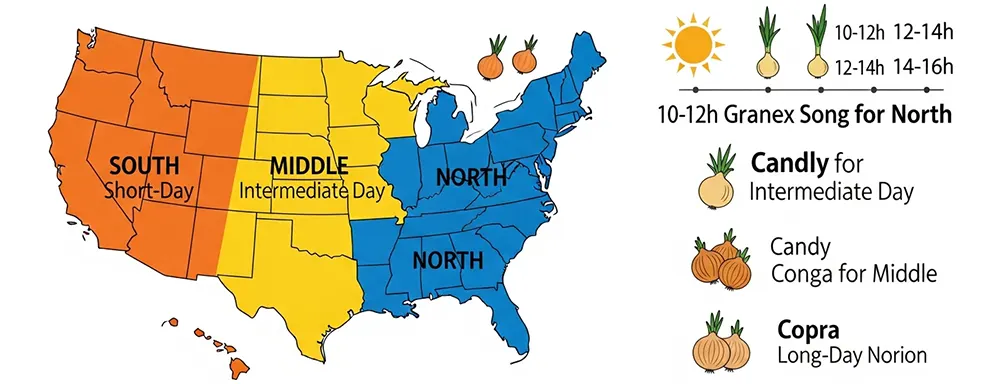
Onions are photoperiod-sensitive crops, and choosing the wrong variety for a particular growing region can result in plants that only grow leaves and do not form bulbs. Based on the length of direct sunlight, onions can be classified into three types: short-day onions, intermediate-day onions, and long-day onions.
| Items | Day Length Required for Bulbing | Suitable Regions | Common Varieties | Characteristics |
|---|---|---|---|---|
| Short-Day Onions | 10–12 hours | Southern United States (e.g., Texas, Florida) | White Grano Yellow Granex Texas Early Grano | Early maturing, sweet, short storage life |
| Intermediate-Day Onions | 12–14 hours | Most parts of the United States (preferred for home gardening) | Candy Super Star Red Candy Apple | Highly adaptable, high success rate, balanced flavor |
| Long-Day Onions | 14–16 hours | Northern Europe and Northern United States | YellowGlobe Copra Patterson | Large bulbs, strong flavor, very good storage capability |
Soil Preparation and Fertilization
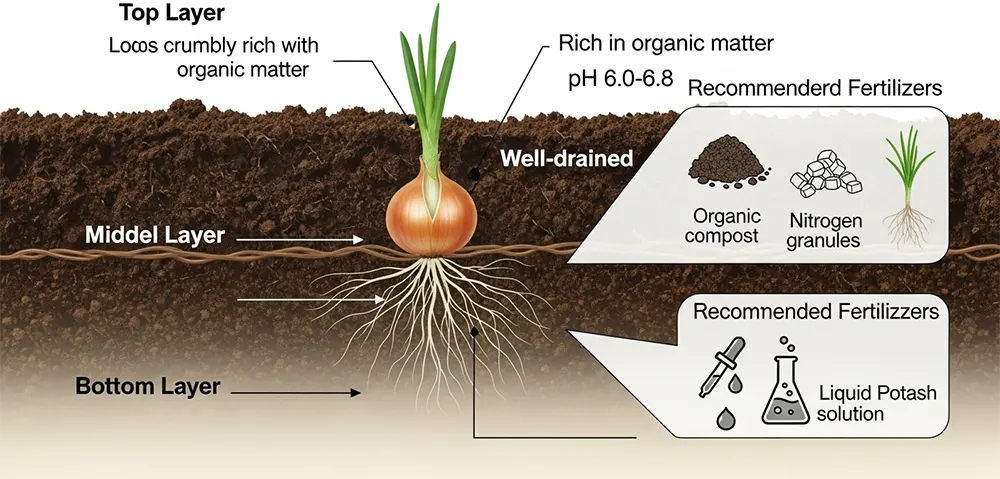
Like other crops, proper soil preparation is very important for onions. Onions prefer loose, well-aerated, well-drained soil rich in organic matter with a slightly acidic pH, ideally between 6.0 and 6.8. They need ample sunlight and good drainage to grow vigorously. Loamy or sandy-loam soils are best. Onions have shallow roots, and compacted soil can lead to small or misshapen bulbs. Heavy clay or waterlogged fields are unsuitable.
If the soil is too acidic, root growth may be inhibited. About 2–4 weeks before planting, lime can be thoroughly mixed into the soil, but it should not be applied together with nitrogen fertilizers or fresh manure. If the soil is alkaline, onions are prone to scab disease, and iron and manganese uptake may be blocked, causing yellowing leaves. Soil acidification can be improved with ammonium sulfate, potassium sulfate, pine needle soil, or leaf mold.
Onions are nutrient-demanding crops. Base fertilization should mainly use well-rotted organic fertilizer or compost, supplemented with a small amount of compound fertilizer. During the early growth stage, moderate nitrogen promotes leaf growth; for example, Rutom Black Gold Amino Acid 12-0-1 High Nitrogen Granule can be used. In the mid-growth stage, phosphorus and potassium should be supplied to support root development and bulb enlargement; Rutom VitaGro High Potash Fruit Food 2-6-12 Liquid Solution is recommended, as it is high in phosphorus and potassium. Once bulbing begins, fertilization should be stopped to avoid affecting maturation and storage.
Sowing
Onions can be directly sown in spring once the soil has thawed. Planting spacing affects both bulb size and yield. For large onions (intermediate-day or long-day varieties), we recommend spacing of 10-15 centimeters between plants and 30-40 centimeters between rows. If plants are too close, they will compete for nutrients, which will lead to the production of only leaves without the formation of bulbs. Proper spacing promotes bulb enlargement and uniform shape. For container planting, a 25–30 cm diameter pot can accommodate 3–4 plants. During the later stages of growth, avoid hilling and keep the planting area without weeds to prevent shading or overcrowding of plants. In this way, we can ensure onions have a healthy growth and a high-quality harvest.
Avoid
To prevent flavor transfer, onions should not be planted with peas, beans, or asparagus. Furthermore, onions should not be planted near other allium crops (such as scallions or chives), as this can lead to the spread of onion maggots between them.
Watering
Onions have shallow root systems and require constant moisture for healthy growth. If the onion planting area receives less than one inch of rainfall per week, the soil should be thoroughly watered at least once a week. During the early growth stage, maintain evenly moist soil, usually watering 1–2 times per week, only when the soil begins to dry, and avoid waterlogging.
During the vigorous growth stage and the initial bulb enlargement stage, water requirements increase. Use a small shovel to check the soil moisture depth—if it is only one or two inches, continue watering. As the onions mature and the leaves begin to fall over, gradually reduce watering. When the bulbs are fully mature and the leaves begin to droop, watering should be stopped. This helps the bulbs mature properly and extends their storage life. Watering is best done in the morning, and prolonged overwatering of the soil should be avoided to prevent root rot and bulb decay.
Pest and Disease Control
Onion pest and disease management should focus on prevention. Common pests include thrips and onion flies (maggots). Keeping the field clean and removing weeds promptly can reduce pest sources. In the early stages of pest infestation, yellow sticky traps can be used to capture thrips, or biological pesticides such as matrine or neem extract can be applied.
Onions are susceptible to several rot diseases, including Fusarium basal rot, gray mold, neck rot, and bacterial soft rot. So we should choose well-drained planting sites and avoid waterlogging and continuous cropping. Watering should ideally be done in the morning to reduce leaf moisture. Infected plants should be removed immediately. Onions should be harvested in dry, cool weather to minimize post-harvest diseases.
Harvesting and Storage
When about half of the tops have fallen over and dried, it is time to harvest onions. Choose a sunny, dry day for harvesting. Use a shovel to gently lift the bulbs from the soil rather than pulling them out, which can avoid damaging the bulbs or root plates. If the weather is warm and dry, onions can be left on the ground to dry for a few days, or they can be moved indoors to dry.
For long-term storage, onions must be properly cured. Place them in a warm (75–90°F / 24–32°C), well-ventilated area for 2–4 weeks until the outer skins are dry and the necks are tight. Improper curing can lead to rot during storage. Once fully cured, onions can be braided, or the tops can be cut off. Store onions in a cool, dry place, and do not allow them to freeze. If temperatures rise above 40°F (about 4°C), onions may begin to sprout. Keeping onions in a cool location helps prevent sprouting. Wrapping onions in newspaper or paper towels and storing them in the refrigerator can also produce especially sweet and juicy onions.
Onion maturity varies depending on the variety and the planting method used (seeds or sets).
How to Use Onions
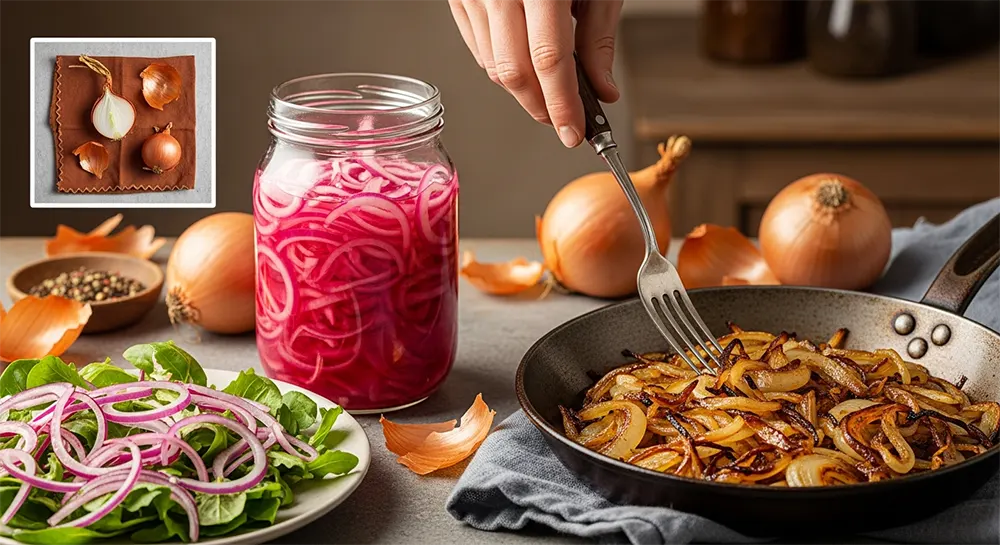
Open almost any standard cookbook, and you will find onions appearing everywhere as a supporting ingredient. They are extremely common in both everyday cooking and daily life. Raw onions can be used in cold dishes, salads, or as an accompaniment to burgers and sandwiches. They have a crisp texture and a slightly pungent taste and are rich in vitamins and active compounds. Cooked onions, whether stir-fried, stewed, boiled, or roasted, lose most of their pungency and develop a sweet flavor. They are widely used in various dishes, such as scrambled eggs with onions, beef stir-fry with onions, stews, and onion soup, and are a basic ingredient in many recipes.
Onions pair well with vegetables such as potatoes, tomatoes, and carrots, as well as various meats, enhancing the overall aroma and flavor. Additionally, onions can be pickled to make pickled onions, which are appetizing, help cut through richness, and are easy to preserve. In daily life, cut onions can temporarily absorb odors, and onion skins can be boiled for use as a natural dye or diluted for watering plants. Using onions wisely not only enriches meals but also improves overall ingredient utilization.

 English
  Spanish
  Japanese
  Korean
  German
  Portuguese
  Italian
  Indonesian
  Vietnamese
  Turkish
  Persian
  Russian
  Chinese